When a luxury ship drops anchor, the whole vessel comes to rest on a length of chain and a hook of steel on the sea floor, and the machine that controls that chain is the anchor winch. It must pay the chain out smoothly, hold tonnes of weight without slipping, and then haul the anchor back up through the water, all while the ship rolls gently and the crew work on an open deck.
From the outside the winch looks like a simple drum, but inside it is a careful balance of gears, brakes and motors, built to be strong enough for a storm and gentle enough to lower an anchor without a jolt. This is how a luxury ship anchor winch works, from the first turn of the drum to the moment the anchor is home.

How It Works
Step 1: The drum grips the chain
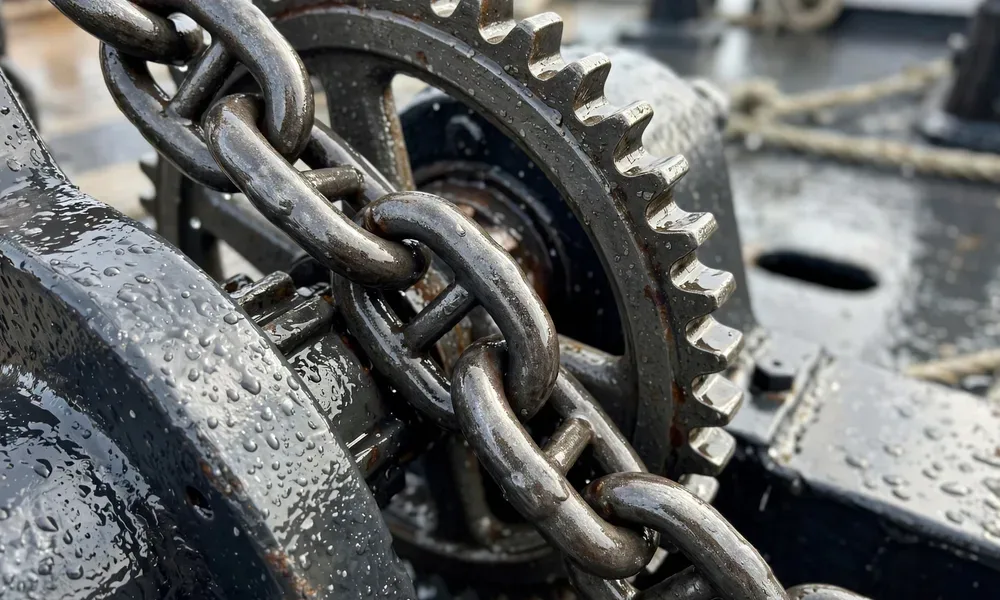
At the heart of the winch is the drum, a wide steel wheel with pockets around its edge that fit the links of the anchor chain exactly. As the drum turns, each link settles into a pocket and is carried around, so the chain moves with the drum instead of slipping over it. The pockets are machined to match the chain, because a loose fit would wear the links and a tight one would jam.
Step 2: The motor turns the gears
Turning a drum that holds tonnes of chain takes far more force than a person can give, so the winch is driven by a motor, usually electric or hydraulic, tucked below the deck. The motor spins fast and light, and a set of gears steps that speed down and the force up, until the drum turns slowly with enormous power. A small motor can lift a great anchor, because the gears trade speed for strength.
Step 3: The brake holds the load
The brake is the part that does the holding, and it is built to be stronger than the motor. When the anchor is down and the ship is riding at anchor, the brake locks the drum in place, so the weight of the ship pulling on the chain cannot turn it. The brake is a band or a set of discs that squeeze the drum, and it is held on by springs, so it stays locked even if the power fails.
To let the chain out, the crew ease the brake off a little at a time, and the drum turns slowly as the chain runs. To stop, they tighten the brake again, and the drum holds firm. The brake pads are checked often, since a worn pad would let the chain slip at the worst moment, and the whole brake is tested with a full load before every long voyage, so no one has to trust it untested.
Step 4: The chain runs through the hawse pipe
From the drum, the chain runs forward through a steel pipe in the deck called the hawse pipe, which guides it down to the anchor stowed in its pocket on the bow. The pipe is lined with a smooth sleeve, so the links do not wear a groove into the deck, and its top is fitted with a cover that keeps the sea out when the anchor is home and the ship is under way.
Step 5: The windlass and the gypsy work together
On many ships the winch shares its deck with a windlass, a close cousin that handles the anchor chain and the mooring lines, and the two machines are often built as one unit. The gypsy is the pocketed wheel that grips the chain, while a smooth drum beside it winds in ropes and warps when the ship is tying up. One motor can drive both, through clutches that let the crew choose which wheel turns.
The way a luxury anchor windlass is made shows how the same idea is built for heavy harbour work, and the shared design means the crew only need to learn one machine. The controls sit close by, with a lever for the brake, a switch for the motor and a gauge that shows the load on the chain, so the operator can feel what the anchor is doing below.
Step 6: The anchor is hauled home and stowed
When it is time to sail, the winch hauls the anchor back, the drum turning slowly as the chain comes in link by link, washed clean by a hose as it rises. The anchor breaks free of the sea floor with a shudder that runs up the chain, and then it rises through the water, dripping and heavy, until it seats itself in its pocket on the bow with a solid clang.
The crew check that the anchor is seated squarely and that the chain is stowed neatly in its locker below, where it lies in coils ready for the next stop. The brake is locked, the covers go on, and the winch rests, ready to do it all again. The way a luxury ship mooring works shows the next job the deck gear must do once the anchor is home, holding the ship fast to the quay.
| Spec | Detail |
|---|---|
| Drum | Pocketed cast steel drum, machined to fit the chain links exactly so the chain cannot slip |
| Motor | Electric or hydraulic motor below deck, geared down to turn the drum slowly with great force |
| Brake | Spring-held band or disc brake, stronger than the motor, that locks the drum even if power fails |
| Gears | Sealed gear case running in an oil bath, built to lift the anchor quietly and without grinding |
| Chain | Forged steel links, paint-marked at set lengths so the crew can read how much chain is out |
| Hawse pipe | Steel pipe through the deck that guides the chain to the anchor pocket, with a sea cover |
What One Costs
A luxury ship anchor winch is an estimated 80,000 to 350,000 dollars, depending on the size of the ship, the weight of the anchor and chain, and whether the motor is electric or hydraulic. A smaller winch for a large yacht sits near the bottom, while a winch built to lift a heavy anchor through deep water, with a silent motor and a polished deck finish, costs far more. The steel drum is only part of the price; the gears, the brake and the careful fitting to the deck all add up, and the way a luxury ship anchor winch is made shows the casting and machining that give the drum its strength.
A Rare Fact
An anchor does not hold a ship by its weight alone, but by the way its flukes dig into the sea floor, and the chain lying along the bottom helps by pulling almost flat on the anchor. That is why sailors pay out far more chain than the depth of the water: the long, low pull is what keeps the hook buried.

A luxury ship anchor winch is a machine that does one job and does it without fuss: it grips the chain, turns it with geared power, holds it with a brake stronger than the motor, and brings the anchor home safely every time. It is the reason a great ship can stop anywhere there is water deep enough to anchor, rest quietly through the night, and sail again in the morning with a single turn of a drum.


