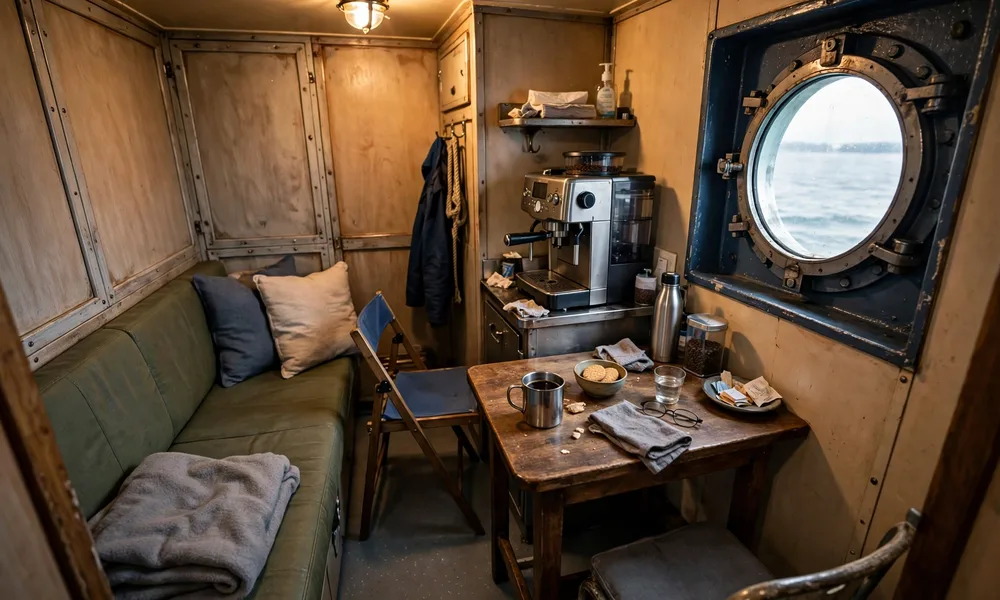
Below the guest decks of a luxury ship, down a quiet corridor with no sea view for most of its length, there is a small door that opens onto a room built for one purpose: sleep. The bed is narrow, the wardrobe is shallow, and the desk is just wide enough for a laptop, yet the crew member who lives here will spend more hours in this room than anywhere else on the ship except their workstation.
Luxury ship crew quarters are the hidden homes of the people who keep a ship running. Chefs, engineers, stewards and deckhands work long shifts, often for weeks without a day off, and the quality of their rest decides how well they work. Building these quarters means fitting comfort, storage, soundproofing and safety into a space smaller than a hotel room, and doing it hundreds of times over on a single ship.

How It’s Made
Step 1: Planning the layout for every rank
Not every crew member gets the same cabin. The captain and senior officers have larger rooms, often with a sitting area, while junior crew share smaller cabins, sometimes two to a room. The planners start with a list of every job on the ship, work out how many people each job needs, and then draw a plan that fits them all below deck without wasting a single square metre.
The layout must also respect the rules. Maritime law sets minimum sizes for crew cabins, demands a certain amount of fresh air and light, and requires separate cabins for men and women in shared accommodation. The way luxury ship crew quarters are specified shows how those minimums and extras are written into a single plan.
Step 2: Building the cabin modules
Modern crew quarters are rarely built cabin by cabin on the ship. Instead, each cabin is built as a module in a factory on land, a complete room with walls, floor, ceiling, wiring and plumbing already fitted. The modules are lifted by crane into the ship’s hull while it is still under construction, slotted into place like drawers in a chest, and connected to the ship’s power, water and ventilation.
Building in modules is faster and more precise than building inside a steel hull, where every wall is curved and every corridor is narrow. The same idea of building strong, precise structures in sections is used across shipbuilding, and the way a luxury ship tugboat is made shows how a small, hard-working vessel is put together from carefully fitted parts.
Step 3: Soundproofing the walls and floors
A ship never sleeps, and neither do its engines. Crew cabins sit close to machinery, corridors and other cabins, so soundproofing is one of the most important parts of the build. The walls are made of layered panels with dense insulation inside, the floors sit on rubber mounts that absorb vibration, and the doors are sealed so tightly that a conversation in the corridor stays in the corridor.
The builders test the soundproofing by running the engines at full power and measuring the noise inside a finished cabin. If the level is too high, they add another layer of insulation or seal a gap around a pipe. A crew member who works a night shift needs to sleep through the day while the ship is moving, and that sleep is only possible if the cabin is quiet.

Step 4: Fitting the bed, storage and desk
Inside the cabin, every piece of furniture is fixed to the walls or the floor, so it cannot slide when the ship rolls. The bed is the centrepiece, a narrow single bed with a good mattress, a reading light and a small shelf for a book and a phone. Under the bed there is storage for a suitcase, and above it a locker for clothes, because a crew member’s whole life on board must fit into a few cubic metres.
The desk is small but carefully placed, usually under a porthole or a light, with a chair that tucks away when it is not used. Hooks, rails and drawers are fitted into every spare corner, and the wardrobe has a mirror on the inside of the door, so the cabin feels larger than it is.
Step 5: Wiring the light, air and power
Each cabin needs fresh air, good light and reliable power, and all three must work even when the ship is far from land. Ventilation ducts bring in cooled, filtered air, and the system is balanced so no cabin is stuffy while another is freezing. The lights are warm and dimmable, so a crew member can read in bed without waking a cabin mate, and the sockets are placed where a phone charger can actually reach them.
Safety is wired into the same system. Smoke detectors, emergency lighting and a call button are fitted in every cabin, and the wiring is protected so a fault in one cabin cannot knock out a whole deck. The same thinking about backup systems and separation runs through the whole ship, and the way a luxury ship engine room is specified shows how engineers keep the most important systems running no matter what fails.
Step 6: Finishing, testing and handing over
The final step is the finish. The walls are painted in calm, light colours, the floor is covered in a hard-wearing surface that is easy to clean, and a curtain or blind is fitted over the porthole.
Before handover, an inspector walks through every cabin with a checklist, testing the lights, the ventilation, the water and the door locks. Any fault is fixed on the spot, and the cabin is only signed off when it is ready for someone to sleep in that night. A luxury ship crew quarters may be small and plain beside the guest suites above, but it is built with the same care, because the people who sleep there are the people who make the luxury above deck possible.
| Specification | Typical luxury ship cabin |
|---|---|
| Cabin size | About 8 to 15 square metres, by rank |
| Occupancy | One person, or two in shared junior cabins |
| Bed | Single bed, fixed to the wall, with storage below |
| Sound level | Kept low enough for daytime sleep beside engines |
| Ventilation | Filtered, cooled fresh air, balanced per cabin |
| Lighting | Warm, dimmable lights with a bedside reading light |
| Storage | Wardrobe, lockers, drawers and under-bed space |
| Safety | Smoke detector, emergency light and call button |
A luxury ship crew quarters is an estimate of $20,000 to $60,000 per cabin to build and fit out, depending on the size, the rank of the occupant and the quality of the finish. On a large ship with hundreds of cabins, the total runs into millions, yet it is money well spent, because a rested crew works better, stays longer and makes fewer mistakes.
Here is a rare fact worth knowing. On some luxury ships, the crew quarters are built with the same fireproof, soundproof modules used for the guest cabins, and the only difference is the size and the view. A few older ships even had crew cabins with no porthole at all, lit only by electric light for weeks at sea. Modern rules now demand daylight or a porthole wherever possible, and the newest ships give even junior crew a window, because the people who work below deck deserve to see the sea they are sailing on.


