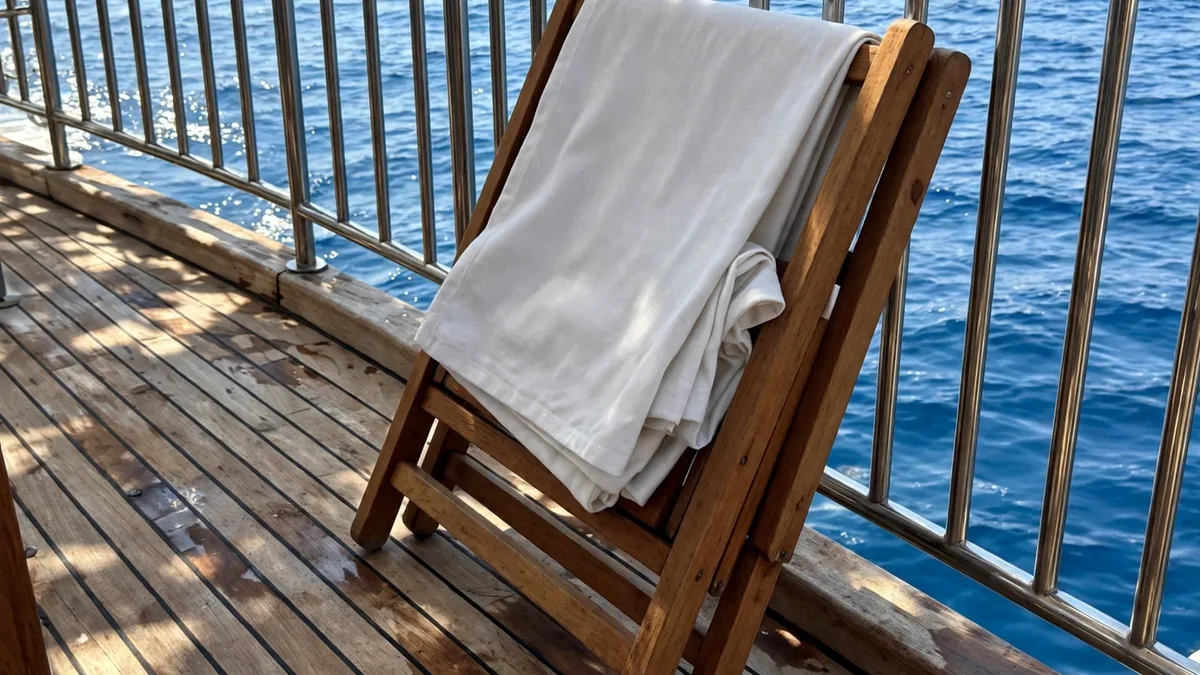
Folded flat against the rail, a yacht deck chair takes up no more space than a towel. A steward picks it up with one hand, gives it a flick, and it opens with a single confident click, standing on the teak ready for a guest who has not even sat down yet. It looks like the simplest seat on the yacht, a wooden frame and a sling of pale fabric, but that click is the sound of a small machine working exactly as designed.
A luxury yacht deck chair is a folding outdoor chair built for life at sea, with a teak or stainless steel frame, a fabric sling, and a locking hinge that holds the back at several angles. It is made by cutting and shaping the frame, fitting a hinge that can be folded thousands of times without loosening, and sewing a sling that stays taut in sun and salt. Every part has to fold flat, survive the weather, and never pinch a finger or collapse under a guest.
How It’s Made
Step 1: Choosing the teak and cutting the frame
The chair starts as a plank of teak, the oily hardwood that has been used on boats for centuries because it resists rot, salt, and sun without paint or varnish. The maker cuts the frame pieces, the two side rails, the back posts, and the front legs, and shapes each one with rounded edges so bare legs and hands never catch a sharp corner. Teak is heavy for its size, so the pieces are kept slim, and every cut is checked against a pattern, because a folding chair only works when both sides match exactly.
Step 2: Shaping the joints and the folding geometry
A deck chair folds because its joints are planned like a piece of engineering, not guessed at. The side rails cross at a pivot point, the backrest hinges at the top, and a small wooden stay or a metal bar locks the back at four or five angles. The maker drills the pivot holes with a jig so the two sides line up perfectly, then sands the mating faces smooth so the wood slides against wood without squeaking. The yacht sundeck below gives the chair its stage, and the chair itself is sized to fit between the deck fittings, folding flat enough to stack against a rail when the yacht is under way.
Step 3: Fitting the stainless steel hinge
The hinge is the most precisely made part of the whole chair, and it is the part that decides whether the chair feels expensive or cheap. It is machined from marine-grade stainless steel, with a thick pivot pin, a spring, and a locking catch that holds the backrest at each angle. The maker fits the hinge into a shallow recess cut into the teak, so the metal sits flush and cannot snag clothing, and bolts it through the wood with stainless fasteners that will never rust and stain the frame. Before the chair leaves the workshop, the hinge is folded and unfolded hundreds of times, and it has to click firmly into every position.

Step 4: Sewing the fabric sling
The sling is the seat, the backrest, and the armrest in one piece of fabric, and it is cut from solution-dyed acrylic, coloured all the way through the fibre so the sun cannot bleach it. The maker cuts the cloth with a little extra width, hems the edges twice, and sews a sleeve at each end that slides over the wooden dowels at the top and bottom of the frame. The sling is deliberately cut slightly loose, because the tension comes from the sitter’s weight, not from the stitching.
Step 5: Adding the footrest and the fittings
Many yacht deck chairs have a small footrest that folds out from under the seat, a short extension of the same teak and fabric that lets a guest stretch out fully. The footrest hinges on its own small pivot and locks flat when it is not wanted, so the chair still folds into a slim package. The maker also fits rubber or teak feet to the bottom of the frame, spreading the load so the chair does not dent the deck. The yacht sun lounger nearby does the same job with a ratchet instead of a folding stay, and the deck chair’s simpler mechanism is part of its charm: fewer parts, fewer things to go wrong.
Step 6: Finishing, testing and the first sit
The finished chair is oiled, not varnished, so the teak keeps its honey colour and can be re-oiled in an afternoon when it starts to silver. Then comes the test: the chair is folded and opened again and again, loaded with sandbags heavier than any guest, and left outside in rain and sun for days to prove the hinge still clicks and the sling still holds.
A yacht deck chair earns its place by disappearing into the day. It folds away when the deck is needed, opens in a second when a guest wants the sun, and asks for nothing more than a rinse with fresh water and an oiling once a season. That is the whole job, and it is harder to build than it looks.
Yacht Deck Chair Specifications
| Feature | Typical Detail |
|---|---|
| Frame | Teak, sometimes with 316 stainless steel or aluminium parts |
| Folding hinge | Machined stainless steel, four or five locking angles |
| Sling | Solution-dyed acrylic fabric, double-hemmed, dowel sleeves |
| Footrest | Folding teak and fabric extension, locks flat when stowed |
| Feet | Rubber or teak pads that spread the load on the deck |
| Folded size | Around 10 to 15 centimetres thick when folded flat |
| Weight | Around 6 to 10 kilograms, light enough to carry one-handed |
How Much Does a Yacht Deck Chair Cost?
Prices are estimates and vary with size, materials and maker. A single luxury yacht deck chair typically costs an estimated $800 to $3,500, with teak and stainless steel models at the top of the range and aluminium models lower. A matched set of six with covers and a storage rack can run an estimated $6,000 to $18,000. It sounds like a lot for a folding chair, but a cheap one wobbles, rusts, and pinches fingers within a season.
A Rare Fact About Yacht Deck Chairs
Here is a detail most guests never notice: the sling on a yacht deck chair is cut loose on purpose. The fabric only pulls taut when someone sits in it, because the sitter’s weight is what tensions the cloth, and a sling sewn tight in the workshop would stretch, sag, and tear under a season of use. The deck chair price explains where the rest of the money goes, and the loose sling is the quietest part of it: a piece of cloth that does its work by giving way, not by holding firm, and lasts years longer because of it.

The best yacht deck chairs are the ones guests reach for without thinking. They are in the sunniest spot, the fabric is dry, the back clicks into place, and the sea is right there. Everything else on the yacht can wait; the chair has done its job before lunch.


