Step aboard a luxury yacht and the first thing your feet tell you is the deck. It is warm underfoot in the sun, grippy when it is wet, and quiet in a way that a bare fibreglass deck never is. Guests notice it without thinking about it, and they remember it the same way they remember a good floor in a good house. A yacht deck is not just a surface to walk on. It is the floor of an outdoor home that has to survive sun, salt, and bare feet.
A luxury yacht deck is the walking surface of the yacht, built from teak planks or a modern synthetic decking laid over a fibreglass or aluminium base. It is made by shaping the deck structure, laying the planks with sealed seams, and finishing the surface so it grips in the wet and stays cool in the sun. The deck has to be strong enough to carry the weight of guests and gear, sealed well enough to keep water out of the cabin below, and beautiful enough to be the first thing anyone sees when they come aboard. That mix of strength and beauty is the work of the boatyard.

How It’s Made
Step 1: Shaping the deck structure
Before any wood is laid, the deck structure is shaped from fibreglass or aluminium, with a slight curve, called camber, so rainwater runs off to the sides instead of pooling in the middle. The deck is stiffened from below with beams and frames, and the openings for hatches, skylights and the mast are cut and reinforced. The surface is checked for fairness, because every bump in the base becomes a bump in the finished deck. The yard also plans the drainage at this stage, with scuppers, the small openings that let water run off the deck and over the side.
Step 2: Choosing and preparing the planks
The decking itself is usually teak, a dense oily wood that grips when wet and resists rot, though many modern yachts use a synthetic decking that looks like teak and needs less care. Real teak planks are cut to a steady width, usually around 45 millimetres, and each one is checked for straight grain and even colour. The planks are sanded on the back and left to settle in the yard, so they reach the same moisture as the boat before they are laid. A deck laid with green wood will shrink and open its seams, and a deck laid with mismatched planks will look patchy in the sun.

Step 3: Laying the planks
The planks are laid one by one, glued and screwed to the deck base, with a small gap between each one for the seam. Workers start at the centreline and work outward, keeping the rows straight and the gaps even, because a wavy seam is the first thing a guest will notice. Each plank is pressed down firmly and held while the glue sets, and the screws are set into plugs of matching wood, so no metal shows on the surface. The work is slow and careful, and a large deck can take a team of fitters several weeks to lay.
Step 4: Caulking the seams
Once the planks are down, the gaps between them are filled with a black rubber caulking, which keeps water out and gives the deck its classic striped look. The caulking is squeezed into the seam, smoothed with a blade, and left to cure before the deck is sanded. The black seams are more than decoration. They flex as the wood swells and shrinks with the weather, so the deck stays watertight through hot summers and cold winters. A seam that is too hard will crack, and a seam that is too soft will squeeze out underfoot.
Step 5: Sanding and finishing the surface
The finished deck is sanded smooth, first with coarse paper to level the planks and the caulking, then with fine paper to bring up the grain. The deck is washed down to raise the grain, sanded again, and left bare, because teak is not varnished on a working deck. Varnish would be slippery when wet and would peel in the sun. Instead the wood is left to silver with age, or treated with a light oil that feeds the grain without making it slick. The yacht bow forward and the yacht hull below are painted to a mirror gloss, but the deck is meant to be walked on, and a bare, grippy surface is the point.
Step 6: Fitting the hardware and hatches
The last step is the hardware. The hatches are fitted and sealed, the cleats and winches are bolted through the deck with backing plates below, and the handrails and stanchions go up around the edge. Every bolt hole is sealed, because a leak through a deck fitting is the most common cause of damp below. The deck is washed, the seams are checked one last time, and the yacht is ready for the water, and the yard knows that the deck is the part of the boat the guests will touch with every step they take.
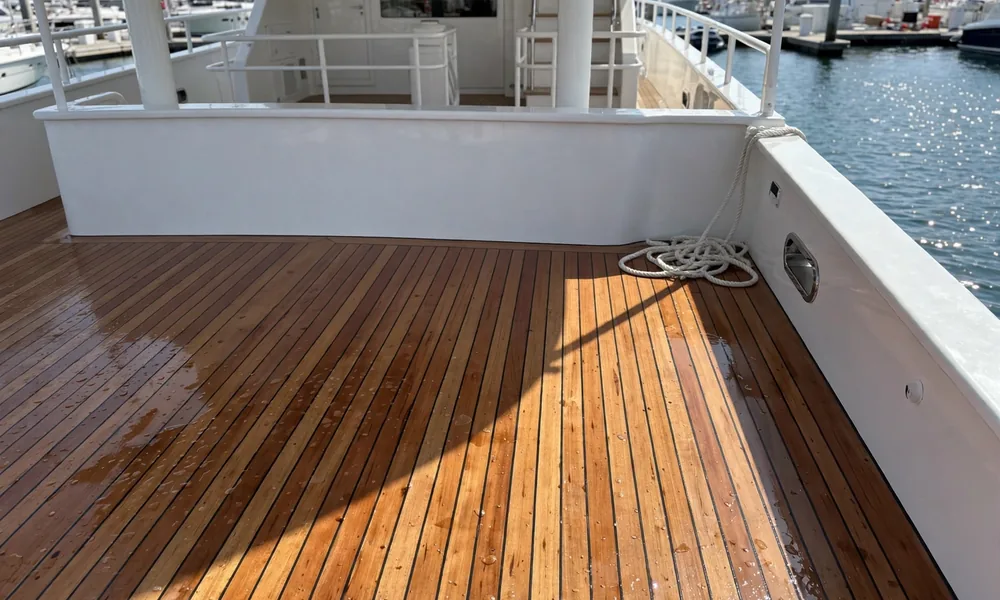
The deck also decides how the yacht feels in the heat. Teak stays cooler underfoot than bare fibreglass, which can burn bare feet on a hot afternoon, and it grips when it is wet, which matters when the crew are washing the boat down or guests are coming back from a swim. That is why the deck gets washed every morning, not just to keep it clean, but to keep the wood cool and the seams swollen shut.
Yacht Deck Specifications
| Feature | Typical Detail |
|---|---|
| Material | Teak planks or synthetic teak decking |
| Plank width | Around 45 millimetres |
| Plank thickness | 9 to 12 millimetres over a fibreglass base |
| Seams | Black rubber caulking, flexible and watertight |
| Structure | Fibreglass or aluminium deck with camber |
| Finish | Sanded bare, oiled or left to silver |
How Much Does a Yacht Deck Cost?
Prices are estimates and vary with yacht size, wood and yard. A new teak deck for a large luxury yacht can run an estimated $100,000 to $500,000 or more, with the wood itself a large part of the cost, because good teak is scarce and slow grown. A synthetic teak deck typically costs an estimated $50,000 to $200,000 for the same yacht, and needs far less care. Re-caulking an existing deck, with new seams and a fresh sanding, typically costs an estimated $10,000 to $40,000. It is expensive work, but the deck is the floor of the yacht, and a cheap deck is a false saving that shows up in every bare footstep.
A Rare Fact About Yacht Decks
Here is a detail most owners never notice: the black seams between the teak planks are not just there to keep the water out. On the old wooden ships, the seams were filled with oakum and pitch, and the job of hammering the caulking in was called caulking the deck, which is where the phrase comes from. A well-caulked deck was so tight that a sailor could pour a bucket of water on it and watch it run off the sides without a drop leaking below. The yacht anchor chain on the foredeck still runs over that same surface, and the crew still wash the deck down every morning, the way sailors have for centuries. Get the seams right, and the deck stays dry below, grippy above, and beautiful for decades.


