A go-kart is the smallest racing machine there is, and its spec sheet is the shortest you will ever read. There is no boot, no back seat, no stereo and no roof to discuss, just a motor, a battery, a frame and four small wheels, and the whole machine weighs less than the driver sitting in it. Yet those few numbers decide everything about how the kart feels, because with so little machine around you, every kilowatt and every kilogram is something you feel in your hands.
Electric karts have changed the sheet completely. A petrol kart’s numbers were about engine size and revs, but an electric kart’s numbers are about power delivery, battery life and weight, and a kart that looks modest on paper can be shockingly quick on the track. The sheet is short, but it rewards a careful reading.
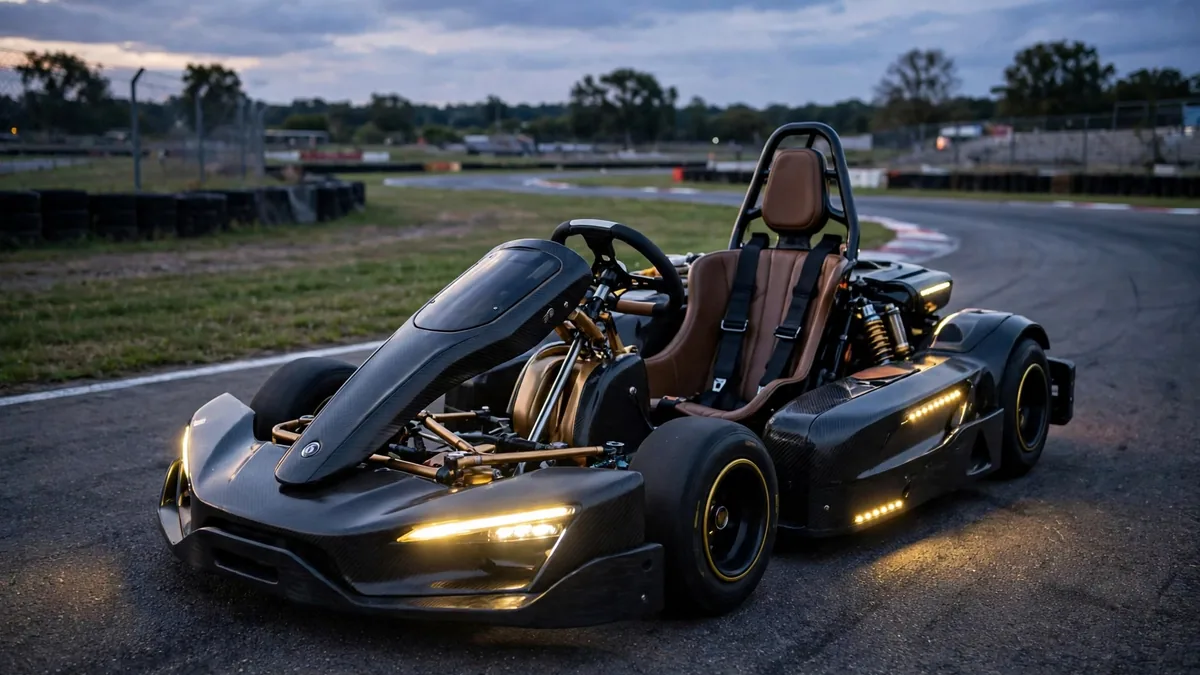
Luxury Electric Go-Kart Specs at a Glance
| Spec | Detail |
|---|---|
| Motor power | About 10 to 30 kilowatts, one brushless motor driving the rear axle |
| Battery pack | About 2 to 5 kilowatt-hours, lithium-ion, swappable on some karts |
| 0 to 60 mph | About 3 to 4 seconds, quicker than most sports cars |
| Top speed | About 60 to 80 miles per hour on a full-size outdoor track |
| Lap pace | About 2 to 5 seconds a lap quicker than a petrol kart of the same class |
| Weight | About 90 to 150 kilograms without the driver |
| Run time | About 20 to 40 minutes of hard driving per charge |
| Charging time | About 1 to 2 hours on a fast charger, longer on a standard socket |
These are typical figures for a luxury kart, not promises for every kart on the market. A hire kart at an indoor track will be far tamer, while a top-level racing kart will be quicker still, and the numbers only make sense for the class of kart you are actually comparing.
Power, Torque and the Punch Off the Line
Motor power of about 10 to 30 kilowatts sounds small beside a car’s hundreds, until you remember the kart weighs about 90 to 150 kilograms. Power to weight is what matters, and a 20-kilowatt kart carries roughly the same power per kilogram as a supercar, which is why the 0 to 60 time of about 3 to 4 seconds is real, not a trick of the spec sheet.
Torque is where the electric kart embarrasses the petrol one. An electric motor makes its full twist from a standstill, so the kart leaps out of slow corners with no clutch slip and no waiting for revs, and the driver feels the push instantly. The how a luxury electric go-kart works story explains how that instant delivery works, and why it makes an electric kart feel faster than its top speed suggests, because most of a lap is spent accelerating out of corners, not cruising at full speed.
Battery, Run Time and the Pit Stop Problem
The battery is small, at about 2 to 5 kilowatt-hours, which is less than a tenth of a family car’s pack, yet it must deliver huge bursts of power lap after lap. Hard driving drains it in about 20 to 40 minutes, and that short run time is the kart’s biggest weakness against petrol, where a splash of fuel takes seconds and a recharge takes an hour or two.
Swappable batteries are the luxury answer to that problem. Some karts let a mechanic lift out a spent pack and slot in a fresh one in under a minute, so the kart is back on track while the old pack charges, and a racing team with two packs per kart can run almost all day. The luxury electric kick scooter specs show the same battery thinking on a smaller machine, where a swappable pack turns a short-range toy into a practical vehicle.
Charging time of about 1 to 2 hours on a fast charger sounds slow until you compare it with the old days of petrol karts, when refuelling meant handling fuel, oil and fumes in the pit lane. An electric kart charges from a socket, makes no fumes and needs almost no maintenance between sessions, which is why indoor tracks have switched to electric so completely.
Chassis, Weight and Why a Kart Feels So Fast
The chassis is a simple steel tube frame, and its stiffness is tuned by hand, because a kart has no suspension at all. The frame itself flexes over bumps, the tyres soak up the rest, and the driver feels every ripple of the track through the seat. A stiff frame suits a smooth track, a flexible one suits a bumpy track, and the best karts let a mechanic adjust the flex with a spanner.
Weight is the number that decides how the kart handles. At about 90 to 150 kilograms without the driver, the kart is so light that the driver’s own weight is a large part of the total, and a heavier driver is genuinely slower. The battery is the heaviest part of the machine, and builders mount it as low as possible, because a low battery keeps the kart flat through corners instead of tipping it onto two wheels.

The steering is direct and unassisted, with no power steering and no slack, so the kart goes exactly where the driver points it, instantly. The how a luxury electric kick scooter works explains the same directness on a smaller scale, where the rider’s balance does the steering, and a kart driver’s hands do the same job, with every twitch of the wheel reaching the tyres at once.
As an estimate, a luxury electric go-kart costs about $8,000 to $30,000, the motor and controller about $2,000 to $8,000 of that, the battery about $2,000 to $7,000 more, and the chassis, bodywork and finishing about $3,000 to $12,000 on top. These are estimated ranges, not quotes, and the final figure depends on the class, the battery and the finish. What never changes is that the kart is built in small numbers for people who take lap times seriously, and that is what the price buys.
A Rare Fact From the World of Electric Go-Karts
Here is a detail few drivers ever learn: an electric go-kart can be tuned from a phone. The motor controller holds a map of how power is delivered, and a mechanic can soften the launch for a beginner, sharpen it for a racer, or cap the top speed for a young driver, all without touching a spanner. Some hire tracks change the map between sessions, so the same kart feels gentle for a child’s birthday party and ferocious for an evening race league, and the kart’s character lives in software as much as in steel.
What the Specs Mean for You
If you are comparing luxury electric go-karts, start with four numbers: power to weight, run time, battery swapping and lap pace. A kart with strong power for its weight, at least half an hour of hard running, a swappable pack and lap times quicker than a petrol kart of the same class is worth its price. Top speed matters less than the brochures suggest, and charging matters more than anyone admits, because a kart that spends its day plugged in is a kart that never races. The best electric go-kart is the one that makes you forget the numbers entirely, pinning you to the seat out of every corner while the track rushes past.


