A davit spec sheet is a single page of numbers, and it is the most honest document in the whole lifeboat station. Brochures talk about smooth operation and elegant design; the sheet talks in tonnes, metres and degrees: how heavy a boat the arms can carry, how far they can reach, and how fast they can lower it.
On a luxury ship the stakes behind those numbers are high. The davit holds a fully loaded lifeboat above the boat deck for years, through salt spray and storms, and then, on the worst day of the ship’s life, it must swing that boat out and lower it to the sea with the ship listing and the power gone. This guide reads the sheet line by line, and says what a good value looks like on a large luxury ship.
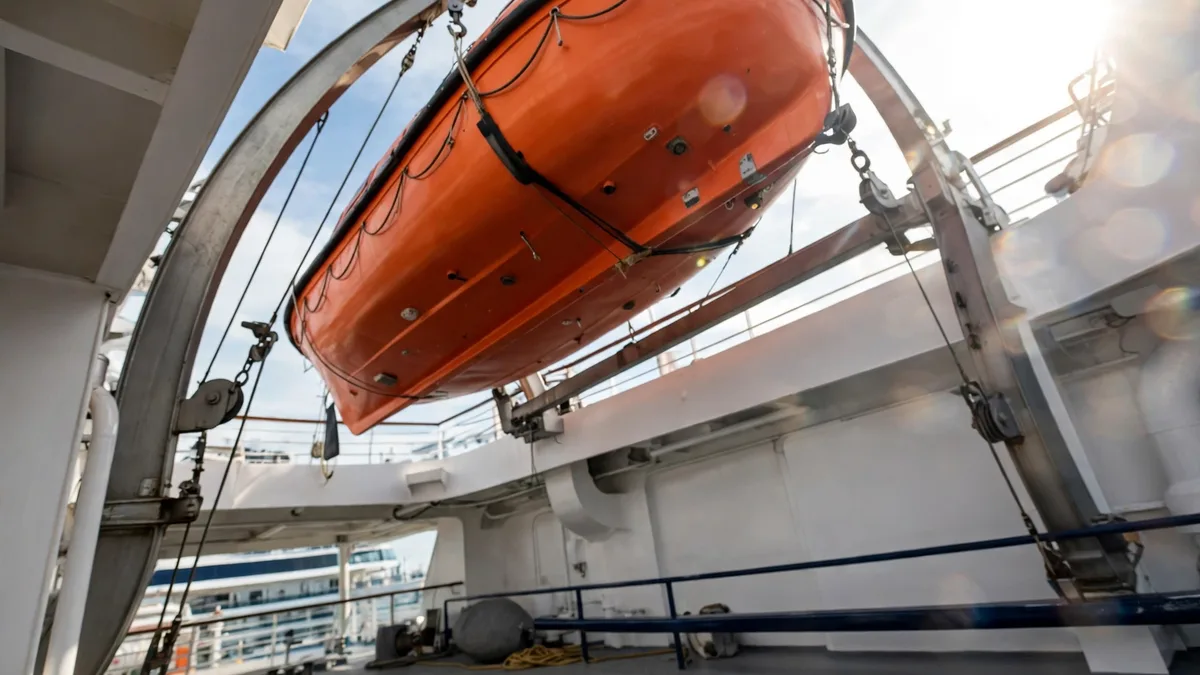
The Spec Sheet, Line by Line
1. Safe working load
The first line is the safe working load, or SWL: the maximum weight the davit may lift and lower in normal service, given in tonnes. It covers the lifeboat, its engine and equipment, and every person on board at once. A large cruise ship lifeboat davit typically carries an SWL of 8 to 15 tonnes, while a rescue boat or tender davit may be rated for 2 to 5 tonnes.
The SWL is the weight of the boat fully loaded, not empty, and the sheet should say so. Everything is sized from this one figure, which is why how a luxury ship davit is made starts with the same number.
2. Outreach, height and footprint
Outreach is the horizontal distance the davit can place the boat from the ship’s side, usually 3 to 6 metres on a large ship: enough to clear the hull and any balconies below, Lifting height is the vertical distance from the boat deck to the waterline, and on a cruise ship it can be 20 metres or more.
The arms get their own figures too: overall height, the distance between the two arms, and the footprint of the base frame. A pair of arms for a large lifeboat may stand 5 to 8 metres tall, spaced 6 to 10 metres apart, and a complete station can weigh 8 to 20 tonnes before the boat is hung in it. The sheet should give that weight: the deck beneath must carry all of it.
3. Slewing and luffing angles
Slew is the angle through which the arm turns around its vertical axis, and luffing is the angle through which it rises and falls. A slewing davit often turns 180 degrees or more, swinging the boat from its stowed position right out over the side. On a luffing davit the arm pivots from near vertical to 60 or 80 degrees from the horizontal.
These angles decide whether the boat can be launched when the ship is not upright. Marine rules require a davit to work with the ship listed 20 degrees to either side and trimmed 10 degrees, so the sheet should state the list and trim it is rated for.
4. Hoisting and lowering speed
Hoisting speed is how fast the winch can raise the boat, typically 10 to 18 metres per minute under full load. Lowering speed matters more: usually 18 to 36 metres per minute, set by the brake rather than the motor.
Winch power sits beside the speeds, usually a 7.5 to 22 kilowatt electric motor, or a hydraulic motor of similar output, and the sheet should give the speeds at full load, not empty. It should also state the speed with the power off, since a powered davit must still lower safely by brake alone when the electricity fails, and the brake, not the motor, sets the pace, as how a luxury ship davit works shows.
5. Wire rope: diameter, length and construction
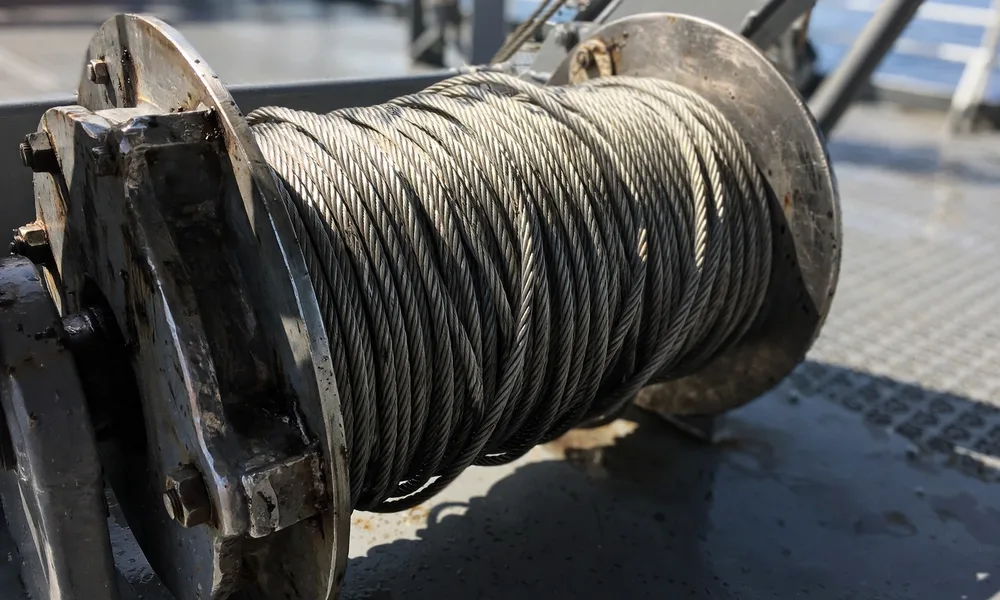
The falls are the wire ropes that carry the boat. Diameter comes first, usually 12 to 20 millimetres on a large lifeboat davit: a thicker rope carries more but needs a bigger drum. Length must cover the full lowering distance plus several spare turns left on the drum at the bottom,
Construction is given as a code, such as 6×36, six strands of thirty-six wires each, with the core, grade and finish named. Galvanised wire resists salt water; stainless resists it better and costs more. The minimum breaking load should be at least six times the safe working load of the fall, and the sheet should state that factor plainly.
6. Materials and corrosion protection
The steel grade is the first material figure, usually a marine structural steel such as S355, given with its yield strength in megapascals. The sheet should name the grade for the arms, the base frame and the pins separately, because pins are often a higher-strength alloy steel and pivot bushes are bronze.
Corrosion protection is given as a paint system and a thickness, typically a zinc-rich primer plus two coats of marine epoxy, with a total dry film thickness of 300 to 400 microns. Stainless fittings, galvanised wire and sealed bearings are listed line by line.

7. Safety factor and proof load
The safety factor is the ratio between the load that would break the davit and the load it may carry. For a lifeboat davit the structural parts are typically designed to a factor of 4.5 or more against the safe working load, while the wire rope is designed to a factor of 6.
Proof load is the test figure: the load the davit is actually tested to before entering service, usually 1.1 times the safe working load for a functional test, and 1.5 times for the structural test of the arms and foundations. The sheet should state both. A davit whose proof load only equals its working load has never been asked to prove anything.
8. Standards and certification
The last lines name the rules the davit was built to: the SOLAS Convention, the IMO Life-Saving Appliance Code, and the ISO 15364 standard for launching appliances, together with the class society that approved it, such as Lloyd’s Register, DNV or Bureau Veritas. They set the angles, factors, speeds and test loads a davit must meet.
Certification is given as a certificate number and a date, with an inspection interval, usually annual, and a full load test every five years. The certificate covers one station, one boat and one position on the ship, When the certificate lapses, the davit is out of service, whatever its steel and wire are still good for.
Reading the Sheet as a Whole
No single figure tells the truth on its own. A high safe working load means little if the outreach cannot clear the hull; a fast lowering speed means little if the brake cannot hold the boat still halfway down; a thick wire rope means little if the drum is too small to hold its full length.
The other test is whether the sheet answers the awkward questions. Does it give speeds at full load, not empty? Does it state the list angle, the manual hoisting speed and the proof load? Does it name the steel grade, the paint thickness and the certificate? A sheet that answers them all is written by a builder who expects to be checked, and the price usually explains why, as why a luxury ship davit is so expensive makes clear.