On a luxury yacht, clean sheets appear on the beds each evening and fresh towels hang in every bathroom, and nobody ever sees where they come from. The work happens in a small room low in the hull, behind a plain door, where two or three machines wash, dry and press everything the guests touch. It is the hardest-working room on board, and the least photographed.
The specification sheet for that room looks dull at first glance. It is a list of capacities, spin speeds, water figures and power draws, written for engineers rather than owners. Read them properly, and the little room starts to make sense.
This guide walks through the figures on a yacht laundry specification sheet and explains what each one means in plain language, with typical numbers for a 30-metre yacht, a 50-metre yacht and a 70-metre superyacht.
Luxury Yacht Laundry Specs at a Glance
Before the detail, here are the headline numbers. A smaller yacht sits at the modest end of each range, while a superyacht laundry pushes further, but the shape of the room stays the same: compact machines, a counter, and air that never stops moving.
| Specification | Typical 30 m Yacht | Typical 50 m Yacht | Typical 70 m Superyacht |
|---|---|---|---|
| Room floor area | 6-8 square metres | 8-12 square metres | 12-18 square metres |
| Washer capacity | 8-10 kg per load | 10-13 kg per load | 13-18 kg per load |
| Dryer capacity | 8-10 kg per load | 10-13 kg per load | 13-18 kg per load |
| Spin speed | 1200 rpm | 1400 rpm | 1600 rpm |
| Water per wash | 40-55 litres | 50-70 litres | 60-90 litres |
| Power draw | 2-3 kilowatts | 3-5 kilowatts | 5-8 kilowatts |
| Noise level | 55-60 decibels | 50-55 decibels | 45-50 decibels |
| Air changes | 8-10 per hour | 10-12 per hour | 12-15 per hour |
These are typical new-build figures, not rules. Read the numbers against the yacht’s job, not its length alone.
Size and Capacity: How Much Linen a Day
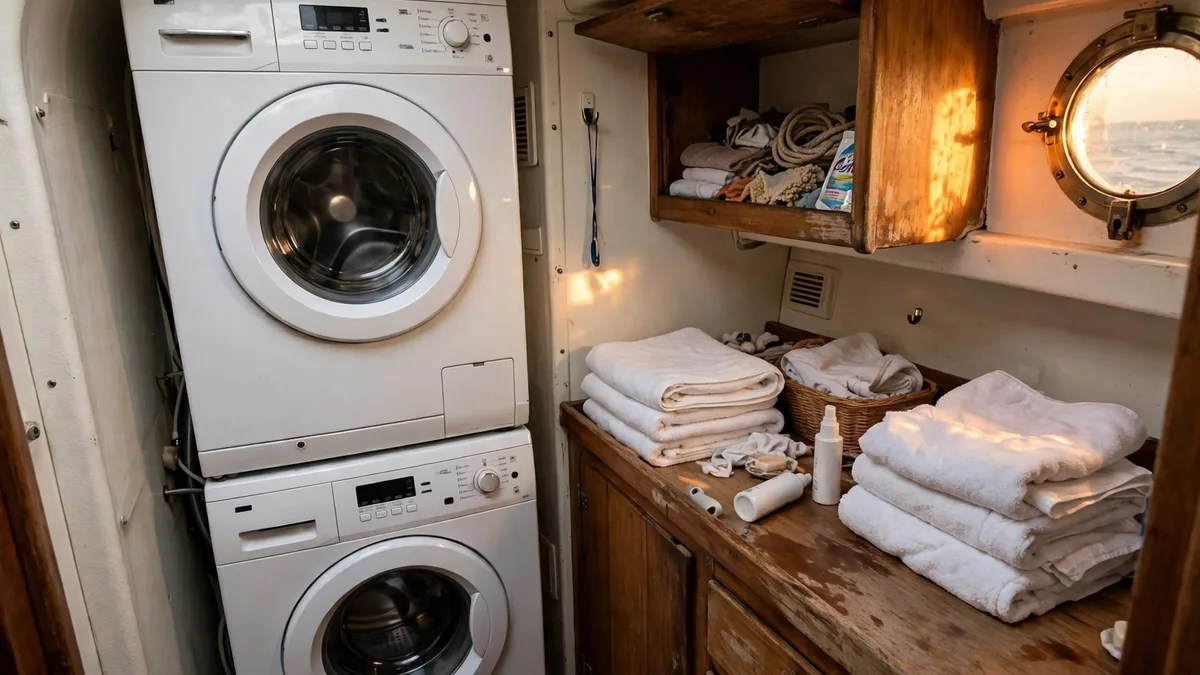
The first numbers on the sheet are the room area and the washer capacity, and they belong together. Six to eight square metres on a 30-metre yacht sounds tiny, and it is, but it only has to hold two machines, a counter and a shelf or two. The washer inside it takes eight to ten kilograms per load, which is roughly the sheets and towels for two cabins, so the crew run it again and again through the day rather than loading it once.
What matters more than the raw capacity is the number of machines. Two washers and two dryers beat one large pair, because one machine can wash while the other dries, and a breakdown does not stop the whole laundry. A dryer smaller than its washer is a bottleneck the crew feel every single day, and how a yacht laundry is made shows how the room is built around that pairing, with the machines stacked or set side by side to save floor space.
Water, Power and Heat: The Running Costs on Paper
Water is the number owners notice second, because fresh water at sea is made, not found. A wash cycle of forty to fifty-five litres on a small yacht rises to sixty to ninety litres on a superyacht, and a busy laundry may run eight or ten cycles a day. That is hundreds of litres before anyone has had a shower, so the sheet’s water figure is really a question about the watermaker: can it keep up with the laundry and the guests at the same time?
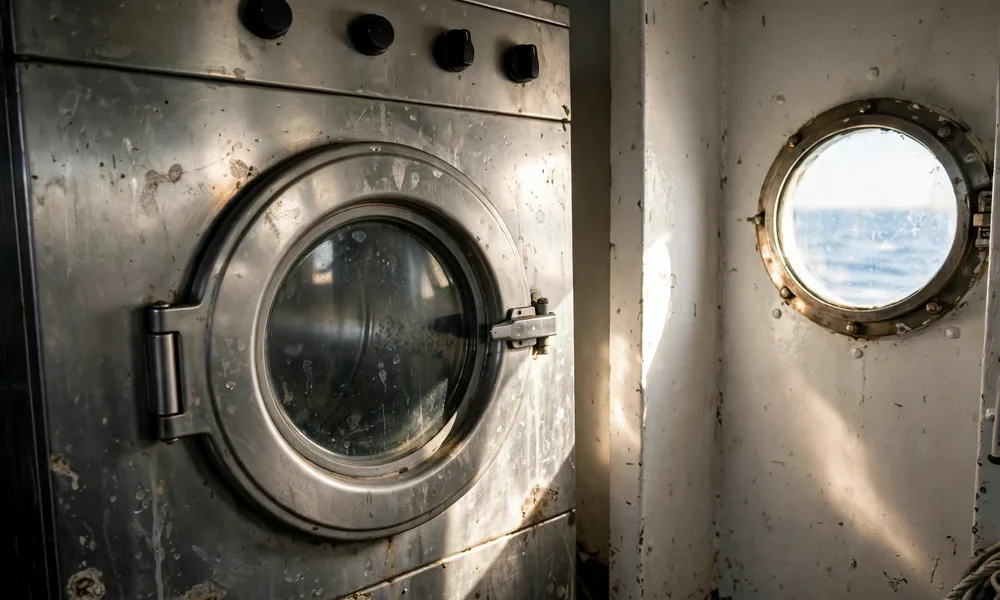
Power and heat sit beside the water figure. Two to three kilowatts for a small laundry rises to five to eight kilowatts on a superyacht, and most of it goes into heating the water and running the dryer. The dryer is the hungry one, because drying towels at sea means driving the damp out with hot air, and the sheet often lists a separate figure for it. Venting matters here too: a dryer that vents its damp air outside keeps the little room dry, while one that dumps it into the room turns the laundry into a steam bath within an hour. The full working cycle, from metered water to vented dryers, is covered in how yacht laundry works, which follows a load from the washer to the folded stack.
Noise and Air: The Quiet Numbers
The numbers that look dullest on the sheet are often the ones that decide whether the laundry is liveable. Noise is listed in decibels, typically fifty-five to sixty on a small yacht and forty-five to fifty on a superyacht, and it measures how much of the spin cycle escapes the room. A washer on a fast spin shakes hard, and on a boat that shake travels through the hull into the cabins above, so yards spend real money on rubber mounts, heavy drums and sound-absorbing panels around this small room. The lower the number, the more of that work has been done.
Ventilation is listed as air changes per hour, usually eight to fifteen, and it matters because a laundry is a hot, damp room by nature. A good system brings in fresh air without draughts and carries the steam straight outside, so the folded linen stays dry and the room never smells of damp. On larger yachts the laundry has its own climate zone, and the sheet lists the humidity the system is designed to hold. A room that cannot breathe will fill with steam within minutes of the first wash, and the crew will feel it in every load they fold.
A Rare Fact About Yacht Laundry Specs
Here is a detail that surprises even people who work at sea. Some superyacht laundries list a separate spin speed for the owner’s clothes, lower than the speed used for towels and sheets. Delicate fabrics are spun gently so they last longer, while towels and tablecloths are spun hard to drive the water out fast. The specification sheet carries both figures, because the machines are programmed with separate cycles, and the crew choose the cycle the way a chef chooses a heat: by what is in the drum.
What the Specs Mean for You
If you are buying, chartering or simply touring a yacht, the laundry specification tells you more about the yacht’s working life than the saloon does. A room with two matched machines, a water figure the watermaker can cover, and a noise level in the forties means the yard took the crew’s working day seriously. A single small washer, a thirsty cycle and thin walls means the laundry will struggle the moment the yacht is full.
Next time you step aboard a luxury yacht, ask where the laundry sits and how many loads it runs in a day. The answer will tell you how the yacht is really run, and the crew who keep it running take their breaks nearby, which is why how the crew mess works is part of the same story: a well-specified laundry is not a luxury for one room, it is the room that keeps every other room fresh.