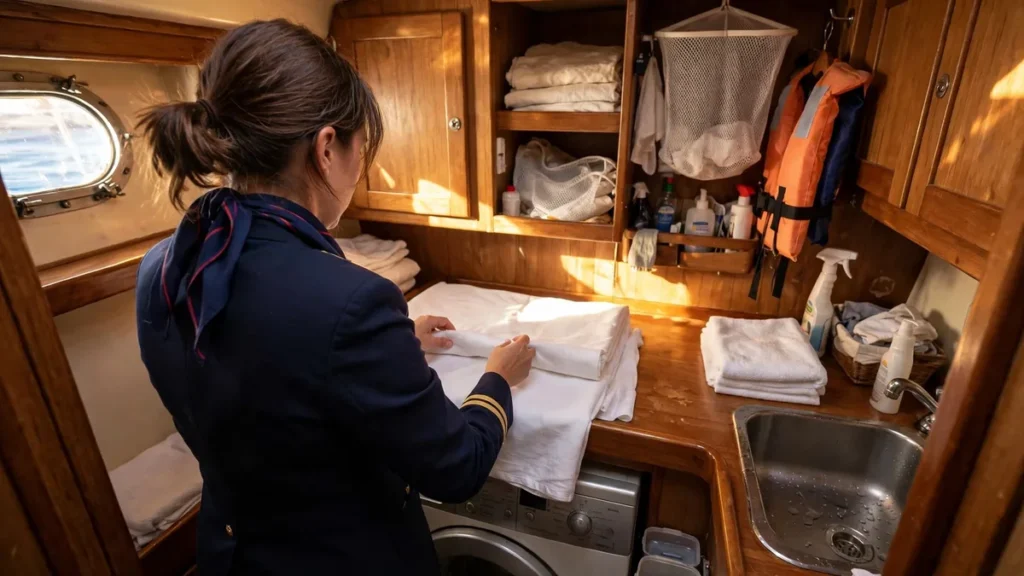
A luxury yacht carries enough clean linen for a week at sea, and none of it comes from a shop on shore. Somewhere below deck, behind a door most guests never open, a small room hums day and night, washing sheets, towels and tablecloths while the yacht rolls gently underneath it.
It is the hardest working room on board. The crew wash, dry, fold and press everything the guests touch, often twice a day, in a space no bigger than a walk-in wardrobe. This is how a luxury yacht laundry is made, from a bare steel compartment to a room that keeps a floating hotel spotless.
How It’s Made
Step 1: The compartment is chosen and sealed
Every yacht laundry starts with a choice of room, usually a low, quiet compartment deep in the hull, close to the crew quarters and the cabins it serves. The builders first check the space for headroom, drainage and ventilation, then seal the steel walls with a waterproof coating so a leak or a spill can never reach the cabins next door.
Then comes the soundproofing. Thick insulation goes into the walls and ceiling to muffle the spin cycle, and the floor is laid with a rubberised coating that grips in a swell and drains toward a central sump. A vent is cut through to the outside air, because a laundry that cannot breathe will fill with steam within minutes of the first wash.
Step 2: The machines are bolted to the deck
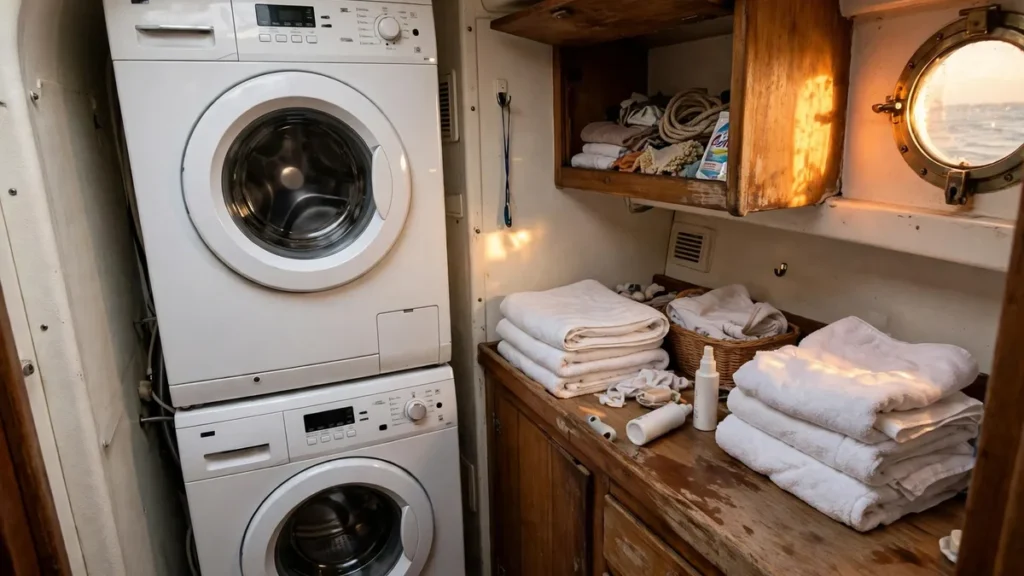
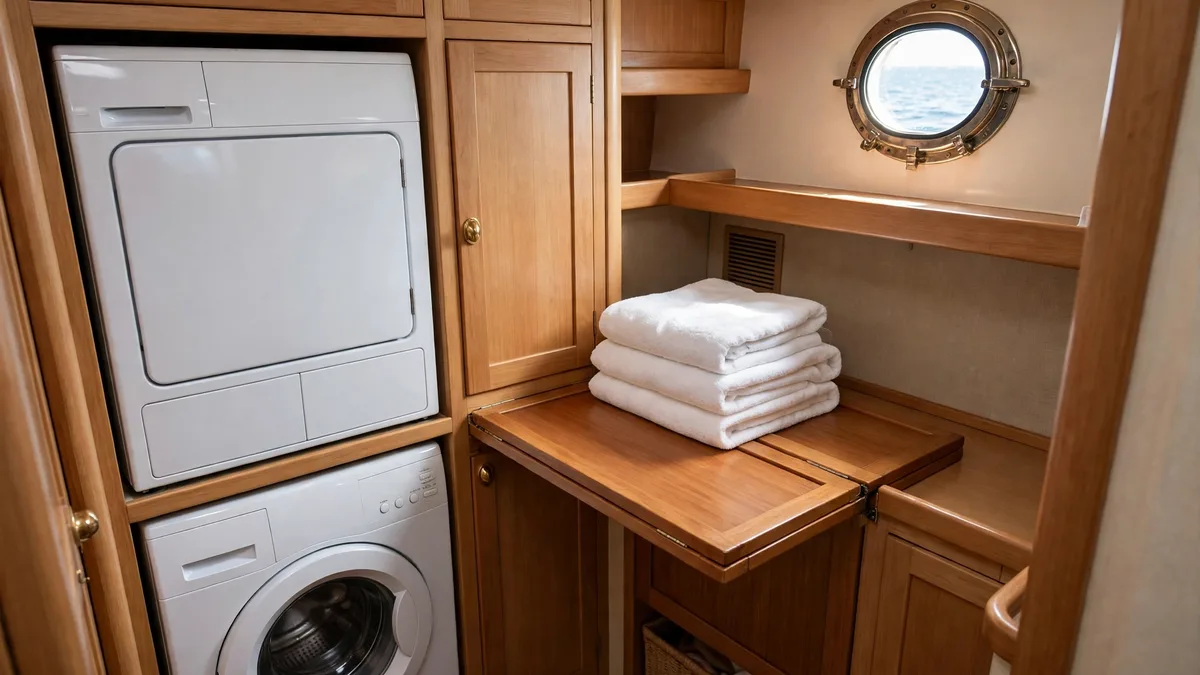
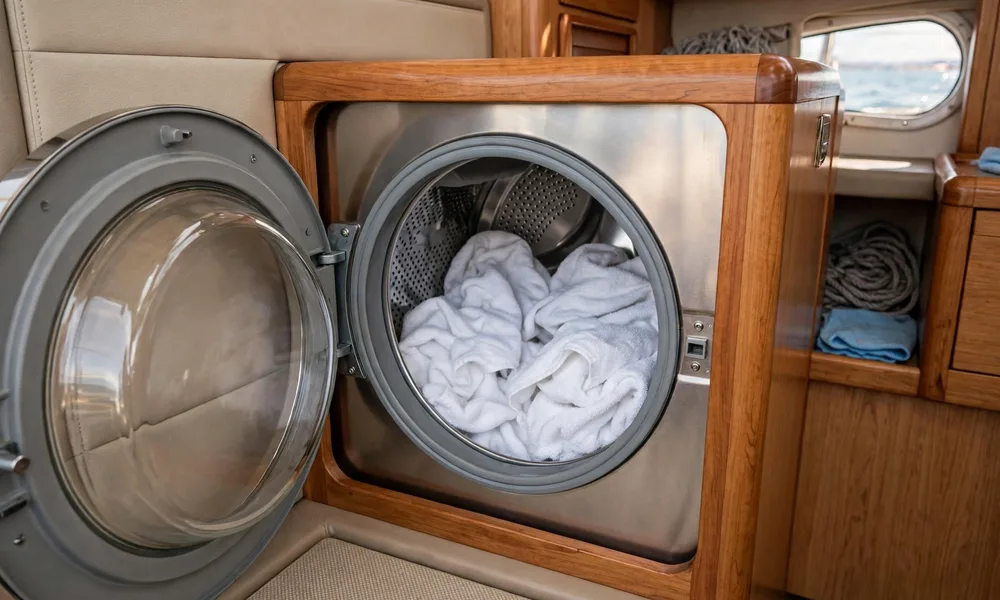
With the room sealed, the machines arrive. A yacht laundry usually has a compact marine washing machine and a separate dryer, stacked one above the other to save floor space. Each one is bolted through the deck on rubber mounts, because a spinning drum in rough weather can shake itself across a room if it is only sitting on the floor.
The machines are marine grade, built to run on the yacht’s power supply and to cope with the pitch and roll of the sea. Their drums are smaller than a household machine but spin faster, and their doors lock with a heavy latch that cannot pop open in a swell. Fresh water and waste pipes are run in copper and clipped to the bulkhead, with a filter on the intake to catch salt and grit.
Step 3: The folding counter and shelves go in
Next comes the joinery. A folding counter is built along one wall at waist height, usually in teak or pale oak, with a smooth top that can be wiped down between loads. Above it go open shelves for detergent and stain remover, and below it deep cupboards for baskets, pegs and spare parts.
Every shelf has a raised lip or a fiddle rail, so bottles and boxes stay put when the yacht heels over. The counter itself is hinged in some laundries, folding up against the wall to clear floor space when the crew need to move a full basket through the door. The wood is sealed with marine varnish, because steam and damp would warp bare timber in a single season.
Step 4: Ironing, pressing and drying are fitted
A yacht laundry is more than a washroom, so the next step is the pressing gear. A fold-down ironing board is fixed to the wall, a steam iron hangs on a heatproof hook beside it, and a trouser press stands in the corner for the crew uniforms and the owner’s shirts. Everything is wired to its own circuit, so the iron can never trip the washing machine mid-cycle.
Drying space is fitted at the same time. A heated rail or a small drying cabinet takes the items that cannot go in the tumble dryer, such as swimwear and delicate fabrics, and a retractable line runs across the room for hand-washed pieces. The air from the vent keeps the room dry, and a small dehumidifier runs quietly in the corner on humid nights.
Step 5: Water, power and safety systems are connected
Then the engineers connect the room to the yacht’s systems. The washing machine draws fresh water from the yacht’s tanks, which the watermaker refills from the sea, and the waste water runs through a treatment unit before it is discharged. A separate grey water tank holds the laundry water in port, where discharge is not allowed.
Safety comes with the plumbing. A leak detector sits on the floor and cuts the water supply if it senses a puddle, a fire extinguisher is fixed by the door, and the electrics are sealed against steam. Every pipe and cable is labelled, so any crew member can find the shut-off valve in the dark if a hose ever bursts at three in the morning.
Step 6: The room is stocked, tested and put to work
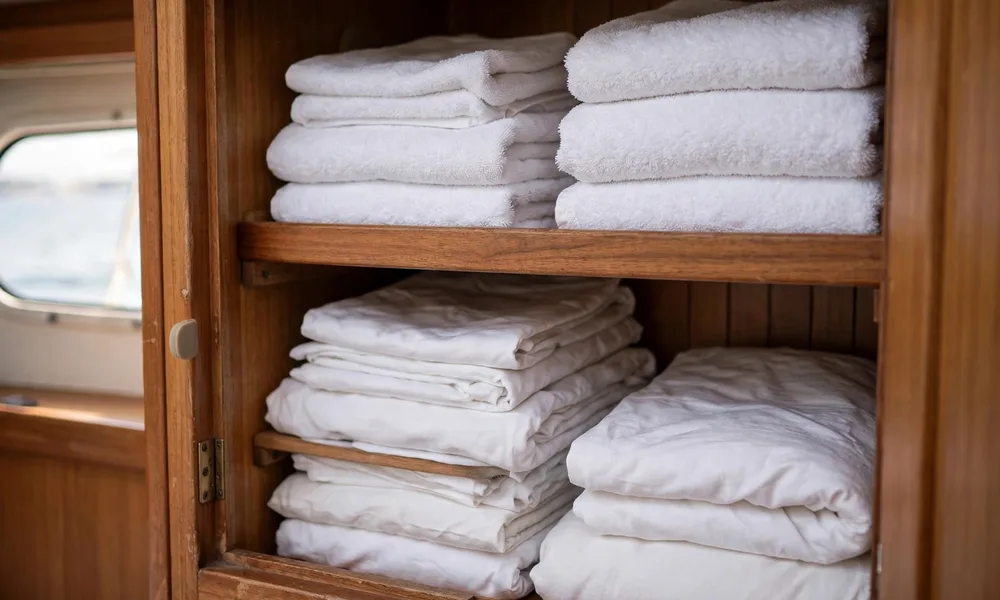
The last step is stocking the room like a small shop. Detergent, softener, stain remover and spare filters are lined up on the shelves, baskets are labelled for whites, colours and delicates, and a printed sheet on the wall lists the wash settings for every fabric on board, from cotton sheets to silk napkins.
Then the laundry is tested at sea. The crew run full loads through a chop, checking that the machines stay bolted down, the shelves hold their bottles and the vent clears the steam. Once it passes, the room goes to work, and it rarely stops until the yacht is back in port.
| Spec | Detail |
|---|---|
| Room | Sealed steel compartment low in the hull, soundproofed, rubberised floor draining to a sump |
| Machines | Compact marine washer and dryer, stacked, bolted to the deck on rubber mounts |
| Joinery | Teak or oak folding counter, shelves with fiddle rails, cupboards for baskets and supplies |
| Pressing | Fold-down ironing board, steam iron, trouser press, heated drying rail and cabinet |
| Systems | Fresh water from the watermaker, grey water tank, leak detector and steam-sealed electrics |
| Testing | Full wash loads run through a chop, checking bolts, shelves, steam and drainage |
The hardest part of building a yacht laundry is the space. Everything has to fit in a room barely bigger than a wardrobe, yet it must wash for a dozen people, dry what cannot be tumbled and press shirts to a crease, all while the floor beneath it moves with the sea.
What One Costs
Fitting out a luxury yacht laundry typically costs an estimated $40,000 to $150,000, set mostly by the machines, the joinery and the plumbing. A simple two-machine room sits near the bottom, while a full laundry with a drying cabinet, press and separate linen store costs far more. The crew who run it eat and rest nearby, and how the crew mess works shows where they take their breaks, while how a yacht cabin is made covers the rooms the fresh linen is carried to each morning.
A Rare Fact
Some superyacht laundries wash the owner’s clothes in fresh water made by the yacht itself, because seawater run through the watermaker is often softer and cleaner than the tap water in many ports, so white shirts stay whiter for longer.
A luxury yacht laundry is a sealed steel room, two bolted-down machines, a teak folding counter, a press in the corner and a vent that never stops breathing, all tested in a chop until nothing moves. It is the smallest room the guests never see, and the one their comfort depends on most. The costliest room of all is the one where the water runs hottest, and why a yacht bathroom costs so much explains what makes it so dear.