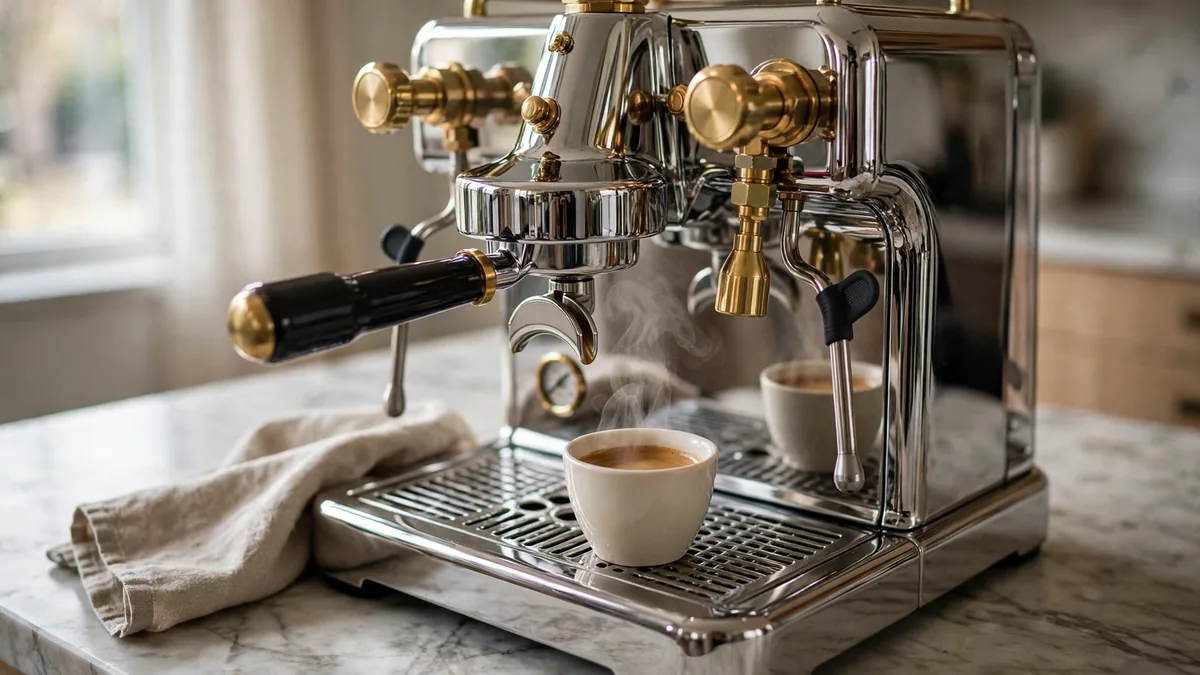
The kitchen is quiet at six in the morning, and the machine on the counter is already awake. It hums for a few seconds, a small light changes colour, and a thin stream of dark coffee falls into a warmed cup, slow and steady, with golden-brown crema spreading across the top. Nothing about the moment looks complicated. Yet the box doing the work costs more than many people spend on a used car, and its spec sheet reads like the manual for a small boiler room. That is the point of a luxury espresso machine: it hides a surprising amount of engineering behind a very simple pleasure.
The spec sheet at a glance
| Figure | Typical range | What it tells you |
|---|---|---|
| Boiler type | Single, heat-exchange or dual boiler | Whether you can brew and steam milk at the same time |
| Boiler capacity | Roughly 1.5 to 3 litres | How many drinks it can make before the temperature sags |
| Pump pressure | 9 bars, adjustable to about 6 to 12 | How hard water is pushed through the coffee puck |
| Temperature control | PID, accurate to about 1 degree | How precisely the water temperature is held |
| Grinder | Built-in burr, 55 to 65 mm | How evenly the beans are ground, and how fresh the coffee is |
| Price | Roughly $3,000 to $12,000 | What a luxury home machine costs, as an estimate |
The boiler: the heart of the machine
Every espresso machine is, at its core, a small water heater with a pump attached, and the boiler is where the money goes first. A basic machine has one small boiler and makes you wait between brewing coffee and steaming milk, because one temperature cannot do both jobs. A dual-boiler machine, the luxury standard, has two separate boilers, one held at brewing temperature and one at steaming temperature, and each one stays where it belongs.
Pump pressure: nine bars, and why more is not better
Nine bars is the number every espresso maker quotes, and it is worth knowing what it means. A bar is roughly the pressure of the atmosphere at sea level, so nine bars is nine times that, pushing hot water through a tightly packed puck of ground coffee. That pressure squeezes the oils and dissolved solids out of the grounds and builds the crema on top. A luxury machine holds a steady nine bars at the group head, the part the portafilter locks into, and many let you adjust it down to six or up to twelve, which can soften a harsh dark roast or sharpen a light one. As with any luxury appliance, the useful number is the one measured where the work happens, not the one printed biggest on the box, which is the same lesson the guide to luxury robot vacuum specs teaches about suction figures.
Temperature control: the quiet revolution
Espresso is fussy about temperature in a way that surprises most people. Water a few degrees too hot scorches the grounds and pulls out bitter, ashy flavours; a few degrees too cool leaves the coffee sour and thin, because the good flavours never dissolve. The sweet spot sits around 93 to 96 degrees Celsius, and a luxury machine holds it there with a PID controller, a small computer that watches a temperature sensor many times a second and nudges the heater on and off in tiny pulses. A PID display also lets you change the target by a single degree, which matters more than it sounds: a bright, fruity coffee often tastes best a degree or two cooler than a chocolatey bean.
The grinder: fresh coffee, ground to order
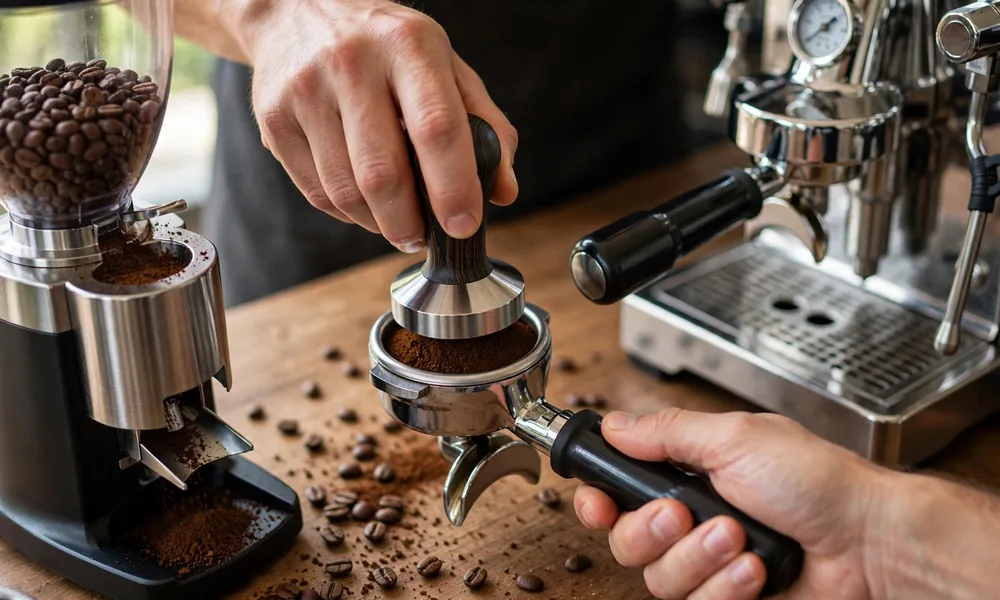
Many luxury machines have a grinder built into the same box, and the spec sheet usually gives its burr size in millimetres. Burrs are the two ridged discs that crush the beans, and bigger burrs, usually 55 to 65 millimetres across in a home luxury machine, grind faster and more evenly, which means fewer bitter dust-like fines and fewer sour boulders in the same dose. What matters more is that the grinder lets you nudge the fineness by tiny amounts, because a change of a few microns in grind size can turn a choked, dripping shot into a flowing one. Grinding fresh for each cup also matters: ground coffee stales in minutes, and a machine that grinds on demand is doing the single most effective thing any coffee gadget can do.
Pre-infusion and the group head
Before full pressure arrives, a good machine soaks the puck gently at low pressure for a few seconds. This is pre-infusion, and it lets the grounds swell and settle so the water passes through evenly instead of finding a crack and rushing through it, a flaw called channelling that leaves a shot both bitter and sour at once. The group head, the heavy metal part the portafilter locks into, also matters: on the best machines it is a solid chunk of brass or stainless steel, heated by the boiler, so it does not steal heat from the water on its way to the coffee. The same thinking sits behind the sensors in how a luxury smart speaker works, where small, well-made parts do quiet work you never see.
Build, materials and the daily routine
A luxury espresso machine is built to be repaired, not replaced. The case is usually stainless steel, sometimes with brass fittings, and the inside is laid out so a technician can reach the pump, the boiler and the valves without dismantling the whole machine. The water tank is often two to four litres, big enough for a morning of drinks, and many machines can be plumbed directly into the water supply so the tank becomes a backup rather than a chore. A machine that weighs thirty kilograms is not being wasteful; it is being stable, quiet and long-lived.
What it costs
A luxury home espresso machine usually costs roughly $3,000 to $12,000 as an estimate, with the middle of the range buying a dual boiler, a PID controller and a good built-in grinder. What the money buys, above all, is consistency: the same shot, cup after cup, morning after morning, without the temperature swings and pressure wobbles that make cheaper machines a gamble. And if you ever wondered how much precision a small device can pack in, the numbers behind a luxury action camera’s specs tell a similar story of tiny parts doing exacting work.
A rare fact
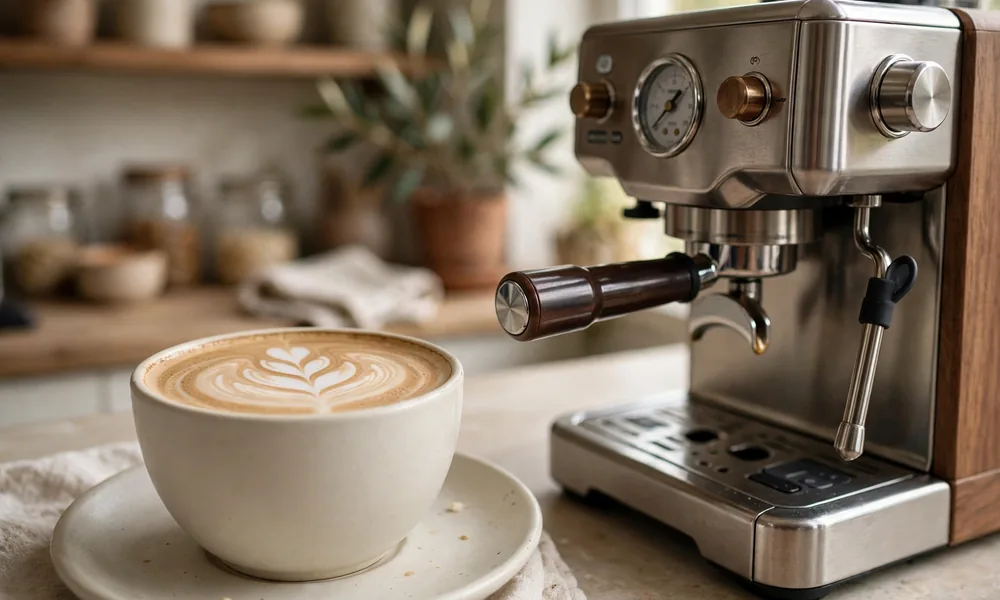
Here is a small detail most owners never notice: the pressure gauge on many luxury machines is not really measuring the pump. It measures the pressure at the group head, after the water has passed through a small valve, which is why the needle sits at nine bars during a shot and drops the moment the shot ends.