In a quiet kitchen in the morning, a woman says a single word and the room answers. Music starts low, the lights warm a shade, and a small cylinder on the shelf tells her the weather before she has asked for it properly. She does not touch it. She does not look at it. The speaker has been listening for its name, and for nothing else, all night long.
That neat trick, a device that is always awake but never seems to be listening, is the heart of a luxury smart speaker. This is how it works.

Step 1: Listening for the wake word
The speaker’s first job is to hear its name and ignore everything else. A small, low-power chip runs all the time, listening to the room through a ring of microphones and comparing what it hears to the shape of the wake word. It does this on the device itself, so ordinary conversation never leaves the house.
The microphones are arranged in a circle so the speaker can tell which direction a voice is coming from, even when music is playing. A person can whisper from across the room, and the speaker will still pick the voice out of the noise, because it knows where to listen.
Step 2: Understanding the request
Once the wake word is heard, the speaker wakes fully and sends the next few seconds of speech to be understood. Software turns the sounds into words, works out what the person wants, and decides which answer fits: a song, a timer, a fact, or a command for another device in the house.
That understanding is tuned for real rooms, not studios. It copes with accents, with children, with a television playing in the background, and with a request that trails off halfway. How Micro-LED Displays Are Built, Step by Step belongs to the speaker’s cousins with screens, where the same idea of a bright, precise display is fitted into a device that must be understood at a glance.
Step 3: Driving the sound
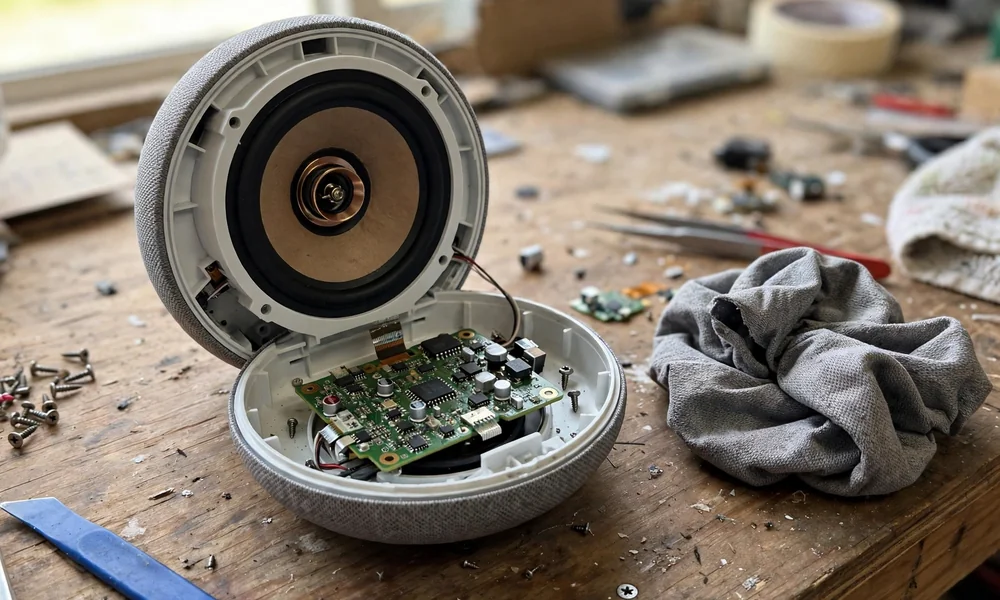
The speaker’s voice and music come from drivers, small loudspeakers tuned to the cabinet they sit in. A woofer handles the low notes, a tweeter the high ones, and the space between them is shaped so sound spreads evenly around the room instead of beaming in one direction.
The cabinet itself is part of the instrument. It is sealed and braced so it does not buzz or rattle at volume, and the fabric cover is chosen to let sound through while hiding the hardware inside. Inside the Titanium Frame in Your Phone shows the same obsession with a rigid, silent enclosure in a different device, where the case must never add a sound of its own.
Step 4: Tuning itself to the room
A luxury speaker does not sound the same in every room, because no two rooms sound the same. When it is first set up, it plays a short series of tones and listens to how they bounce off walls, shelves, and curtains, then adjusts its own equaliser to suit the space.
That tuning is repeated quietly over time, because a room changes when furniture moves or a rug arrives. The speaker keeps a model of the room in its memory and refines it, so the music stays balanced whether the speaker sits on an open shelf or in a crowded corner. A speaker that lives on a kitchen counter learns the clatter of pans and the hum of the fridge, and it learns to ignore both.
Step 5: Talking to the rest of the house
The speaker is also a remote control for the home. It speaks the wireless languages of lights, locks, thermostats, and televisions, and it keeps a list of which devices belong to which room, so that saying the lights should dim means the lights in this room, not the ones upstairs.
Commands are checked before they are sent, so a voice from a television cannot unlock a door, and a child’s request for a purchase is stopped before it reaches the shop. Inside the Factory That Builds the Foldable Phone Hinge comes from a different kind of precision engineering, but the discipline is the same: a tiny mechanism that must work perfectly, thousands of times, without ever being noticed.
Step 6: Staying quiet, private, and up to date
When it is not needed, the speaker goes back to its low-power watch, its ring of light dimmed and its main processor asleep. A physical switch can cut the microphones entirely, for people who want silence they can feel with a fingertip rather than trust to software. The light ring is the speaker’s honest face: when it is lit, the microphones are live, and when it is dark, they are not.
Overnight the speaker updates itself, learning new phrases, new devices, and new answers, and it does so without ever interrupting the room. A luxury speaker is judged by what it does not do as much as by what it does: it never speaks uninvited, never plays at the wrong moment, and never forgets whose house it is in.
Specifications
| Detail | Specification |
|---|---|
| Microphones | Ring of six or more, with echo cancellation |
| Drivers | Woofer and tweeter, with passive radiators |
| Sound output | Room-filling, around 360 degrees |
| Processor | Low-power always-on chip plus a main processor |
| Room tuning | Automatic, using played tones and microphone feedback |
| Display | None on most models; a small screen on display models |
| Connectivity | Wi-Fi, Bluetooth, and smart-home wireless |
| Privacy | On-device wake word, physical microphone switch |
| Power | Mains powered, with a low-power standby mode |
| Software updates | Automatic, usually overnight |
Price
The estimated price of a luxury smart speaker is around 300 to 700 dollars, and that figure is an estimate only, because the cost depends on sound quality, the number of drivers, and whether the model includes a display. The cabinet and fabric are a modest share; the microphone array, the tuning, and the voice software are where the money goes. Any subscription is usually for extra music or voice features, and the speaker works without one. A buyer is paying for a device that hears a whisper across a noisy room, fills the space with music, and runs the house without ever demanding attention.
A rare fact
Few people know that a smart speaker’s microphones are tested by being shouted at from a loudspeaker while music plays at full volume. Engineers blast a recording of a crowded party at the device, then speak the wake word quietly from the far side of the room, and the speaker must still answer. The test is repeated with the speaker turned to face away, with a vacuum cleaner running, and with a dog barking. A speaker that passes is not really listening harder; it is listening smarter, cancelling the noise it knows so it can hear the voice it does not.
When the music fades and the room goes quiet, the speaker sits on its shelf like any other small object in the house. Say its name, and it wakes in a fraction of a second, ready to help, as if it had been waiting for you all along.