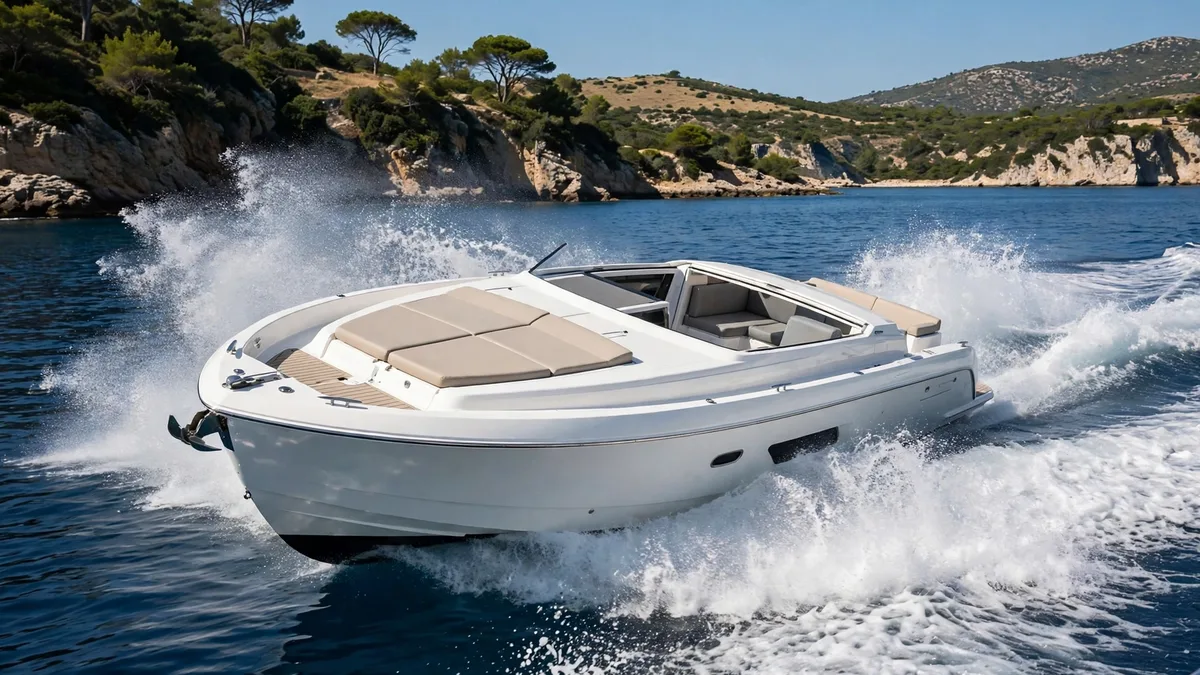
A day cruiser is a boat built for a single perfect day. It leaves the marina in the morning, runs fast across open water, anchors off a beach for lunch and swimming, and comes home before sunset. There is no overnight cabin to speak of, no long-range fuel tank, no crew quarters. Everything about it is tuned for speed, comfort and style in daylight, and that focus is what makes it such a pleasure to use.
At the luxury end, a day cruiser is far more than a fast boat with nice seats. It is a hand-built machine with a sculpted hull, a powerful engine, a cockpit finished like a sports car interior and details that take weeks of skilled work. Here is how a luxury day cruiser is made, from the mould that shapes its hull to the day it first touches the water.
How It’s Made
Step 1: The mould and the hull
Every day cruiser starts in a mould, a polished form shaped exactly like the finished hull. Builders spray gelcoat into the mould first, the glossy coloured skin that gives the boat its shine, then lay in layers of fibreglass cloth and resin, building the hull up like a shell. In the best yards the fibreglass is infused with resin under vacuum, which squeezes out air bubbles and makes a lighter, stronger hull. The hull cures in the mould for days, then it is lifted out, polished and inspected for the smallest flaw, because on a luxury boat the finish is part of the product.
Step 2: The stringers and the deck
Inside the hull, builders fit stringers, long structural beams that run the length of the boat and give it stiffness, and bulkheads that divide the interior into sections. Foam is poured into the spaces between the stringers, which adds buoyancy and deadens sound. The foam also adds strength, so the hull feels solid underfoot even when the boat is running hard through a chop. The deck, with its cockpit, sunpad and bow seating, is built separately in its own mould and then lowered onto the hull and bonded in place. At this point the boat starts to look like a boat, with its sleek lines and open cockpit taking shape.
Step 3: The engine and the drive
A luxury day cruiser is usually powered by one or two large outboard engines, or by an inboard engine with a sterndrive, and the choice shapes the whole boat. Outboards free up space inside and are easy to service, while sterndrives sit lower and keep the transom clean for swimming. The engines are bolted to a reinforced transom, fuel tanks are fitted low in the hull for stability, and the steering and throttle controls are run through the boat to the helm. A typical luxury day cruiser can reach 40 to 50 knots, fast enough to make the water feel like a road. The best superyacht tenders ranked guide shows how many large yachts carry a day cruiser as their tender, using it to run guests ashore in style.
Step 4: The cockpit and the helm
The cockpit is where the owner spends the day, so it is finished with the same care as a car interior. Seats are upholstered in marine-grade leather or vinyl that can take sun and salt spray, the dashboard holds a glass screen with navigation, engine data and sound controls, and the steering wheel and throttles are placed for easy reach. Cup holders, cool boxes, a small sink and a sunpad are fitted into every spare corner. A windscreen protects the crew from spray at speed, and it folds flat when the owner wants an open feel at anchor. The joinery is often teak or a pale wood, sealed against water, and the whole cockpit is designed to drain quickly when a wave comes aboard.
Step 5: The details that make it luxury
What separates a luxury day cruiser from an ordinary one is the detail. The stainless steel fittings are polished by hand, the upholstery stitching is double-sewn, the swim platform has a teak deck and a ladder that folds away, and the lighting is fitted under the seats and along the gunwales for evening runs. Many owners choose a custom colour for the hull, a matching bimini top and a sound system that can be heard over the engines. The best superyacht beach clubs ranked guide explains how the best boats turn the stern into a beach club, with the swim platform dropping close to the water so guests can step straight into the sea.
Step 6: Testing on the water
Before delivery, the boat is launched and tested on the water. The builder checks the top speed, the fuel use, the handling in turns and the way the hull rides over waves. The trim is adjusted so the boat runs level, the steering is checked for play, and every switch, pump and light is tested. The boat is run hard, because a fault found at the factory is a small job, while the same fault found by the owner on the first weekend is a ruined summer. The best electric yacht interiors ranked guide shows how the newest boats are changing, with electric drives and interiors designed around quiet, clean cruising.

Day Cruiser Specifications
| Specification | Typical Luxury Day Cruiser |
|---|---|
| Length | 9 to 14 metres |
| Hull material | Fibreglass, vacuum-infused resin |
| Engine | Twin outboards or sterndrive, 600 to 900 horsepower |
| Top speed | 40 to 50 knots |
| Guests | 8 to 12 |
| Fuel capacity | 600 to 1,000 litres |
| Build time | Around 4 to 6 months |
The Price
A luxury day cruiser costs an estimated $400,000 to $1.5 million, depending on its size, engines and level of custom work. The hull and engines are the biggest costs, but the finishing, the upholstery and the electronics add up quickly, especially when an owner orders a custom colour or a top-end sound system. Running costs are modest by yacht standards, with fuel, servicing, insurance and marina fees coming to an estimated $30,000 to $60,000 a year. For many owners it is the most used boat they own, because it is the easiest to take out for a day on the water.
A Rare Fact
Some luxury day cruisers are built with a hull step, a small notch in the bottom of the hull that lets air get underneath at speed. The air reduces drag, so the boat goes faster and uses less fuel, almost like it is riding on a cushion of air. The idea comes from racing boats, and getting the step in exactly the right place takes careful testing, because a step in the wrong place can make the boat unstable. When it works, the difference is easy to feel.

A day cruiser is the simplest kind of luxury on the water, and that is its charm. It has no cabins to maintain, no crew to manage and no long passages to plan. It is built by hand in a small yard, finished like a piece of furniture, and made for one thing only: a perfect day at sea. It asks for little and gives back a whole summer of afternoons on the water. When the sun is out and the water is calm, there is no better boat to be on.


