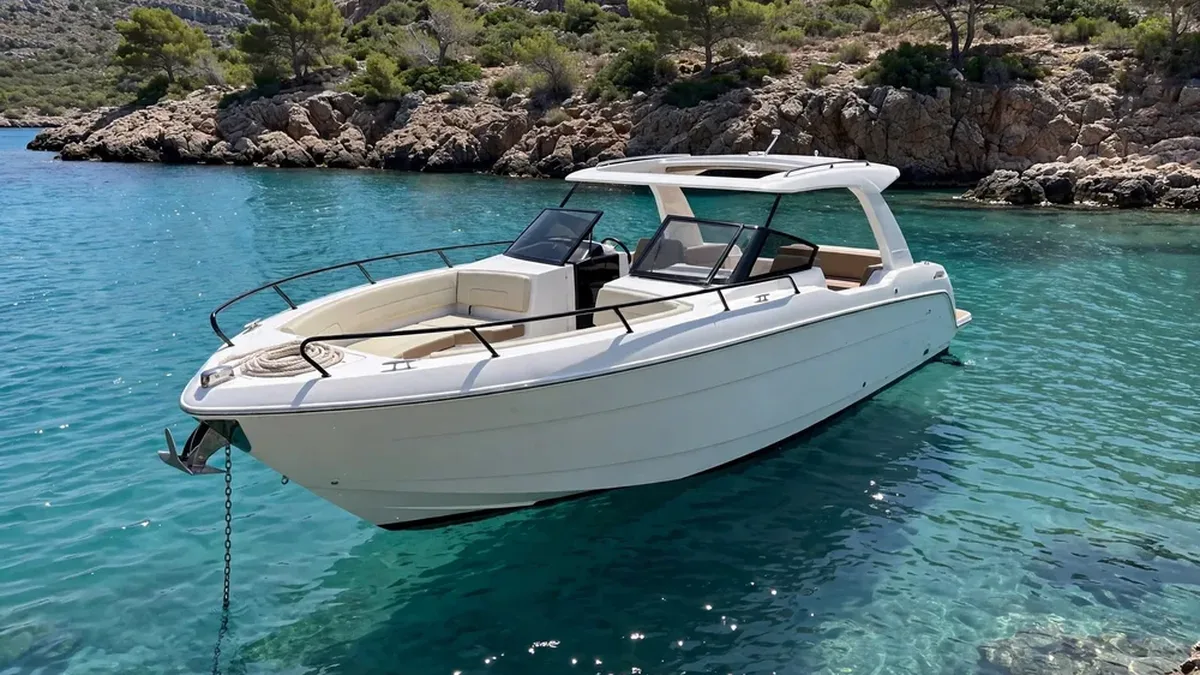
A couple in their fifties stood on a marina pontoon on a Saturday morning, looking at a white day cruiser that was, by any honest measure, a beautiful boat. It was twenty-eight feet long, it had cream leather seats, a polished wooden helm and a sunpad at the back that looked like it belonged in a hotel. Then they heard the price. It was more than their first house had cost, and more than the family car by a factor of ten. They laughed, then they stopped laughing, because the salesman was not joking.
A luxury day cruiser is a boat that does one thing: it takes a small group of people out for the day, in comfort, and brings them home again. It does not cross oceans, it does not sleep a family for a week, and it has no cabin to hide in when the weather turns. So why does it cost as much as a house? The answer is in the materials, the engine, the hand finishing, and the very small number of boats like it that are ever made.
Why a Luxury Day Cruiser Costs So Much
Reason 1: The hull is built like a piece of furniture, not a boat
Most boats are built to a price, with a hull that is strong enough and a finish that is good enough. A luxury day cruiser is built the other way round. The hull is laid up by hand, layer by layer, from fibreglass and resin, often with a foam or balsa core that makes it stiff and light, and then it is faired, the long, slow process of sanding the surface perfectly smooth before it is painted. A hull that looks simple from the pontoon can take weeks of hand work before the paint goes on, and any flaw shows up in the reflection.
Reason 2: The engine is a small fortune on its own
The engine, or more often two engines, is the single most expensive part of a day cruiser. A luxury model typically carries 300 to 600 horsepower, often from a pair of outboards or a large inboard, and the engines alone can cost $30,000 to $80,000. They are not ordinary car engines with a coat of paint. Marine engines are built to run at high revs for hours, in salt air, with cooling systems that use seawater, and they are tested far harder than a road engine. The craft of building a boat like this is explained in our guide to how a luxury day cruiser is made, which follows the hull from mould to water.
Reason 3: The interior is a yacht, shrunk to a day boat
Step aboard a luxury day cruiser and the interior reads like a small yacht: cream leather upholstery, teak decking, polished wood, stainless steel fittings and a helm that looks like a piece of furniture. None of it is cheap, because none of it is ordinary. Marine leather must resist sun, salt and spilled drinks without cracking. Teak decking is laid by hand, plank by plank, and sealed against water. The result is an interior that feels like a lounge, and it is built by people who also build much larger yachts, at yacht prices, on a much smaller boat.
Reason 4: Everything is made in tiny numbers
A car factory makes thousands of cars a day. A luxury day cruiser builder might make a few dozen boats a year, and a boutique builder might make fewer than ten. That changes the economics completely. The cost of designing the hull, building the moulds, testing the boat and certifying it for sale is spread across a tiny number of buyers, so each boat carries a large share of the development cost. There are no economies of scale, no robot assembly line, and no cheap parts bin to raid. Every boat is, in effect, a small production run, and the price reflects that. The same small-run economics shape larger sailing craft too, as shown in our guide to how a luxury catamaran is made.

Reason 5: The details are where the money hides
The price of a luxury day cruiser is not in one big thing but in a hundred small ones, each done properly. The cleats are polished stainless steel, not painted metal. The cushions are made to measure, with piping and stitching that will not come apart in the sun. The cooler is built in, the shower is fresh water, the lighting is warm and dimmable, and the sound system is tuned for an open cockpit rather than a living room. None of these details is expensive alone, but together they add tens of thousands of dollars, and they are the difference between a boat that feels expensive and one that only looks expensive from a distance. The electric side of modern boating is covered in our guide to luxury electric boat specs, where batteries and motors change the same calculations.
Reason 6: The brand, the service and the resale
The last part of the price is not in the boat at all. A luxury day cruiser comes with a brand name that holds its value, a dealer who will service it properly, and a warranty that actually means something. Owners are buying into a network: winter storage, servicing, spare parts and a resale market that recognises the name. That scarcity is part of the price, and it is also part of the reason owners are willing to pay it.
Luxury Day Cruiser Specs at a Glance
| Specification | Typical range |
|---|---|
| Length | About 25 to 35 feet |
| Engine power | About 300 to 600 hp, often twin outboards |
| Top speed | About 35 to 50 knots |
| Passenger capacity | About 8 to 12 people |
| Hull | Hand-laid fibreglass with foam or balsa core |
| Deck and interior | Teak decking, marine leather, polished wood helm |
| Fuel capacity | About 300 to 600 litres |
| Weight | About 3,000 to 6,000 kg |
What Does a Luxury Day Cruiser Cost?
A luxury day cruiser is estimated to cost roughly $200,000 to $500,000, with flagship models estimated at $700,000 to $1,000,000 or more once a twin-engine setup, premium interior and electronics package are added. Running costs are estimated at $10,000 to $30,000 a year for fuel, servicing, insurance, storage and berthing. Prices are estimates only and vary by builder, engine choice and options.
A Rare Fact
The teak on a luxury day cruiser is not just decoration. Teak contains natural oils that resist rot and salt water, which is why it has been used on boats for centuries, and a well-kept teak deck can outlast the boat itself. The most expensive part of the deck is not the wood but the labour: laying it by hand takes days, and removing it for replacement takes even longer.

So why is a luxury day cruiser so expensive? Because its hull is hand-built, its engines cost as much as a car, its interior is a small yacht, it is made in tiny numbers, and every detail is finished properly. Whether that is worth the price depends on how you count the cost. Count it in money per day and it looks absurd. Count it in summer afternoons, in a boat that rides beautifully and holds its value, and the owners who pay it will tell you it was the cheapest expensive thing they ever bought.


