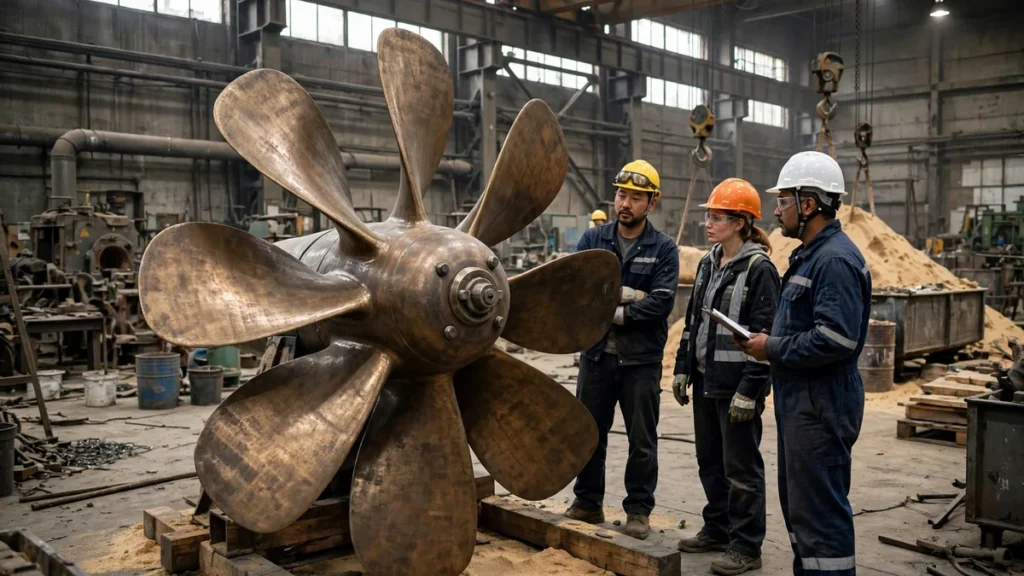
Step into a metal printing hall at dawn and the first thing you notice is the quiet. There is no hammering, no cutting, no shower of sparks from a lathe. Instead, a row of sealed machines hums softly, and inside each one a laser is drawing, line by line, in a bed of fine grey powder. Where the beam passes, the powder melts and freezes into solid metal. Hour by hour, a shape rises out of the dust — a bracket, a nozzle, a hinge — built from nothing but light and powder.
That is additive manufacturing, and it turns the old rules of making things upside down. A traditional factory starts with a block of metal and cuts away everything that is not the part, throwing most of the material away. A printer starts with nothing and adds only what the part needs, The trade is time and cost: printing is slow, and the machines are expensive, so the numbers on the specification sheet decide whether a part should be printed at all.
This guide reads those numbers in plain English. Layer thickness, build volume, print speed, density, surface finish, strength, and accuracy — each one tells you something different about what the machine can do, and what the finished part will be like when it leaves the powder bed.

The Specs That Matter
1. Layer thickness
Every printed part is a stack of thin slices, and layer thickness is the height of each slice. On metal printers it usually runs from about 20 to 100 microns — a human hair is roughly 70 microns thick, so the finest layers are a third of a hair. A part that takes eight hours at 60-micron layers can take twice as long at 30 microns. The way those layers are laid down is the heart of the process, as explained in how additive manufacturing is made, where powder, laser, and motion come together.
2. Build volume
Build volume is the size of the box the printer can fill — its length, width, and height in millimetres. A desktop plastic printer might offer 200 by 200 by 200 millimetres, while a large industrial metal machine can reach 600 by 400 by 500 millimetres or more, and the biggest machines in the world print parts several metres across. Build volume is a hard limit: a part bigger than the box must be split into pieces and joined later, which adds cost and weak points.
3. Print speed
Print speed is usually quoted as a deposition rate — how many cubic centimetres of material the machine lays down per hour. A typical laser powder-bed machine manages roughly 10 to 100 cubic centimetres per hour, depending on the material and the layer settings, while high-speed systems with several lasers working at once can pass 200. The physics behind that trade is laid out in how additive manufacturing works, from the melt pool to the finished layer.
4. Density and porosity
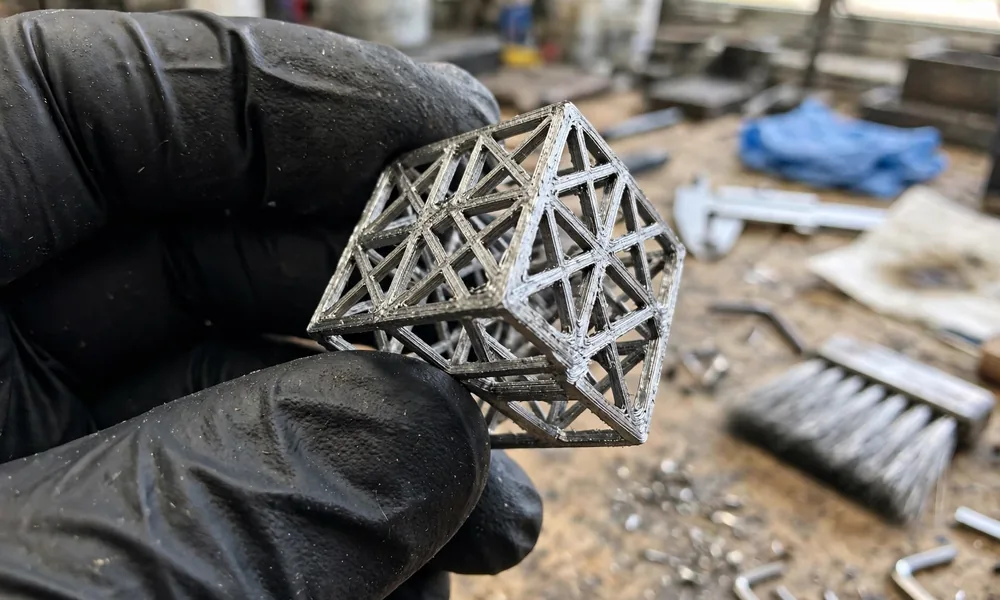
A good metal print should be nearly solid. Density is quoted as a percentage of the solid metal — a well-tuned print reaches 99.5 percent or better, with the remaining fraction made up of microscopic pores trapped inside. A density figure below 99 percent is a warning sign, and a supplier who will not quote density at all is one to avoid.
5. Surface roughness
Straight off the printer, a metal part feels like fine sandpaper. Surface roughness is measured as Ra, the average height of the bumps on the surface, and as-printed metal typically measures about 10 to 25 microns Ra. That is far rougher than a machined part, which can reach below 1 micron, so any face that must seal, slide, or look polished has to be machined or polished afterwards.
6. Tensile strength
Tensile strength is how hard you can pull a part before it breaks, measured in megapascals. Printed titanium alloy, Ti-6Al-4V, typically reaches about 900 to 1,100 megapascals, close to the wrought metal it replaces, while printed stainless steel lands near 500 to 700. A single strength number with no direction attached is only half a specification.
7. Dimensional accuracy
Accuracy is how closely the printed part matches the digital model, usually quoted as a tolerance in millimetres or as a percentage of the dimension. A typical metal printer holds about plus or minus 0.1 millimetres on small features, or about plus or minus 0.2 percent on larger ones, whichever is bigger. Skilled operators fight this with supports, orientation, and simulation software that predicts the distortion before the print starts. The scale of the machines that deliver these numbers is impressive in its own right — the same world of large-format metal printing explored in inside metal 3D printing production.
Additive Manufacturing Specs
| Specification | Typical range |
|---|---|
| Layer thickness | About 20 to 100 microns for metal; 50 to 300 microns for plastic |
| Build volume | About 200 x 200 x 200 mm desktop; up to 600 x 400 x 500 mm industrial |
| Print speed | About 10 to 100 cubic centimetres per hour; over 200 with multiple lasers |
| Density | About 99.5 percent of solid metal or better when well tuned |
| Surface roughness | About 10 to 25 microns Ra as printed; under 1 micron after machining |
| Tensile strength | About 900 to 1,100 MPa for printed titanium alloy; 500 to 700 MPa for stainless steel |
| Dimensional accuracy | About plus or minus 0.1 mm on small features; plus or minus 0.2 percent on larger parts |
| Materials | Titanium, stainless steel, aluminium, nickel alloys, polymers, and ceramics |
What Does Additive Manufacturing Cost?
Additive manufacturing is expensive, and the machine is the biggest reason. An industrial metal printer is estimated to cost roughly $250,000 to over $1,000,000, depending on size and laser count, while a good desktop plastic printer is estimated at roughly $300 to $5,000. The metal powder itself is estimated at roughly $100 to $500 per kilogram, and a single printed part can be estimated at roughly $50 for a small plastic piece to several thousand dollars for a large metal component, depending on size, material, and finishing. All prices are estimates only and vary widely by material, machine, and supplier.
A Rare Fact
The most famous printed part in the world is one you will never see. Inside the LEAP jet engine, which powers many modern airliners, the fuel nozzle was once an assembly of twenty separate pieces, welded and brazed together. Engineers redesigned it as a single printed part: it came out 25 percent lighter, five times more durable, and with internal passages no drill could ever reach.
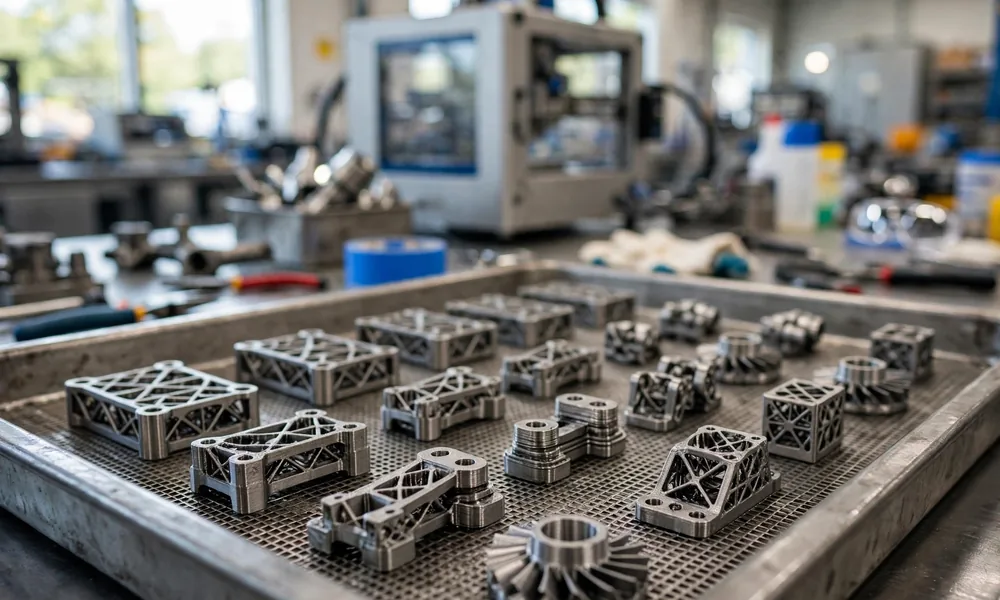
A printed part is a stack of promises: each layer a certain thickness, each cubic centimetre laid down at a certain speed, each surface a certain roughness, each direction a certain strength. Read those numbers together and the specification sheet stops being a wall of jargon and starts being a picture of the part itself — how it was grown, how strong it is, and whether it is worth the price of growing it instead of cutting it.