A submarine propeller is the quietest propeller in the world, and that is the point. A submarine that can be heard is a submarine that can be found, so its propeller is designed to push tonnes of steel through the water without making a sound — no cavitation bubbles, no vibration, no hum. It spins slowly, deep underwater, driven by a shaft that passes through the hull, and it must keep working for years without ever being seen. When a submarine returns to port, the propeller is often covered, because its shape is a secret.
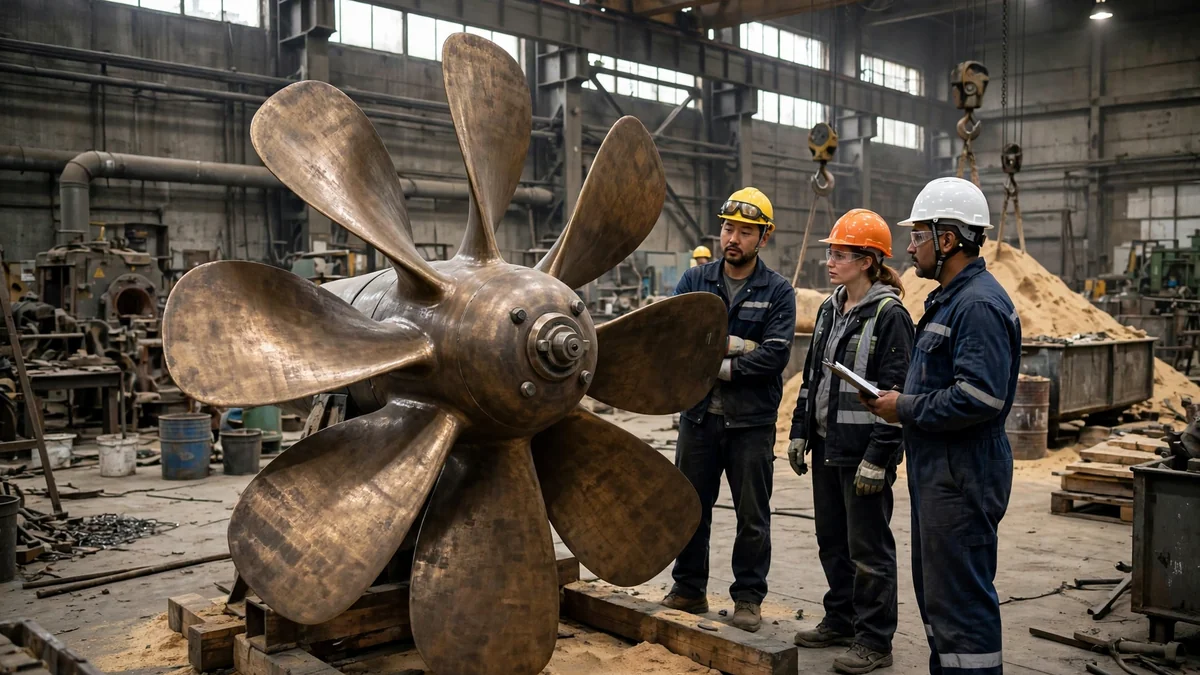
Building one is a blend of foundry work and fine machining, carried out in a handful of specialised yards. The propeller starts as molten bronze poured into a mould, is cooled slowly over days, and is then machined and polished by hand until its blades are smooth to the touch and identical to within a fraction of a millimetre. Here is how a submarine propeller is produced.
How It’s Made
Step 1: Designing for silence
Naval engineers begin with the submarine’s size, its top speed, and the power of its motor, then design a propeller that can deliver the thrust without cavitation — the formation of bubbles on the blade that collapse with a loud crackle. The number of blades, their skew, and their pitch are modelled in software and tested in water tunnels with scale models, because a blade shape that works at one speed can be noisy at another. Modern submarine propellers often have seven blades, heavily skewed backwards like a scimitar, so each blade enters the water gradually instead of all at once. The design is classified, and even the number of blades on some submarines is a state secret.
Step 2: Casting the bronze
The propeller is cast from nickel-aluminium bronze, an alloy chosen because it is strong, resists corrosion in seawater, and can be repaired by welding. A mould is built in a pit, usually from sand packed around a full-size pattern of the propeller, and the molten bronze — heated to over 1,000°C — is poured in a single continuous pour that can take hours. The casting then cools slowly, over days, because cooling too fast would crack it or leave hidden stresses. A large submarine propeller can weigh ten tonnes or more, and the foundry that casts it needs cranes, pits, and furnaces on an industrial scale. The same casting craft is used for the largest ship propellers, as inside ship propeller production shows.

Step 3: Rough machining
Once the casting has cooled and the mould is broken away, the propeller is lifted onto a giant lathe and milling machine. The hub is bored to fit the shaft, and the blades are machined to their rough shape, leaving a few millimetres of extra material for the fine work. The propeller is measured at every stage, because the casting shrinks as it cools and no two castings come out quite the same. Rough machining a large propeller takes days, and the machines that do it are among the biggest machine tools in the world — some are large enough to walk inside.
Step 4: Hand finishing the blades
The final shape of each blade is finished by hand, by craftsmen who grind and polish the bronze with hand tools, checking the profile against templates. The blade’s surface must be smooth to within a fraction of a millimetre, because any roughness creates turbulence, and turbulence creates noise. The leading and trailing edges are shaped to a fine edge, and each blade is weighed and compared with the others, so the propeller is perfectly balanced. This is the slowest part of the whole build, and it can take weeks, but it is also the part that decides whether the submarine is quiet or loud. A single nick in a blade, picked up in service, is enough to make a submarine noisier, which is why propellers are inspected every time a boat is docked.
Step 5: Balancing and testing
The finished propeller is mounted on a balancing machine and spun slowly, and tiny amounts of metal are removed until it is balanced to within grams — an unbalanced propeller would vibrate the whole submarine. It is then inspected with ultrasound and dye-penetrant testing, which reveals cracks too small to see with the eye, and its blade angles are measured with laser trackers to confirm every blade is identical. Some propellers are tested in a water tunnel at full scale or as a model, to confirm the thrust and the noise predictions. Only when every test passes is the propeller cleared for fitting.
Step 6: Fitting to the submarine
Fitting is done in dry dock, where the submarine sits out of the water on blocks. A crane lifts the propeller onto the shaft, and it is drawn onto a taper with a hydraulic nut, locking it in place with a fit so tight that no key is needed. The shaft seal is checked, the propeller is turned by hand to confirm it spins freely, and the whole stern is inspected before the dock is flooded. Once the submarine is back in the water, the propeller is tested at increasing speeds, and hydrophones listen for any sound it makes. A quiet propeller is a successful one, and the crew will not hear it at all — which is exactly how it should be.

Specs
| Specification | Typical figure |
|---|---|
| Propeller material | Nickel-aluminium bronze |
| Propeller diameter | Roughly 5–8 metres |
| Number of blades | Often seven, heavily skewed |
| Propeller weight | Up to around 10 tonnes or more |
| Casting temperature | Over 1,000°C |
| Blade tolerance | Within a fraction of a millimetre |
| Build time | Several months per propeller |
| Service life | Decades with inspection |
Price
A submarine propeller is not sold on the open market, but as an estimate, a large bronze propeller for a submarine costs roughly $1 million to $5 million, depending on size and complexity. The price reflects the specialised foundry, the months of hand finishing, and the testing — and the fact that only a handful of yards in the world can make one. These are estimates, and the true cost is classified along with much else about the boats themselves.
A Rare Fact
Submarine propellers are so secret that, when a submarine is in port, its propeller is often covered with a tarpaulin or a metal shroud, and photographs of it are forbidden. The shape of the blades reveals how quiet the boat is and how fast it can go, and navies guard that information closely. In a few famous cases, the design of a quiet propeller was itself the subject of international espionage, because a quieter propeller can change the balance of power at sea.
The propeller is the submarine’s voice — or rather, its silence — and the way it works underwater is explained in how a submarine propeller works. Smaller propellers face the same problems of thrust and noise, as yacht propeller specs explained shows. The next time you read about a submarine slipping away undetected, remember the molten bronze, the weeks of hand polishing, and the propeller that was built to be heard by no one.


