Press the shutter button on your phone and the picture snaps into focus in a fraction of a second. There is no sound, no visible movement, nothing to suggest that anything happened at all. Inside the camera module, though, a lens the size of a lentil has just travelled a fraction of a millimetre, stopped with an accuracy measured in microns, and held perfectly still while the sensor captured the image. The machine that moved it is an autofocus motor, and it is one of the smallest precision motors ever built.
The modern version lives in a space thinner than a coin. It must move a lens fast enough to track a running child, gently enough not to shake the image, and reliably enough to do it a hundred thousand times over the life of a phone. The materials it is made from decide whether it can do all three, because at this scale there is no room for a second chance.
The Materials Behind the Motor
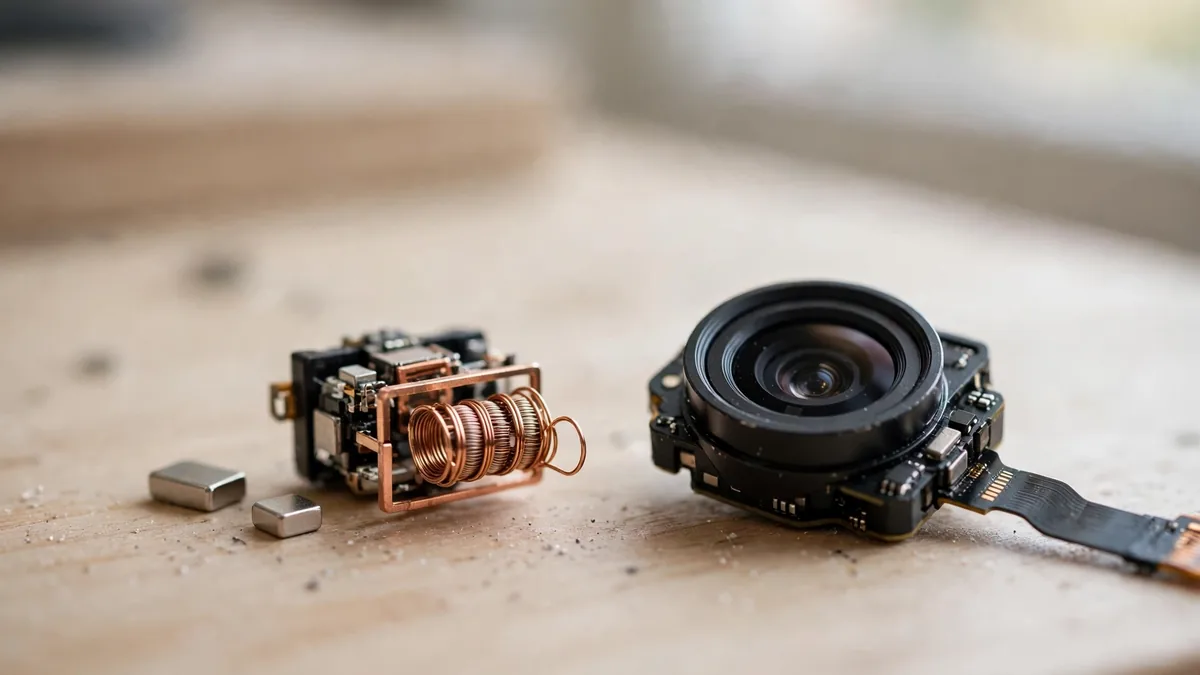
A voice coil motor, the type used in nearly every phone camera, is built from a handful of materials chosen for a single job each. Copper wire, wound into a coil thinner than a human hair, carries the current that creates the magnetic push. Neodymium magnets, the strongest permanent magnets available, provide the field that the coil pushes against. A stainless steel frame holds everything in alignment, while a pair of phosphor bronze springs suspends the lens carrier and pulls it back when the current stops. Ceramic bearings and a plastic lens barrel complete the assembly, each one picked because nothing else survives the heat, the shock and the endless repetition.
Step 1: Winding the copper voice coil
Everything starts with copper wire, sometimes no thicker than forty microns, coated in a thin layer of insulating enamel. A winding machine spins the wire onto a tiny bobbin at high speed, laying down hundreds of turns in a coil barely wider than a grain of rice. Copper was chosen because no other common metal carries more current through such a small cross-section, and because it stays ductile enough to be wound without snapping. The coil that emerges is the muscle of the motor: run current through it and it becomes an electromagnet, ready to push against the magnets around it.
Step 2: Fitting the neodymium magnets
Four small neodymium magnets are glued into the steel frame around the coil, their poles arranged so the magnetic field crosses the coil at right angles. Neodymium iron boron is the strongest permanent magnet material in production, and at this size that strength is not a luxury, it is a requirement. A weaker magnet would need a bigger coil and more current to move the same lens, and there is no room for either.
Step 3: Suspending the lens on phosphor bronze springs
The lens carrier hangs from two flat springs, stamped from phosphor bronze and shaped like tiny spiders. Phosphor bronze was chosen because it bends the same way millions of times without weakening, a property engineers call fatigue resistance. The springs let the carrier slide along the optical axis and nowhere else, so the lens never tilts. When the current stops, the springs pull the lens gently back to its resting position, much like the precision motors in a camera drone that must return to centre after every tiny correction.
Step 4: Machining the steel frame and lens barrel
The frame is stamped and machined from stainless steel, chosen because it is stiff, non-magnetic enough not to disturb the field, and able to survive a drop onto concrete. Inside it, the lens barrel is moulded from a glass-filled liquid crystal polymer, a plastic that holds its shape to within microns across a wide temperature range. The barrel carries one or more glass lens elements, each polished and coated to bend light precisely.
Step 5: Adding the position sensor
Modern autofocus motors do not guess where the lens is; they measure it. A tiny Hall effect sensor sits beside the carrier and reads the position of a miniature magnet attached to it, reporting the lens location thousands of times a second. It is the same idea behind the lens systems in a virtual reality headset, where the optics must stay aligned with the wearer’s eyes to within a fraction of a millimetre.
Step 6: Assembling and testing in a cleanroom
Assembly happens in a cleanroom, because a single speck of dust on a lens element becomes a permanent smudge in every photograph. Workers in gloves and masks place the coil, magnets, springs and barrel together under microscopes, then the finished motor is driven through its full travel range while a laser measures its movement.

Why These Materials Win
Copper was chosen because it moves the most current through the least space, and because it can be wound into coils finer than a hair. Neodymium was chosen because no other magnet delivers the same force from a chip the size of a match head. Phosphor bronze was chosen because it flexes millions of times without tiring, and stainless steel because it protects the whole assembly from drops and heat without bending the magnetic field.
The trade-off is cost and delicacy. Neodymium is expensive and brittle, copper coils are fragile before assembly, and the whole motor must be built in a cleanroom by machines that cost millions. That is why the autofocus in a flagship phone feels instant while a budget camera hunts, and why the same materials appear in the lens assemblies that make a phone camera so costly.
Specifications
| Specification | Detail |
|---|---|
| Motor type | Voice coil motor (VCM), closed-loop |
| Coil wire | Enamelled copper, about 40 microns thick |
| Magnets | Neodymium iron boron, nickel-coated |
| Springs | Phosphor bronze, stamped |
| Frame | Stainless steel |
| Lens barrel | Glass-filled liquid crystal polymer |
| Travel range | About 0.2 to 0.4 millimetres |
| Focus time | Under 0.1 seconds in flagship phones |
| Position sensor | Hall effect sensor with miniature magnet |
| Typical lifespan | Over 100,000 focus cycles |
Price
A single voice coil autofocus motor costs only a few dollars on its own (estimate), but it is sold as part of a complete camera module, and a flagship phone camera module costs roughly 30 to 60 dollars (estimate). Replacement is another story: because the motor is glued and soldered into the module, a failed autofocus motor usually means replacing the whole camera, and a repair shop typically charges 80 to 150 dollars for the part and labour (estimate).
Rare Fact
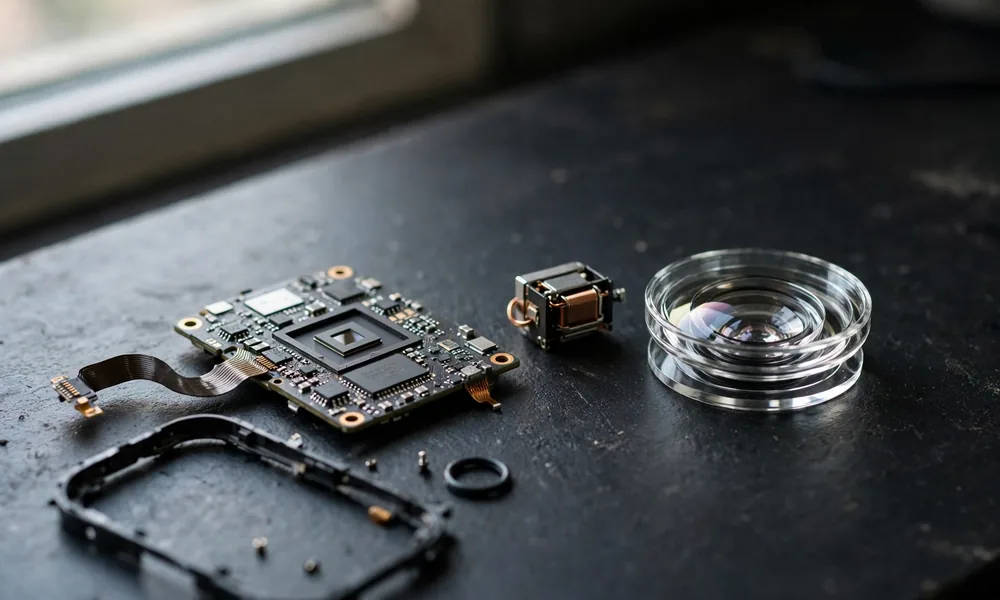
The lens in your phone camera moves less than half a millimetre from one end of its focus range to the other, yet the motor must position it to within about one micron — roughly one fiftieth of the width of a human hair. The motor achieves that precision while the phone is shaking in your hand, in temperatures from freezing to a hot summer day, tens of thousands of times a year.
That is the quiet marvel of the camera autofocus motor: a machine smaller than a fingernail, built from copper, neodymium, bronze and steel, that moves a lens with a precision no human hand could ever match.


