The wind is pushing hard across the headland, gusting in fits that would knock a person sideways, and the little aircraft above the cliff is being thrown around like a leaf. Yet the picture coming back to the screen is calm. The horizon does not tilt. The sea does not judder. The shot looks as though it was filmed from a tripod bolted to the sky, and the only thing holding the camera is a cradle smaller than a coffee mug.
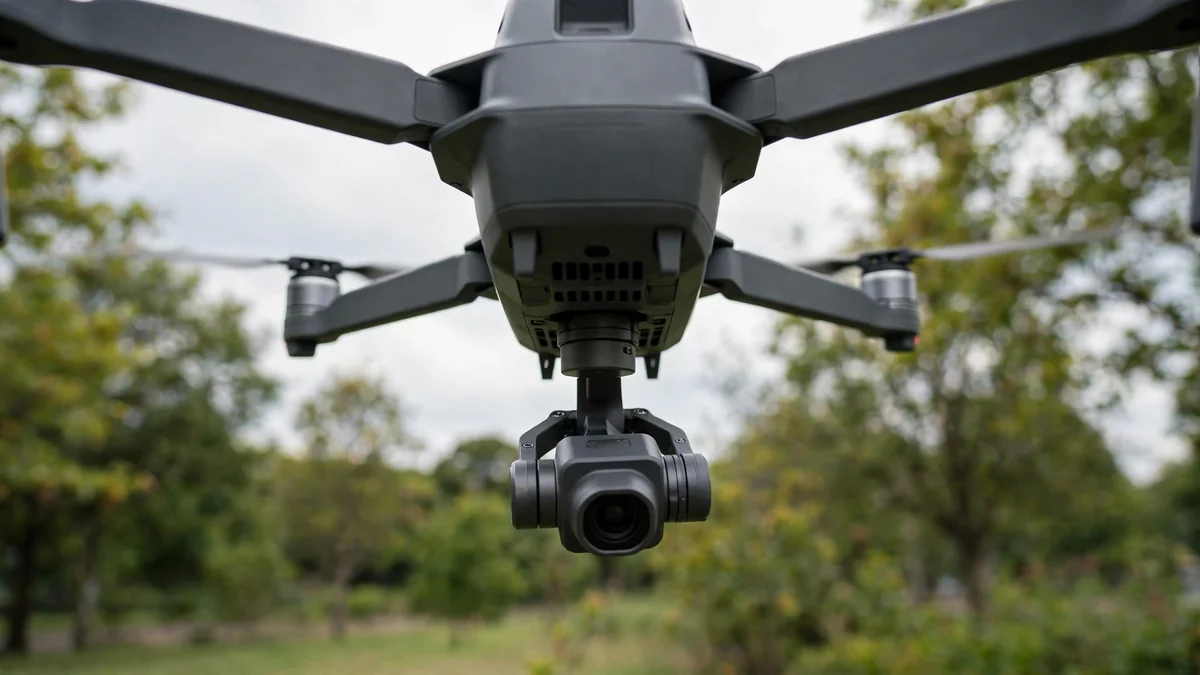
That cradle is the drone gimbal, and it is one of the most quietly demanding pieces of engineering in any flying machine. It has to sense movement, cancel it, and hold a camera steady to a fraction of a degree, hundreds of times a second, while hanging in open air, in cold, in dust, and in vibration from four spinning propellers.
The materials behind it are the reason it works at all. Every part of a gimbal is a compromise between weight, stiffness, damping and cost, and the choices engineers make in those few grams decide whether the footage is cinema-smooth or unusable. Here is what those materials are, and why each one earned its place.
The Materials Behind the Machine
1. Carbon fibre arms
The arms of a modern gimbal are usually carbon fibre, and the reason is stiffness per gram. A gimbal arm has to be rigid enough that it does not flex under the camera’s weight when the drone banks hard, yet light enough that the motors can swing it instantly. Carbon fibre composite is roughly five times stiffer than steel for the same weight, and it damps high-frequency vibration better than aluminium. The trade-off is cost and brittleness: carbon fibre does not bend before it breaks, so a hard crash can crack an arm that a metal one would only dent. That is why the arms are laid up with the fibres running along the load path, and why the joints, where the fibres are cut, are reinforced with extra plies.
2. Aluminium alloy frames
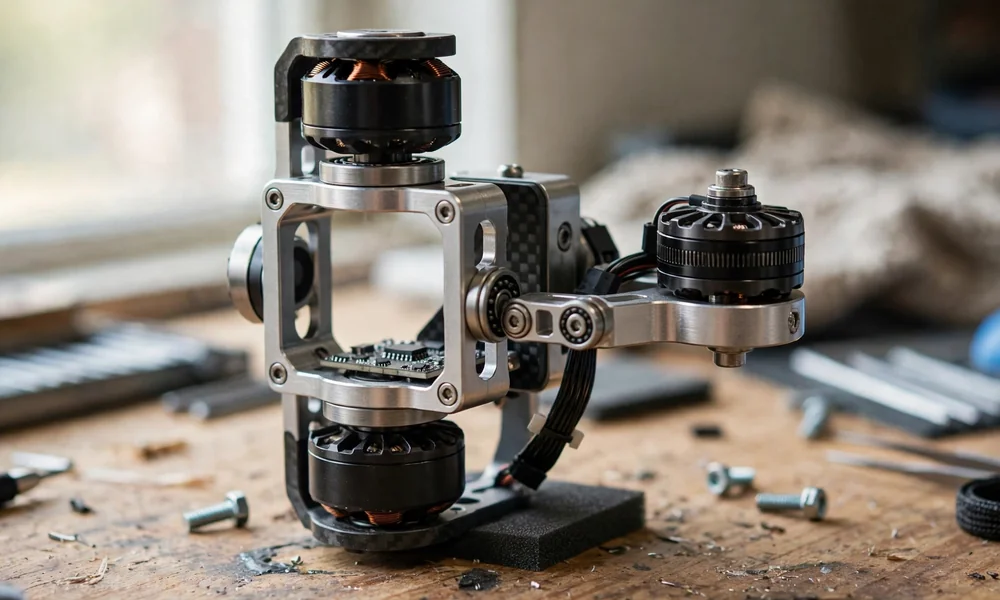
Where carbon fibre is too brittle or too hard to machine precisely, engineers use aluminium alloy, most often 7075 or 6061. The motor mounts and bearing housings are milled from solid aluminium because the bearing seats need tolerances measured in hundredths of a millimetre, and carbon fibre cannot hold that kind of precision. Aluminium also sheds heat from the motors, which matters when the gimbal is working hard in a hover. The metal is usually anodised, giving it a hard, corrosion-resistant skin that survives rain, sea spray and the knocks of being thrown into a backpack.
3. Brushless motors with copper windings
The three motors that drive the pan, tilt and roll axes are brushless outrunners, and their heart is copper. Copper windings carry the current that creates the magnetic field, and copper’s low resistance means less of the battery’s energy turns into waste heat. The magnets are neodymium, the strongest permanent magnets available, which lets a motor the size of a thimble produce enough torque to hold a camera dead still against the wind. The motor bells are often steel or aluminium, and the windings are coated in enamel that must survive both heat and vibration without cracking.
4. Damping balls and silicone mounts
Between the gimbal and the drone body sits a layer of soft material, usually silicone rubber balls or a moulded silicone damper plate. The propellers shake at a high frequency, and if that vibration reaches the camera the footage shimmers with a wavy distortion called jello. Silicone is chosen because it stays flexible across a wide temperature range and absorbs a broad band of frequencies without going soft in summer heat or stiff in winter cold. The stiffness of the dampers is tuned to the weight of the camera: too soft and the gimbal sways, too hard and the vibration gets through. The motors that carry the load, and the numbers that describe them, are covered in our guide to drone motor specs.
5. The camera cradle and balance
The camera itself sits in a cradle that must grip it without flexing and without adding weight. Many cradles use a magnesium alloy, lighter than aluminium and stiff enough to hold a heavy lens, or a glass-filled nylon for smaller cameras. The balance of the whole assembly matters as much as the materials: a perfectly balanced gimbal needs almost no motor effort to hold still, so the motors stay cool and the battery lasts longer. How that balance works in flight is explained in our guide to how a drone gimbal works.
6. Sensors, wiring and weather sealing
The gimbal’s senses come from an inertial measurement unit, a tiny chip holding gyroscopes and accelerometers built on silicon, mounted on a flexible circuit board that can bend without breaking. The wiring that connects it all uses fine stranded copper in silicone insulation, chosen because it stays flexible when the gimbal moves thousands of times a flight. Around the outside, rubber O-rings and gaskets keep out rain and dust, and the circuit boards are coated in a conformal lacquer that stops condensation from shorting them when the drone climbs from warm ground into cold air. Every gram of sealing is weighed against the payload it costs.
Key Specs at a Glance
| Part | Typical material | Why it is used |
|---|---|---|
| Arms | Carbon fibre composite | Maximum stiffness per gram |
| Motor mounts | 7075 aluminium alloy | Precision machining, heat shedding |
| Motors | Copper windings, neodymium magnets | High torque in a tiny package |
| Dampers | Silicone rubber | Broad-band vibration absorption |
| Bearings | Stainless steel, ceramic hybrid | Near-zero play, smooth rolling |
| Cradle | Magnesium alloy or glass-filled nylon | Light, stiff camera grip |
| Stabilisation accuracy | ±0.01 degrees (typical) | Cinema-smooth footage |
What It Costs
A camera drone with a proper three-axis gimbal is not a cheap toy, but it is far cheaper than the helicopter shots it replaced. A capable consumer drone with a stabilised camera typically costs around $500 to $800, while a professional model with a larger sensor and a heavier gimbal runs from about $1,500 to $2,200 (estimates, prices vary by model and region). A replacement gimbal assembly alone can cost $150 to $400, and a single brushless gimbal motor around $30 to $60.
A Rare Fact
Here is something few pilots realise: the gimbal on a filming drone is often more precise than the guidance systems on early spacecraft. A good consumer gimbal holds its camera within one hundredth of a degree, which is roughly the angle subtended by a coin seen from a kilometre away. It does that while hanging from a buzzing aircraft in the wind, using motors smaller than your thumb. The spec sheet numbers behind that precision are broken down in our guide to drone gimbal specs, and the next time you watch a drone shot glide over a cliff edge, remember that the smooth picture is not the drone flying well. It is the gimbal refusing to move at all.