The wind is gusting across the clifftop, strong enough to push the drone sideways and tilt it like a paper plane, and yet the video coming back to the pilot’s screen is perfectly smooth. The horizon never wobbles. The sea below glides past as if the camera were sliding along an invisible rail. Nothing in the shot betrays the fight going on above it.
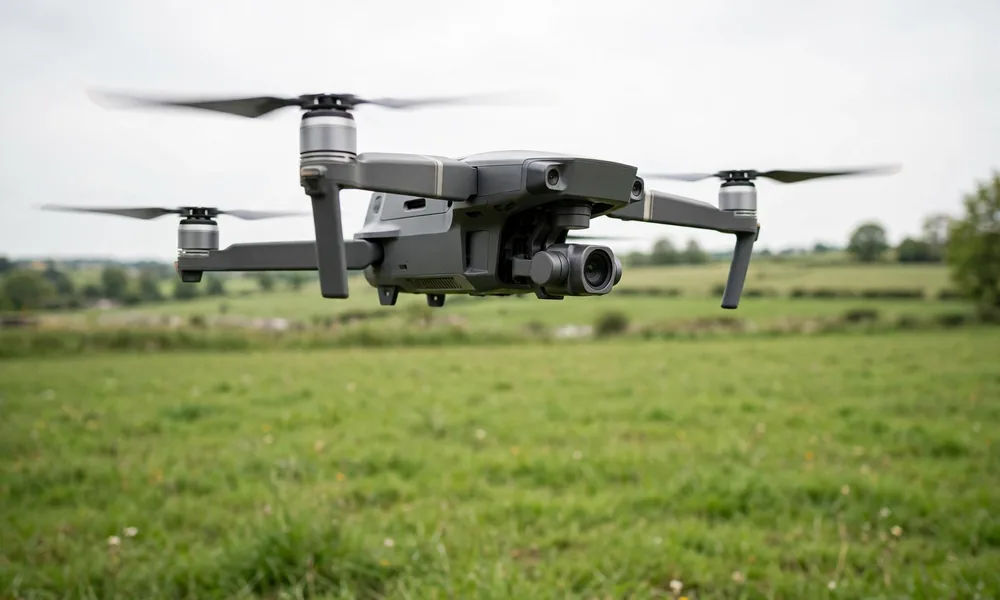
That calm is not luck and it is not software trickery added afterwards. It is a small machine bolted beneath the drone, working hundreds of times a second to cancel out every shake, tilt, and jolt before it reaches the lens. The machine is a gimbal, and it is the reason a flying camera can produce footage that looks as steady as a tripod shot.
A drone gimbal is a three-axis stabiliser: a cradle that holds the camera while three small motors turn it in exactly the opposite direction to every movement of the aircraft. Here is how it does it.

How It Works
Step 1: Feeling every movement
Everything starts with sensing. Mounted on the camera plate is a tiny inertial measurement unit, a chip that combines a gyroscope and an accelerometer. The gyroscope measures how fast the camera is rotating, and the accelerometer measures which way gravity is pulling. Together they report the camera’s position and movement thousands of times a second, building a constant picture of tilt, roll, and shake. Without this stream of measurements the gimbal would be blind, so the sensor is mounted as close to the camera as possible and fixed firmly in place.
Step 2: The controller does the maths
The sensor data flows to a small control board, where a processor runs a control loop that compares where the camera actually is with where it should be. The difference between the two, called the error, is turned into a command for the motors. This loop repeats hundreds of times a second, and it is tuned with great care: too gentle, and the camera lags behind the drone’s movements; too aggressive, and the motors overshoot and the picture starts to shudder. It is the brain of the whole system, and its speed is what makes the footage look effortless.
Step 3: Three motors answer at once
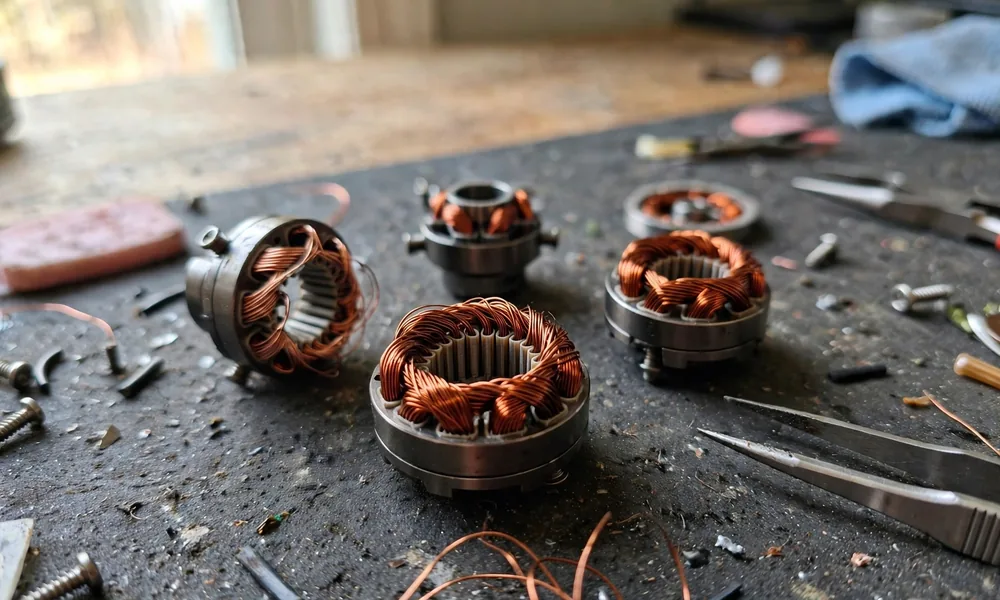
The corrections are carried out by three brushless motors, one for each axis of movement. The pan motor turns the camera left and right, the tilt motor nods it up and down, and the roll motor keeps the horizon level. Each motor turns in the opposite direction to the drone’s movement, by exactly the right amount, at exactly the right moment. Brushless motors are used because they can make tiny, smooth adjustments without the juddering of a geared motor, and because they can hold a position steadily without spinning. The motors that lift a drone into the air are a different breed, and their specifications are laid out in drone motor specs explained.
Step 4: Balancing the camera perfectly
Before any of this can work, the camera must be balanced. The gimbal is adjusted until the camera’s centre of gravity sits exactly on the tilt and roll axes, so that it hangs level on its own with the power off. A balanced camera needs almost no effort from the motors to hold still, which means smoother footage, less heat, and longer battery life. An unbalanced camera forces the motors to fight gravity constantly, and the footage shows it: the motors hum, the battery drains faster, and the horizon slowly sags.
Step 5: Damping the buzz before it starts
Not all vibration can be corrected by motors, so the gimbal is protected from it first. Rubber dampers sit between the gimbal base and the drone’s body, soaking up the high-frequency buzz of the spinning propellers before it reaches the camera. The cables that carry power and video are threaded through the hollow arms on gentle curves, so they flex freely instead of tugging the camera as it moves. This layered defence matters because the tiny shakes a motor cannot catch are exactly the ones that make footage look cheap, a fine tremble that no amount of digital stabilisation can fully remove.
Step 6: Following the pilot’s eye
A gimbal does more than hold still. In follow mode, it tracks the pilot’s commands, panning smoothly when the drone turns and tilting gently when the pilot pushes the stick, while still cancelling out every unwanted shake. The controller blends the pilot’s input with the stabilisation, so the camera moves like a cameraman’s hand rather than a robot’s arm: it eases into a pan, glides, and settles without a jerk. Some gimbals also lock onto a subject, turning the camera to keep a moving boat or a running athlete centred in the frame while the drone flies a completely different path. The full factory story, from machined arms to calibrated units, is told in how drone gimbal is made.
| Axes | Three: pan, tilt, and roll, each with its own brushless motor |
| Sensors | Gyroscope and accelerometer reporting thousands of times per second |
| Motors | Three brushless motors, direct drive with no gears |
| Control | Dedicated processor running a control loop hundreds of times per second |
| Stabilisation accuracy | Within a fraction of a degree under normal flight conditions |
| Weight | Roughly 200 to 500 grams for a typical camera drone gimbal |
| Payload | From a small action camera to a mirrorless camera weighing over a kilogram |
| Vibration protection | Rubber dampers between the gimbal base and the drone body |
What Does a Drone Gimbal Cost?
A three-axis gimbal built into a consumer camera drone is estimated at roughly $150 to $600 as a replacement part, while a professional handheld or drone-mounted cinema gimbal for a heavy camera is estimated at $1,000 to $5,000 or more. The price reflects precision machining, hand balancing, and the fact that each unit is individually calibrated rather than simply assembled. A cheap gimbal can look identical in a photograph, but its motors hum, its sensors drift, and the footage shows every gust of wind. For filmmakers, the gimbal is often worth more than the drone carrying it.
A Rare Fact
The gimbal is far older than the drone. The same ringed cradle was described in the 1500s to keep a ship’s compass level while the vessel rolled at sea, and later versions kept lamps, chronometers, and cameras steady aboard ships and aircraft. Early drone pilots simply bolted those old ideas under their aircraft and shrank them. The breakthrough came when motors and sensors became small and fast enough to fly, and when control software became quick enough to correct movement in thousandths of a second. A mechanism invented to keep a compass readable on a rolling deck now steadies a camera in the sky, and it does the job better than the big rigs ever did.
The next time a drone shot glides over a coastline without a tremor, it is worth remembering what is happening under the aircraft. Three tiny motors are turning, sensors are listening, and a small computer is correcting the world hundreds of times a second. The drone does the flying. The gimbal does the seeing, and it never blinks. The small motors that focus a camera lens face a similar battle with precision, as camera autofocus motor materials engineering explains.


