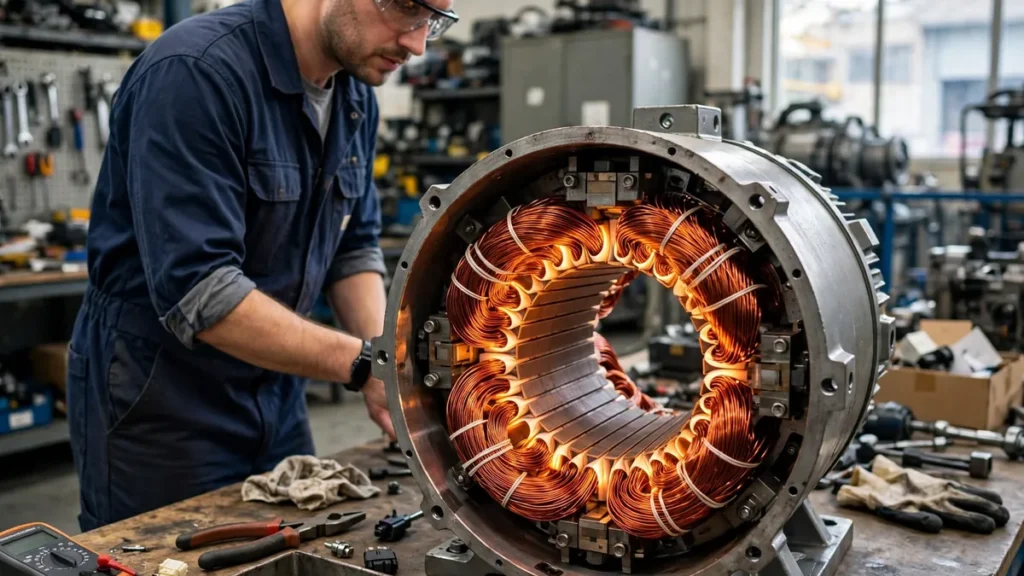
Open up an electric car motor and the first thing you see is copper, a dense forest of it. The stator, the part that stays still, is a ring of steel packed with copper windings, hundreds of turns of wire or bars arranged with a precision that looks almost woven. There are no pistons, no valves, no explosions. Just copper, steel and magnetism, and yet this quiet ring can produce more torque than a V8 engine, instantly and silently.
The windings are the motor’s voice. They are the coils that turn battery current into a rotating magnetic field, and that field drags the rotor around with it. Every number that matters about an electric car, its acceleration, its top speed, its efficiency, its range, traces back to decisions made in the winding: how thick the copper is, how the turns are arranged, and how well they are cooled. Manufacturers guard their winding designs the way engine makers once guarded their cylinder heads.

How It Works
Step 1: Turning current into magnetism
A winding works because of a simple law of physics: an electric current flowing through a wire creates a magnetic field around it. Wind the wire into a coil and the fields of all the turns add together, making a much stronger magnet. The stator holds three sets of windings, one for each phase of the alternating current from the inverter, and when the current flows through them in sequence, the magnetic field rotates around the stator.
Step 2: Packing copper into the slots
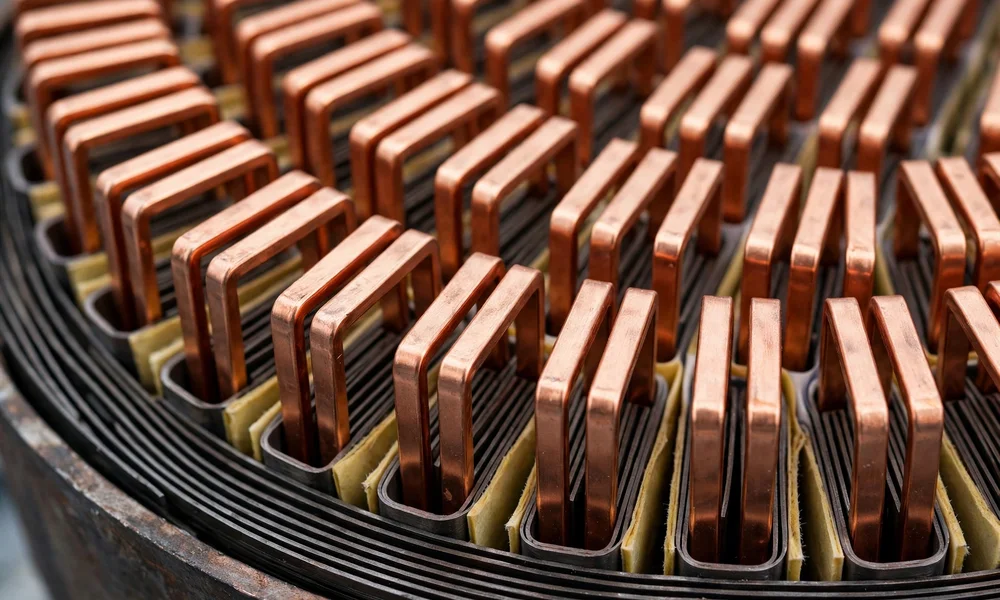
The stator is a stack of thin steel sheets, called laminations, with slots cut around its inner edge. The winding lives in those slots, and the great engineering challenge is to fill them with as much copper as possible. Engineers measure the fill factor, the percentage of the slot actually occupied by copper. Round wire leaves gaps between the turns and typically reaches around forty percent, while rectangular hairpin bars fit together almost perfectly and can reach seventy percent or more.
Step 3: Choosing hairpin or round wire
The hairpin winding gets its name from its shape: each conductor is a U-shaped bar of rectangular copper, bent like a hairpin, dropped into two slots, and then welded to its neighbours at the end of the stator. Hairpins are harder to manufacture, needing precise bending machines and laser welding, but they carry more current, cool better and let the motor spin faster. Round wire is cheaper and still appears in smaller motors and hybrids, but for a high-performance EV the hairpin has become the standard. The winding is the heart of the machine described in the electric motor explained.
Step 4: Insulating every turn
Copper conducts electricity, so every turn of the winding must be insulated from its neighbours or the motor would short itself out. Each wire carries a thin enamel coating, the slots are lined with insulating paper, and the whole winding is often vacuum-impregnated with resin that fills every remaining gap. That resin locks the winding in place against vibration and carries heat away from the copper into the stator steel.
Step 5: Cooling the copper
All the current flowing through the winding produces heat, and heat is the enemy of efficiency. A motor’s power is ultimately limited by how fast it can shed that heat. Many EV motors circulate oil directly over the winding ends, spraying the hottest part of the copper with cooling fluid, while others rely on a water jacket around the stator housing. The best systems keep the winding below about 180 degrees Celsius even under full load.
Step 6: Connecting to the inverter
The winding does not work alone. Its three phases connect to the inverter, which turns the battery’s direct current into the precisely timed alternating current the winding needs, switching thousands of times a second. The number of turns in the winding sets the motor’s voltage and torque character, and the inverter’s switching sets its speed. A motor wound for high torque has more turns of thinner wire, while one wound for high speed has fewer turns of thicker wire. It is the same partnership described in how the EV inverter works.
The Specs, Explained
The specification sheet for a motor winding is a mix of electrical and thermal numbers. Fill factor tells you how efficiently the slots are packed, and current density tells you how hard the copper is working. The table below shows typical figures for a modern hairpin-wound EV motor, against a round-wire motor and a small hybrid motor.
| Property | Hairpin EV motor | Round-wire EV motor | Small hybrid motor |
|---|---|---|---|
| Slot fill factor | 65–75% | 40–45% | 35–45% |
| Peak power | 150–350 kW | 80–200 kW | 30–80 kW |
| Peak torque | 300–600 Nm | 200–400 Nm | 100–250 Nm |
| Maximum speed | 16,000–20,000 rpm | 12,000–15,000 rpm | 10,000–13,000 rpm |
| Current density | 15–25 A/mm² | 10–18 A/mm² | 8–15 A/mm² |
| Insulation class | Class H (180 °C) | Class H (180 °C) | Class F (155 °C) |
| Efficiency at peak | 96–97% | 94–96% | 92–95% |
| Copper mass | 12–20 kg | 10–18 kg | 4–8 kg |
The fill factor is the number to look at first, because it explains the hairpin’s advantage in one figure: seventy percent of the slot filled with copper against forty percent for round wire means far more current in the same space, which means more torque from the same size motor. Current density is the companion number, telling you how many amps each square millimetre of copper carries. At ninety-six to ninety-seven percent efficiency, an EV motor wastes only a few percent of its energy as heat, against roughly thirty percent for a good petrol engine. It all draws power from the pack, so the winding’s appetite is set by how the EV battery pack is made.
What It Costs
A motor winding is not sold separately, so its price is hidden inside the price of the whole motor, but the numbers are still worth knowing. The copper alone in a typical EV motor stator costs roughly $120–$250 at current metal prices, and the finished winding, including the steel laminations, insulation, resin and labour, typically adds $400–$900 to the cost of the motor.
For the owner, the winding is mercifully cheap to live with, and these are estimates. There is nothing to service: no brushes to replace, no oil to change inside the motor, and a winding that never overheats should last the life of the car. If a winding does fail, the repair is normally a full motor replacement at $3,000–$8,000, because rewinding a hairpin stator by hand is rarely economical. Such failures are rare, and most EV motors will outlast the car around them.
A Rare Fact
The hairpin winding, now the cutting edge of EV engineering, is not new at all. It was used in the earliest electric motors of the late nineteenth century, when hand-wound coils were the only way to build a motor, and it appeared in the starter motors of petrol cars for most of the twentieth century. It was abandoned for traction motors because round wire was easier to wind by machine, and it only came back when robots learned to bend and weld hairpins precisely enough for mass production.
That is the quiet story of the EV motor winding: a technology so simple in principle that a schoolchild can demonstrate it with a battery and a coil, and so demanding in practice that it takes robots, lasers and oil cooling to do it properly. The next time an electric car launches silently and instantly, remember the copper forest inside it, turning current into magnetism, and magnetism into motion.