On a quiet morning in a gigafactory, a flat steel tray the size of a dining table glides down a conveyor line. It does not look like much yet — just a shallow metal box with a few brackets. Twelve hours later, that same tray will hold enough stored energy to push a two-tonne car three hundred miles down a motorway, in silence, with nothing but electricity. It is the battery pack, and it is the single most expensive, most complex, and most carefully guarded part of any electric car.
Most drivers never see one. The pack lives under the floor, sealed shut, doing its work in the dark. Yet everything about an electric car — its range, its speed, how fast it charges, even how safe it is in a crash — comes back to this one component. Building it is a strange mix of chemistry, precision engineering, and old-fashioned metalwork, carried out in rooms cleaner than most hospitals. Here is how it is made.

How It’s Made
Step 1: Making the cells
Every pack starts with thousands of individual battery cells, each one a small sealed cylinder or pouch holding a carefully balanced chemical recipe. Inside, thin sheets of anode and cathode material — usually graphite on one side and a nickel, manganese and cobalt blend on the other — are coated, dried, and rolled or stacked with a separator between them. The coating machines lay these layers down to a thickness measured in microns, because a single uneven patch can become a weak spot that shortens the cell’s life. Once filled with electrolyte and sealed, each cell is charged and discharged for the first time, a slow process called formation that can take days. Cells that fail any test are rejected before they ever meet a pack.
Step 2: Building the modules
Good cells are grouped into modules, the pack’s building blocks. A typical module holds a dozen or more cells, wired together and held in a rigid frame with cooling channels running between them. Workers — or more often, robots — place the cells with millimetre precision, then connect them with laser-welded busbars, flat strips of copper or aluminium that carry the current. Sensors are fitted at this stage too, tiny thermistors that will watch the temperature of every group of cells for the rest of the car’s life. A module on its own already stores enough energy to run a house for a day, so every connection is tested twice.

Step 3: Assembling the pack tray
The tray itself is a feat of engineering. Usually made from extruded aluminium or high-strength steel, it is designed to be both a home for the modules and a shield. Crash beams run across it, and the floor of the pack doubles as the floor of the car, which is why electric cars feel so solid and low. Modules are lowered into the tray and bolted down, then wired together into one high-voltage system. A single pack can run at 400 or 800 volts, so the wiring is routed with generous separation, and every joint is insulated and checked. The battery management system — the pack’s brain — is mounted at this stage, a small computer that will balance the cells and guard against overcharging.
Step 4: Cooling and sealing
Heat is the enemy of a battery, so the cooling system is built in before the lid goes on. Thin cold plates or snaking coolant channels sit beneath or between the modules, carrying a water-glycol mix that pulls heat away during fast charging and hard driving. The same thermal thinking that keeps cooling systems working under sustained performance applies here: a pack that stays cool charges faster and lasts longer. Once the cooling is plumbed and pressure-tested for leaks, the lid is fitted with a gasket and torqued down in a precise pattern. The seal has to survive rain, dust, and years of vibration without letting a single drop inside.
Step 5: Testing every pack
No pack leaves the factory untested. It is charged and discharged on a test rig, and engineers watch how every module behaves — any cell group that drifts from the others is flagged. The pack is checked for insulation faults, given a leak test, and sometimes shaken on a vibration table that simulates a lifetime of rough roads. Crash safety is tested on the design long before production, with packs dropped, crushed, and pierced to prove they will not catch fire. Only when the pack passes every check is it given its serial number and cleared for the car.
Step 6: Fitting it to the car
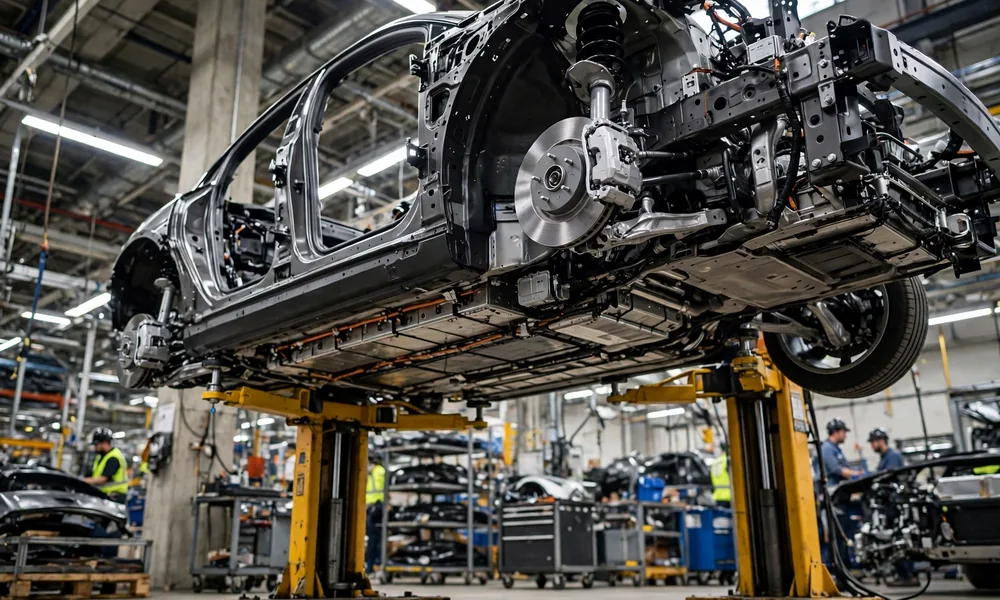
The finished pack is lifted from below into the car’s body on the main assembly line and bolted to the chassis. It connects to the electric motor that turns its stored energy into motion, to the charging port, and to the car’s computers, all through a handful of sealed high-voltage connectors. The moment it is plugged in, the car wakes up for the first time. From that point on, the pack and the car are one machine, and the battery will be the part that defines the car’s character for the next decade or more.
Specs
| Specification | Typical figure |
|---|---|
| Pack capacity | 60–100 kWh in most family EVs |
| Cell count | Roughly 3,000–7,000 cells per pack |
| Pack voltage | 400 V, or 800 V in newer models |
| Pack weight | 400–600 kg, about a quarter of the car |
| Energy density | Around 150–270 Wh per kg at cell level |
| Cooling | Liquid cold plates, water-glycol loop |
| Expected life | 8–15 years, often 150,000 miles or more |
| Charging | 10–80% in roughly 18–40 minutes on DC fast charging |
Price
The battery pack is the priciest part of an electric car, typically accounting for around a third of the vehicle’s cost. As an estimate, a replacement pack for a mainstream electric car costs roughly $5,000 to $15,000, while a large long-range pack can cost $20,000 or more — these are estimates, and the real figure depends on capacity, chemistry, and the carmaker. Prices have fallen sharply over the past decade as factories have scaled up, and that fall is the main reason electric cars keep getting cheaper.
A Rare Fact
Some of the world’s biggest battery factories use so little human labour on the cell lines that the cleanest rooms are almost empty — the air is kept cleaner than an operating theatre not for the workers, but because a single speck of dust inside a cell can grow into a short circuit years later. The most advanced packs are built in rooms where the air is filtered and dried so thoroughly that a person standing inside would feel their skin dry out within minutes.
The battery pack is where chemistry becomes a car. Small electric bikes face the same challenge on a smaller scale — see how e-bike range depends on more than battery size — but in a full-size EV, the pack is the heart, the floor, and the fuel tank all at once. The next time an electric car glides past in silence, remember the thousands of cells, the laser welds, and the sealed steel tray underneath the floor that make it possible.


