A cruise ship kitchen — the galley, as sailors call it — is a restaurant kitchen scaled up until it stops looking like a kitchen at all. On a large ship it may cover two decks, employ more than a hundred cooks, and serve 15,000 meals a day to several thousand passengers and crew. It does this in a space that would be cramped for a land restaurant serving a tenth as many people, while the whole building is moving, sometimes rolling in a swell, and hundreds of miles from the nearest shop. Understanding how it works means understanding logistics as much as cooking: the food is only the last step in a chain that starts weeks before the ship sails.
The layout of the galley
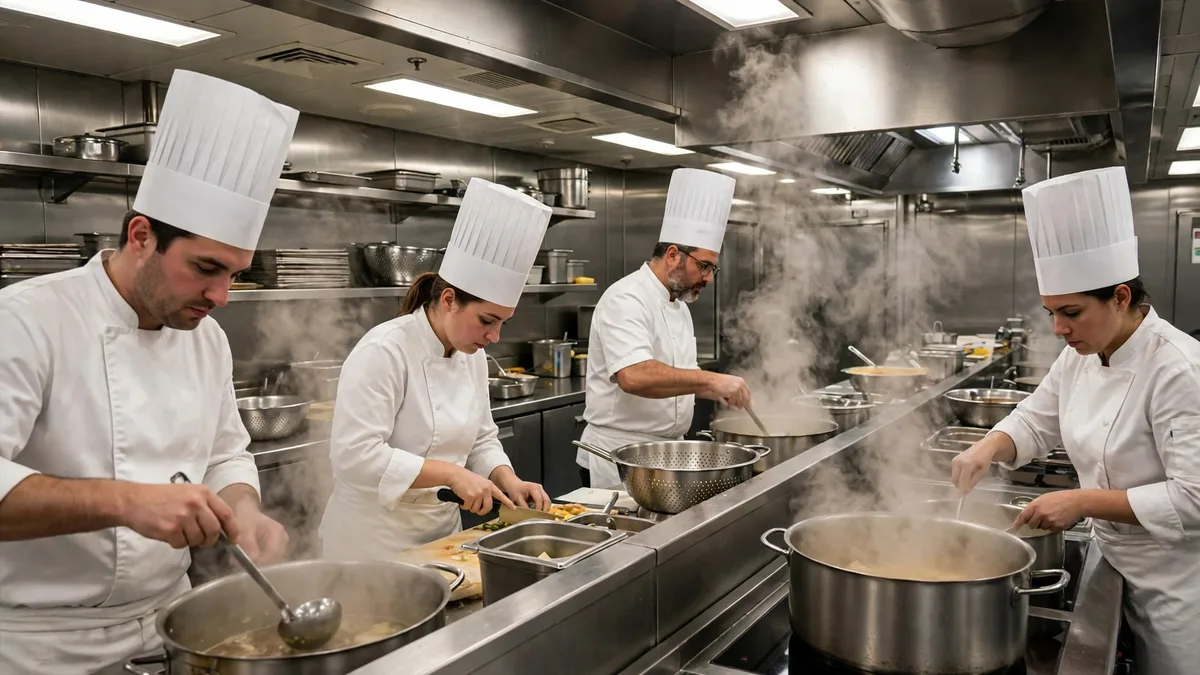
The galley is laid out like a factory, with food moving in one direction from delivery to plate. At one end are the cold rooms and dry stores, where provisions are kept. Next come the preparation areas, divided by task: a butchery for meat, a fish preparation area, a vegetable preparation area, a bakery and a pastry section. Then comes the hot line, where the cooking happens, with ranges, ovens, grills and fryers in a row, and finally the service area, where dishes are plated, garnished and passed to the waiters. Each section has its own staff, its own equipment and its own hygiene rules, and food never flows backwards through the line.
Provisioning: loading a floating town
Provisioning starts weeks before the voyage, when the ship’s provision master orders food based on the passenger count, the menus and the itinerary. The order is enormous — pallets of produce, meat, dairy, bread, frozen goods and drinks — and it is delivered to the ship in the hours before sailing, when the ship is alongside and the loading doors are open. Cranes and forklifts move the pallets into the stores, where a team checks every delivery against the order, weighs it, and stows it in the right cold room before the ship sails. A late delivery or a short count cannot be fixed at sea, so the loading is checked twice.
Fresh produce is the hardest part. Fruit and vegetables have to last a week at sea, so they are ordered in stages of ripeness: some ready to use on the first day, some that will ripen by the fourth or fifth. Bananas, avocados and tomatoes are the classic examples, and the provision team knows exactly how many days each will take. Bread is baked on board every day, in quantities that would keep a village bakery busy, and pastries are made fresh for each service. The best cruise ship restaurants, ranked are the public face of all this work, but the ranking is decided as much in the stores and the cold rooms as it is in the dining room.
A day in the galley
The galley’s day starts long before the passengers wake. The bakers come on first, often in the middle of the night, to mix dough and fire the ovens so that fresh bread and pastries are ready for breakfast. The breakfast cooks follow, preparing eggs, bacon, cereals and fruit for several thousand people, much of it served in a buffet where the food has to be replenished constantly without ever running out or sitting too long. By the time the passengers are eating, the lunch preparation is already under way.
Lunch and dinner are the two big services, and the galley works in a rhythm built around them. The morning is for preparation: vegetables peeled and cut, meat portioned, sauces made, desserts finished. The afternoon is for the final cooking, with the hot line at full power and every station manned. Service itself is a burst of intense activity, with waiters calling orders, plates going out in waves, and the pass — the counter where finished dishes are checked and collected — running like a checkpoint. A single waiter may carry a dozen plates at a time, and the galley has to produce them in the order they are called, at the right temperature, without mistakes.
How the food reaches the table
Serving thousands of people at once is a problem of timing. In the main dining room, passengers are seated in sittings, so the galley knows how many covers it must produce and when. Orders are taken by waiters and relayed to the galley, often through a computer system that prints the order at the right station. The cold starters go first, then the hot mains, then the desserts, each timed so that the food arrives hot and the plates come back cleared in time for the next course. The system works because it is rehearsed daily, with the same menu cycle repeated across the voyage.

The people who run it
The galley is run by the executive chef, who is responsible for the menus, the provisioning and the whole kitchen brigade. Under the executive chef are the sous chefs, each in charge of a section — the hot line, the pastry, the bakery, the cold kitchen — and under them the cooks, the prep staff and the cleaners. On a large ship the brigade can number 150 people or more, drawn from many countries, working in shifts that cover 18 hours or more a day. The crew’s own mess has its own cooks, feeding the crew with different food on a different schedule.
Life in the galley is demanding. The work is physical, the hours are long, and the ship’s movement adds a layer of difficulty that land kitchens never face. Cooks learn to brace themselves against a roll without thinking about it, to catch a sliding pan before it falls, and to keep working when the ship is pitching in weather that has the passengers in their cabins. The reward is a career that travels: a good cruise ship chef can work on ships all over the world, and the experience is valued in hotels and restaurants ashore. The case for quieter cruise ships touches on the same human side of the ship — the crew live and work in the noise and vibration of the vessel, and the galley is one of the loudest places on board.
Feeding a small town at sea
The best way to understand a cruise ship kitchen is to stop thinking of it as a restaurant and start thinking of it as a town’s food supply. It orders like a supermarket, stores like a warehouse, cooks like a factory, and serves like a restaurant — all at the same time, in a moving building, with no resupply. The cooks are only the visible part: behind them are the provision master, the storekeepers, the bakers, the cleaners and the engineers who keep the cold rooms cold and the ovens hot. The luxury trawler yacht and how it works shows the same self-sufficiency at a smaller scale, a vessel that must carry everything it needs and make it last until the next port.