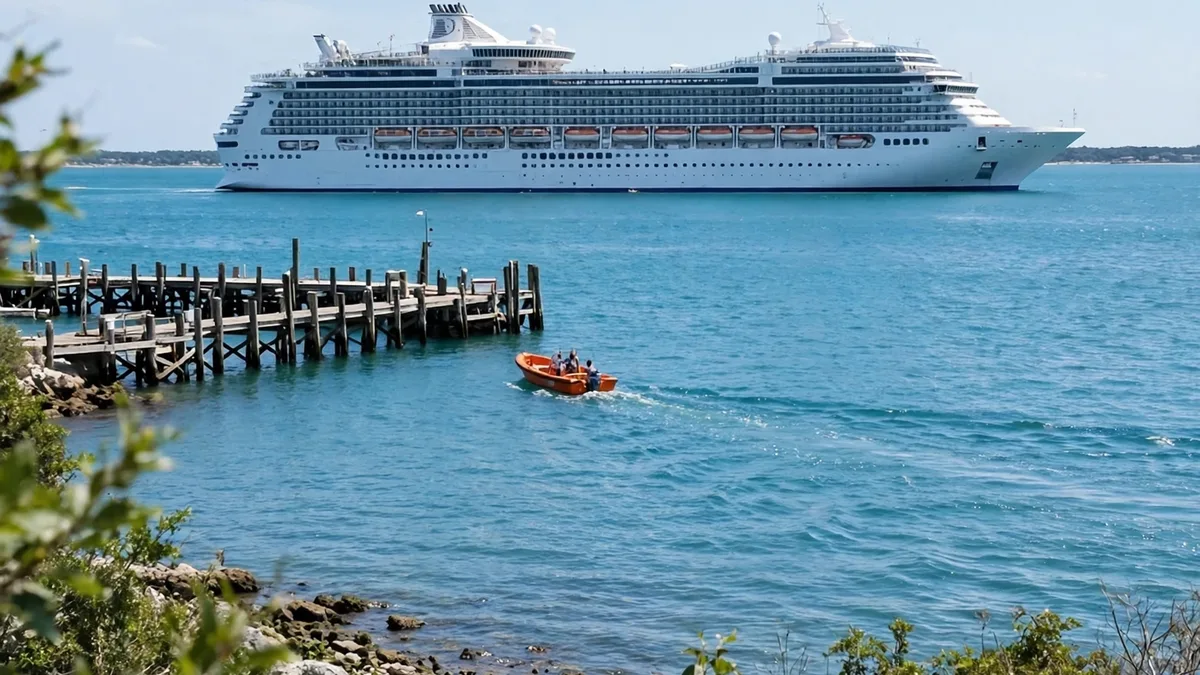
A cruise ship tender is a small boat that carries passengers between a cruise ship and the shore when the ship cannot dock. Many of the world’s most popular cruise ports are too shallow, too small, or too busy for a large ship to come alongside a pier, so the ship drops anchor offshore and the tenders do the work of the gangway, running back and forth all day. Tender operations are the unglamorous logistics that decide whether a port day runs smoothly or falls apart, and a big ship can move thousands of people ashore and back in a few hours using them.
How a tender day is planned
Tender operations start the night before, when the ship’s officers plan the schedule for the next port. The plan depends on how many passengers want to go ashore, how far the anchorage is from the pier, how many tenders are available, and how long each round trip takes. A typical round trip, from the ship to the pier and back, takes between twenty and forty minutes, including loading and unloading at both ends. A ship with six tenders running continuously can move roughly a thousand passengers an hour, which means a ship of three thousand passengers needs three hours to get everyone ashore, and three hours to bring them back.
Because the numbers are so large, passengers are not allowed to simply turn up and board. The ship issues tender tickets, either paper tickets handed out in the morning or a place in a numbered group called through the ship’s announcement system. Passengers on organised shore excursions go first, because their tours have fixed departure times, followed by passengers who booked independently, and then everyone else. The system is fair in theory and frustrating in practice, which is why tender ports are consistently the least popular part of a cruise itinerary in passenger surveys.
Launching a tender: the davits
The most dramatic part of tender operations is the launch. The ship’s tenders sit on the boat deck, high above the water, held in cradles on davits, the cranes that lower them over the side. To launch, the crew swings the davit out over the water, lowers the tender on steel falls, the wire ropes that carry it, and sets it down gently on the surface. Then the crew releases the falls, the tender’s engine starts, and it pulls away from the ship’s side.
Recovering a tender is the same process in reverse, and it is harder, because the tender has to come alongside the moving ship, hook onto the falls, and be lifted clear of the water while the waves push it against the hull. In rough weather, the crew uses a painter, a rope from the tender to the ship, to hold the boat steady while the hooks are attached. The whole operation is practised constantly, because the same davits and the same crew launch the lifeboats in an emergency, and a lifeboat launch that goes wrong is far worse than a delayed tender.
The tender ride: what passengers experience
For passengers, the tender ride is a short boat trip, usually between ten and twenty minutes, and it is often the most memorable part of the day. The tender leaves the ship’s side, crosses open water, and comes into a small harbour or a floating pontoon, where passengers step ashore. The boats are open or partly covered, with rows of bench seats and a crew member at each end to help passengers board. There is no shade on most tenders, no refreshments, and no toilet, which is why the cruise lines warn passengers to use the facilities on the ship before they board.
Boarding is the slow part. Passengers step from the ship’s shell door, a large opening in the hull at water level, onto the tender, which is moving with the waves. Crew members hold passengers’ hands and count them aboard, because the tender has a strict capacity and the count must match the manifest. Elderly passengers and those with mobility problems get extra help, and wheelchairs are carried aboard by the crew. In rough weather, boarding can be genuinely frightening, and the crew will slow the operation or stop it rather than risk a fall between the ship and the boat.
The ride itself is usually smooth, because the tender stays in the sheltered water between the ship and the shore, but it can be bumpy in a chop. The coxswain drives at a moderate speed, around eight to ten knots, because a faster speed throws spray over the passengers and makes the boat harder to handle in a crowded anchorage. At the pier, the tender ties up, passengers disembark onto a pontoon or a set of steps, and the boat turns around for the next load. The best electric yacht tenders are built for a similar job on a much smaller scale, but the principles of a small boat working alongside a large one are the same.

Safety rules and what can go wrong
Tender operations are governed by strict safety rules, because a small boat next to a large ship is one of the riskiest places on a cruise. Every passenger wears no life jacket on a tender, which surprises people, but the rules say that life jackets are carried on board and the crew is trained to distribute them if needed, because a hundred passengers putting on life jackets on a crowded boat would take longer than the crossing itself. The tender carries life rafts, a first aid kit, and a radio, and the coxswain is trained in basic first aid.
The ship’s captain has the final say. If the weather is deteriorating, if the swell is building, or if the pier is becoming unsafe, the captain can stop the operation at any time, even if it means stranding passengers ashore. In that case, the ship sends its tenders to collect the passengers as soon as conditions allow, and the shore excursions are cancelled. It is a frustrating decision to make, but the alternative, a tender accident in bad weather, is far worse. The luxury tender world shows how much engineering goes into a small boat, but no amount of engineering removes the judgement call at the heart of the operation.
Why some ports will always need tenders
It would be simpler if every cruise port had a deep-water pier, but the geography does not allow it. Some of the most popular cruise destinations are small islands with shallow bays, historic towns with harbours built for fishing boats, or places where the water is protected and a pier would damage the environment. Building a cruise pier in those places would cost hundreds of millions and change the character of the town, so the ships anchor offshore and the tenders do the work instead. The river cruise ship avoids the problem by being small enough to dock almost anywhere, but the ocean cruise ship has no such option.
The honest summary is that tender operations are a piece of maritime logistics that most passengers notice only when they go wrong. When they work, the tenders run like a bus service, and the port day feels effortless. When they do not, the queues, the waiting, and the missed tours are the story of the day. Behind that simple picture is a team of sailors, a set of boats, and a plan that starts the night before and is re-planned all day long.


