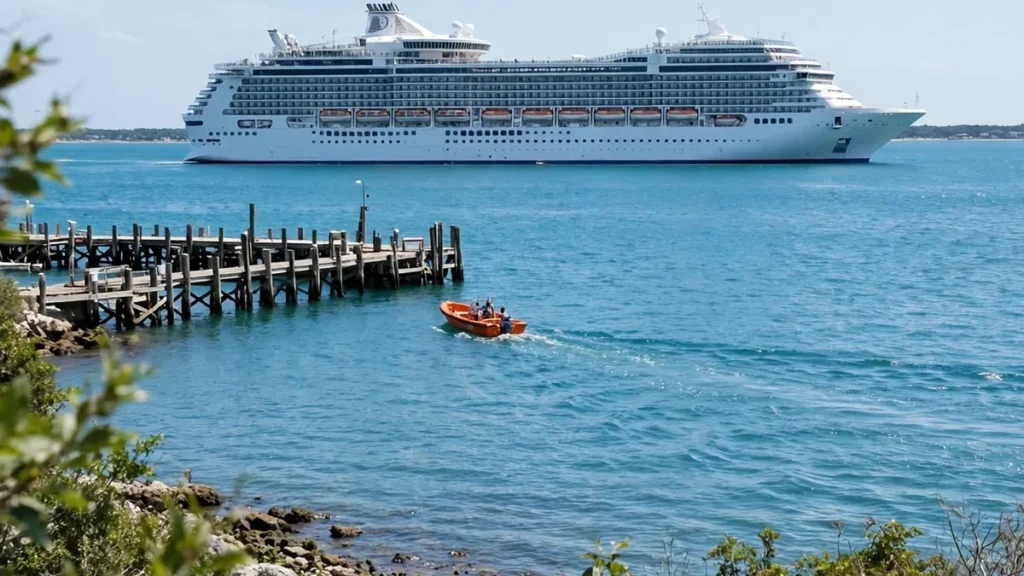
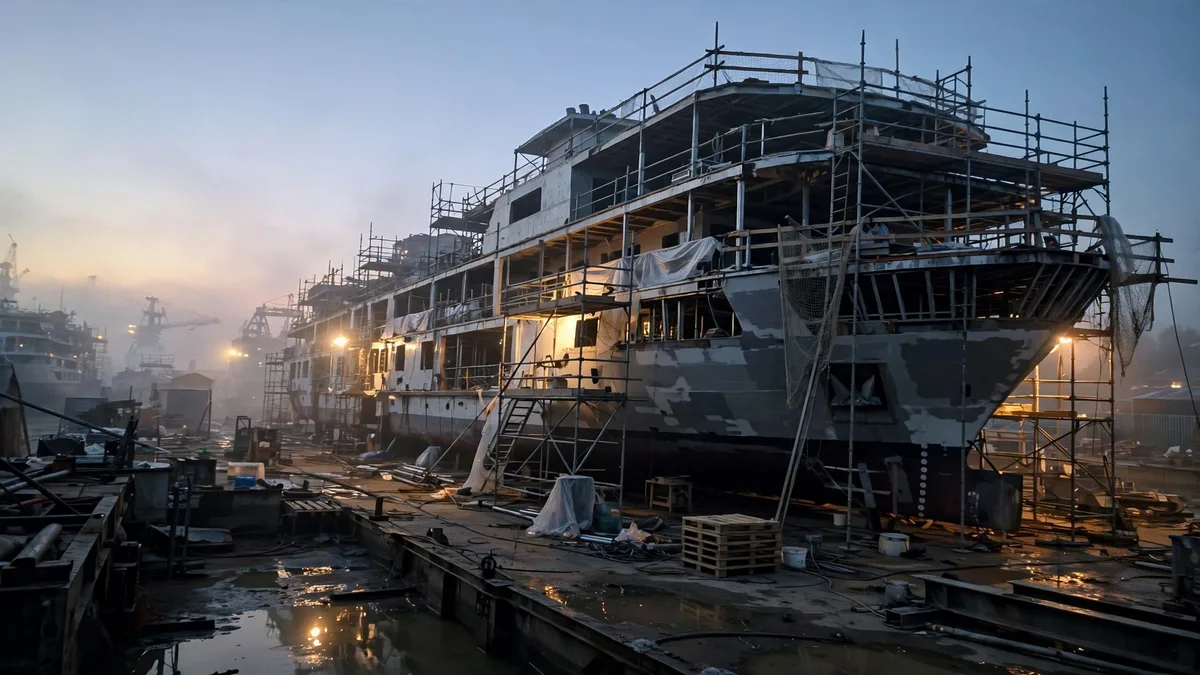
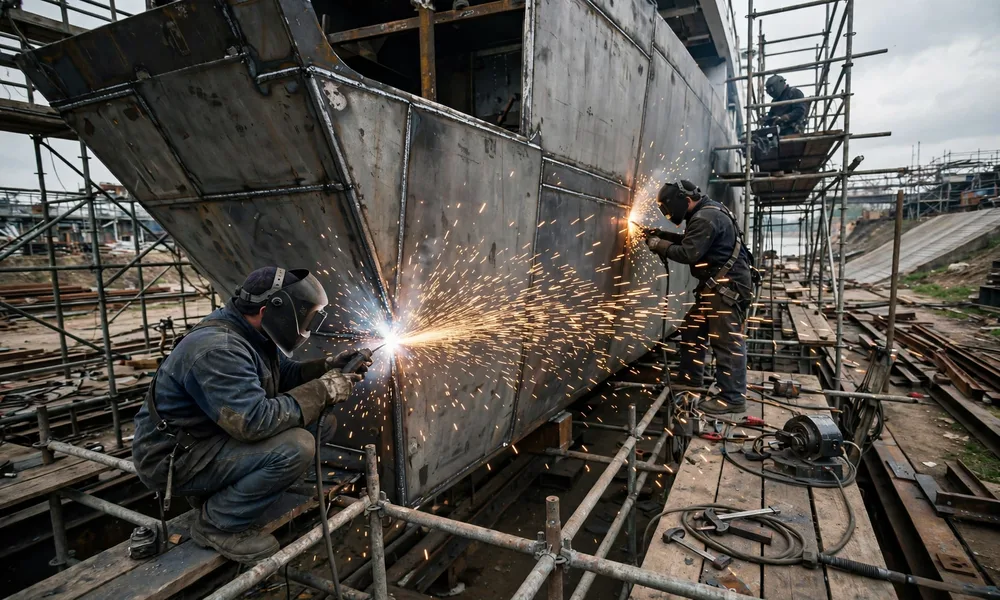
At first light on the Danube, the river is the colour of cold tea, and the hull taking shape on the slipway looks far too long for the water it will one day float on. Welders in orange helmets move along its flank like ants on a grey whale, sparks falling into the mist. This is not an ocean liner. It is a river cruise ship, a floating hotel built to thread bridges, locks, and shallow bends, and every centimetre of it has been argued over before a single plate was cut.
A river cruise ship is a strange machine. It must be luxurious enough to charge thousands per cabin, yet shallow enough to float in less than two metres of water. It must carry a restaurant, a sun deck, a spa, and two hundred passengers, yet squeeze under bridges with only centimetres to spare. Building one is less like building a ship and more like building a hotel inside a steel shoebox, then teaching the shoebox to swim.
The yard that builds it is quieter than you would expect. There is no thunder of rivet guns, only the hiss of plasma cutters and the low hum of cranes. A river cruise ship takes roughly eighteen months from first steel to first passenger, and most of that time is spent on things no guest will ever see: ballast tanks, engine beds, and kilometres of cable hidden behind wood panelling.
How It’s Made
- Steel cutting and block building. The ship begins as flat steel plates, cut by computer-guided plasma torches into hundreds of panels. Workers weld these panels into blocks, each one a room-sized section of hull, deck, or superstructure. A typical river cruise ship is assembled from around sixty blocks, and each block is checked for shape before it leaves the workshop floor.
- Hull assembly on the slipway. Cranes lift the blocks onto the slipway one by one, starting with the flat bottom and working upward. Welders join the blocks with full-penetration welds, and inspectors test every seam with ultrasound. The hull is deliberately shallow, with a flat bottom that spreads the ship’s weight across the riverbed’s thin cushion of water.
- Engines and propulsion. Two or four diesel engines are lowered through openings in the deck and bolted to reinforced beds deep in the hull. Most river cruise ships use azimuth thrusters, pods that can rotate a full 360 degrees, which let the captain steer sideways into a lock without tugboats. The engines are mounted on rubber mounts to keep vibration away from the cabins above.
- Superstructure and cabins. Once the hull is watertight, the white superstructure is stacked on top, deck by deck. Cabins arrive as prefabricated modules, complete with beds, bathrooms, and wiring, and are slid into place like drawers. A crew can fit out a dozen cabins in a single day, which is why the upper decks seem to appear overnight.
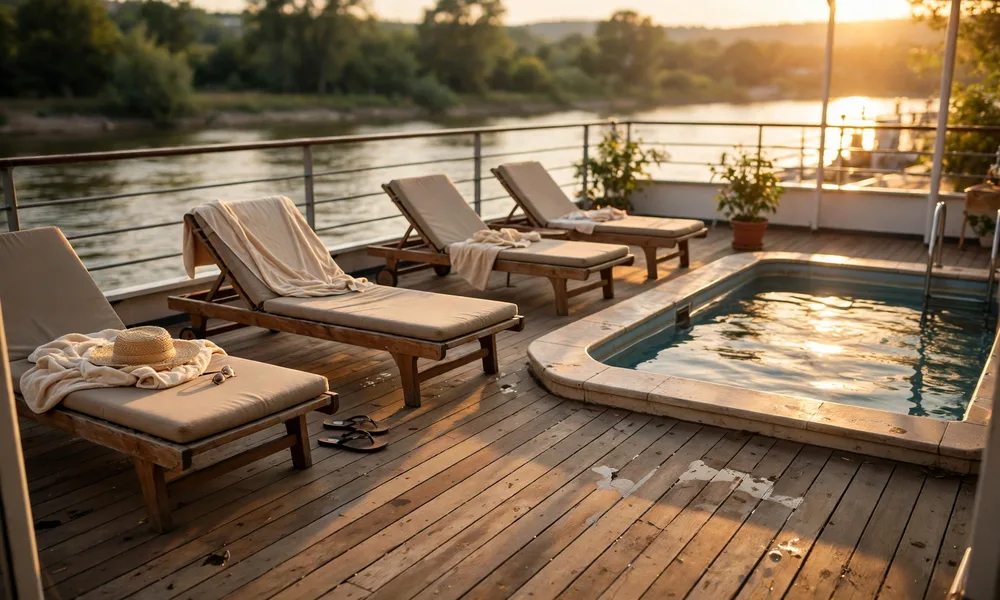
- Outfitting the hotel. This is the longest phase. Carpenters fit walnut panelling, electricians pull kilometres of cable, and plumbers connect hundreds of metres of pipe. The galley is installed as a single stainless-steel unit, the lounge gets its panoramic windows, and the sun deck receives its pool, loungers, and retractable canopy. Every gram is counted, because weight decides how deep the ship sits in the water.
- Launching and sea trials. The finished ship slides down the slipway or is floated out of a dry dock, and the yard holds its breath. Then come weeks of trials: turning circles in the river, stopping distances, thruster tests, and blackout drills where the engineers deliberately kill the power to prove the backup generators start in seconds. Only when the trials pass does the owner accept delivery.
- The first cruise. The ship’s maiden voyage is really a final test, with the builder’s engineers still aboard, listening for rattles and watching fuel consumption. By the time the first paying guests step onto the gangway, the ship has already travelled hundreds of kilometres, and the crew knows every creak in her hull.
The genius of the design is the shallow draft. A river cruise ship draws barely 1.6 metres, so it can sail rivers that would strand an ocean vessel. To achieve this, designers spread the weight wide rather than deep, giving the ship a beam of over eleven metres, and they keep the superstructure light, using aluminium where an ocean ship would use steel. The result is a vessel that feels like a hotel but handles like a barge.
Key Specifications
| Specification | Typical Value |
|---|---|
| Length | 135 metres |
| Beam (width) | 11.4 metres |
| Draft | 1.6 metres |
| Passengers | 190 |
| Crew | 50 |
| Engines | 2 x 1,600 kW diesel |
| Cruising speed | 22 km/h |
| Cabins | 95 |
| Decks | 4 |
| Build time | 18 months |
The dimensions are not arbitrary. A length of 135 metres is the maximum that fits the locks of the Rhine-Main-Danube canal, and the 11.4-metre beam is the widest that can pass through them. The ship is, quite literally, built around the locks it must travel through, which is why almost every European river cruise ship shares the same proportions. For a closer look at how other passenger vessels handle tight waterways, see how an autonomous ferry navigates crowded harbours and how an electric hydrofoil ferry lifts itself clear of the water at speed.
How Much Does a River Cruise Ship Cost?
A new 190-passenger river cruise ship costs an estimated $25 million to $40 million, depending on the yard, the fit-out, and the level of luxury. The hull and machinery account for roughly half the price, while the interior, from marble bathrooms to the sun-deck pool, takes most of the rest. Smaller 100-passenger ships can be built for an estimated $12 million to $18 million, while a flagship with suites and a spa can push past an estimated $45 million.
Running costs are just as steep. Fuel, crew wages, port fees, and maintenance add up to an estimated $15,000 to $25,000 per day while sailing, which is why river cruise tickets cost what they do. A single dry-docking for hull inspection and repainting can cost an estimated $500,000, and it happens every few years. Even so, a well-run ship can earn back its build cost in under a decade, sailing nearly year-round on Europe’s rivers.
A Rare Fact
Most river cruise ships can lower their wheelhouse. When a low bridge approaches, the captain presses a button and the entire bridge, glass, instruments, and all, sinks hydraulically into the deck, sometimes dropping more than two metres. The ship slides under the bridge with centimetres to spare, the wheelhouse rises again, and the passengers on the sun deck rarely notice a thing. It is one of the quietest pieces of engineering on the river, and one of the most important.
There is something quietly remarkable about a machine built to such exact limits. A river cruise ship cannot be longer, wider, or deeper than the locks allow, so every part of it is a negotiation between comfort and constraint. The result is a hotel that floats, a ship that behaves like a building, and a piece of engineering that only reveals its cleverness when it slips under a bridge that looks far too low. Compared with the heavy ice-strengthened hulls of a polar cruise ship built for frozen seas, the river cruiser is a study in lightness and precision, proof that the hardest engineering problems are often the quietest ones.