Hold a drone motor in your palm and it feels like almost nothing: a small silver disc the size of a coin, cool to the touch, with a short shaft poking out of the middle. Spin the shaft with a fingertip and it whirs freely, smooth and silent. Then you remember what this little disc does. It lifts a camera into the sky, holds it steady in a gust of wind, and answers a pilot’s commands a hundred times a second, all on a battery the size of a chocolate bar.
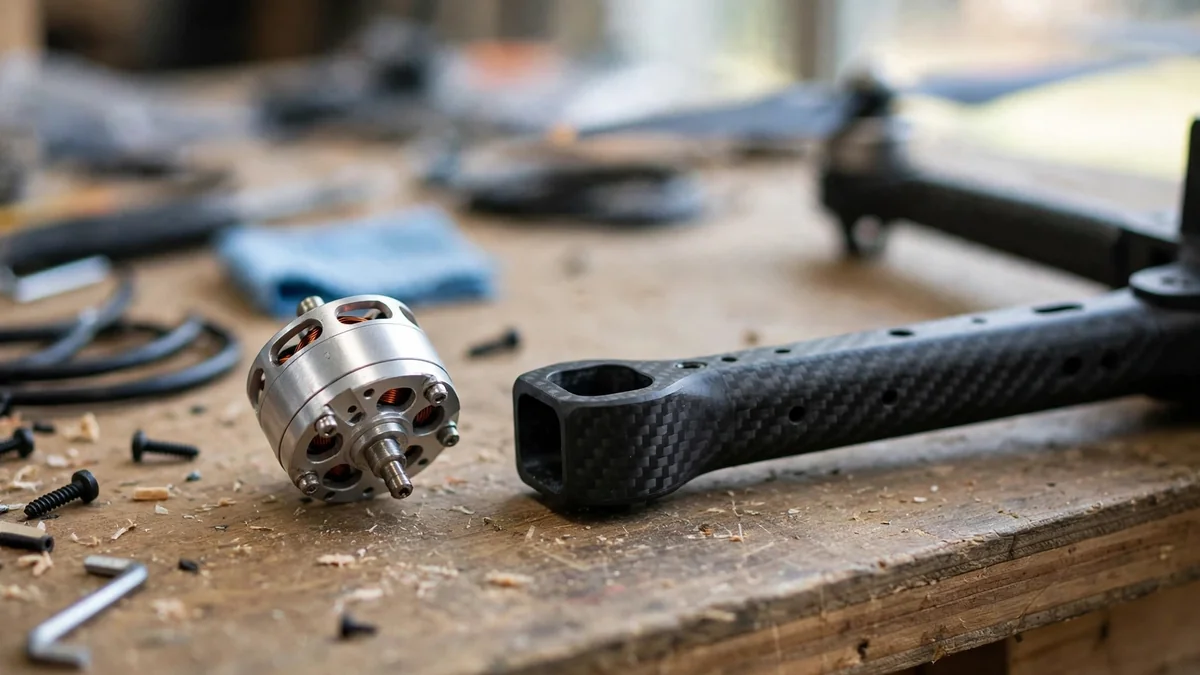
A drone motor is a brushless electric motor, a design with no brushes to wear out and almost no friction to waste power. This is how a drone motor is made, from a spool of copper wire to a spinning disc that can lift its own weight many times over.
How It Is Made
Drone motors are made in enormous numbers, tens of millions a year, and the factories that build them are a study in automation. A motor that is slightly out of balance will vibrate, a vibrating motor blurs photographs and wastes battery, and a motor that wastes battery brings the drone down early.
Step 1: Stamping the stator laminations
At the heart of the motor is the stator, a star-shaped core of thin steel sheets. The steel is electrical steel, chosen for its magnetic properties, and it is stamped from sheet metal in layers just a fraction of a millimetre thick. Stacking thin sheets instead of using a solid block stops wasteful eddy currents from circulating in the steel and heating it up.
Step 2: Winding the copper coils
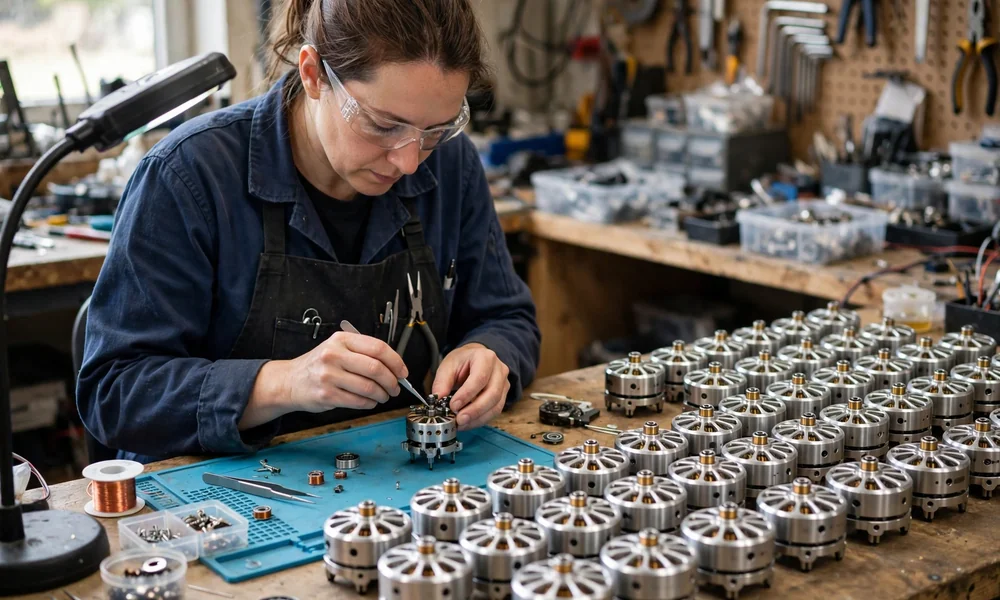
Next, copper wire is wound around the stator teeth, one coil per slot, in a precise pattern that decides the motor’s speed and torque. The wire is enamelled copper, thin as a human hair in small motors, thicker in heavy-lift ones, and it is wound by machines that count every turn and keep the tension perfectly even. The winding pattern, whether the coils are connected in a star or delta arrangement, sets the motor’s character: its Kv rating, the revolutions per minute it spins for each volt applied. The numbers that define all of this, from Kv to thrust, are laid out in the specifications of drone motors.
Step 3: Fitting the magnets and the bell
The outer part of the motor, the bell, is a cup of aluminium or steel that spins around the stator. Inside the bell, powerful neodymium magnets are glued in a ring, alternating north and south poles, each one seated in a machined pocket and checked for polarity. The bell is machined on a lathe to keep its weight low and its balance perfect, and the shaft is pressed into its centre. In an outrunner motor, the type almost all drones use, the bell and its magnets spin around the fixed stator, giving high torque at low speed, exactly what a propeller needs.

Step 4: Bearings and the shaft
The shaft runs through two tiny ball bearings pressed into the stator housing. These bearings are the most stressed parts in the motor: they carry the propeller’s thrust, survive crashes, and spin at up to thirty thousand revolutions per minute. The shaft itself is hardened steel, ground to a precise diameter, and a small circlip or screw holds the bell onto it. Getting the bearings right is the difference between a motor that lasts thousands of flights and one that develops a wobble after a season.
Step 5: Assembly and balancing
With stator, bell and bearings ready, the motor is assembled: the bell slides over the stator, the shaft passes through the bearings, and the retaining clip snaps on. Then comes balancing. The motor is spun up on a test rig while sensors measure vibration, and tiny amounts of material are removed or added until it runs smoothly. A balanced motor runs cooler, quieter and longer, and it keeps the drone’s camera free of the tiny shaking known as jello, the wobble that ruins aerial video. The gimbal that steadies that camera is a precision instrument in its own right, built around the materials engineering of the drone gimbal that carries it.
Step 6: Testing under load
Every motor is tested before it leaves the factory. It is mounted on a thrust stand, a propeller is fitted, and the motor is run through its full speed range while instruments measure thrust, current draw, temperature and vibration. A motor that draws too much current for its thrust is rejected, as is one that runs hot or vibrates. Once a motor passes, its wires are tinned, its screws are checked, and it is packed for the drone factory, where it will be bolted to an arm and wired to a speed controller.
Specifications
| Specification | Typical value |
|---|---|
| Motor type | Brushless outrunner |
| Stator slots | 12 |
| Magnet type | Neodymium N52 |
| Kv rating | 800 to 2,500 rpm per volt |
| Max speed | Up to 30,000 rpm |
| Weight | 20 to 80 grams |
What It Costs
A single drone motor for a camera drone typically costs between $15 and $60 at retail, depending on size and quality, with high-end racing and heavy-lift motors reaching $80 to $150. A complete quadcopter needs four, so motors account for a noticeable share of a drone’s price, though far less than the camera or the battery. The price is driven by the magnets, the bearings and the testing: a motor built with genuine neodymium magnets and sealed bearings costs more to make but lasts far longer than a cheap copy.
A Rare Fact
Brushless motors were first developed for a very different job: driving the capstans of tape recorders and the heads of computer hard drives, where smooth, precise spinning mattered more than raw power. The drone industry adopted them in the late 2000s almost by accident, when hobbyists realised that the small brushless motors sold for model aeroplanes could lift a camera. The first camera drones were built in garages from model aircraft parts, and their motors were the same ones that powered toy planes. The little motor in your palm carries that history in its shape, and the craft of making it well is now shared with the workshops that build the drone gimbal, made to keep a camera level while the motors do their work below it.
Pick up a drone motor and spin it with your finger. That smooth, silent whir is the result of stamped steel, counted copper turns, glued magnets and balanced bearings, all working together in a disc the size of a coin.