The hill does not care how fit you are. It rises out of the valley in one long sweep, and halfway up, most riders start to bargain with themselves. Just to the next bend. Then something changes. A quiet hum joins the sound of tyres on tarmac, the pedals seem to lighten under your feet, and the hill that was winning a minute ago starts to lose. You are not suddenly stronger. You are being helped, smoothly and almost invisibly, by a machine the size of a lunchbox in the heart of your bicycle. That machine is a mid-drive motor, and it has quietly become the most important piece of engineering on a modern e-bike.
A mid-drive motor sits where the cranks meet the frame, at the bottom bracket. Unlike a hub motor, which spins a wheel directly, a mid-drive motor works through the bike’s own gears. It adds its power to yours at the crank, and the chain carries the combined effort to the rear wheel. The result feels less like being pushed and more like having stronger legs. It climbs better, balances better, and uses the gears you already have. That is why almost every serious electric mountain bike, cargo bike, and touring e-bike uses one.
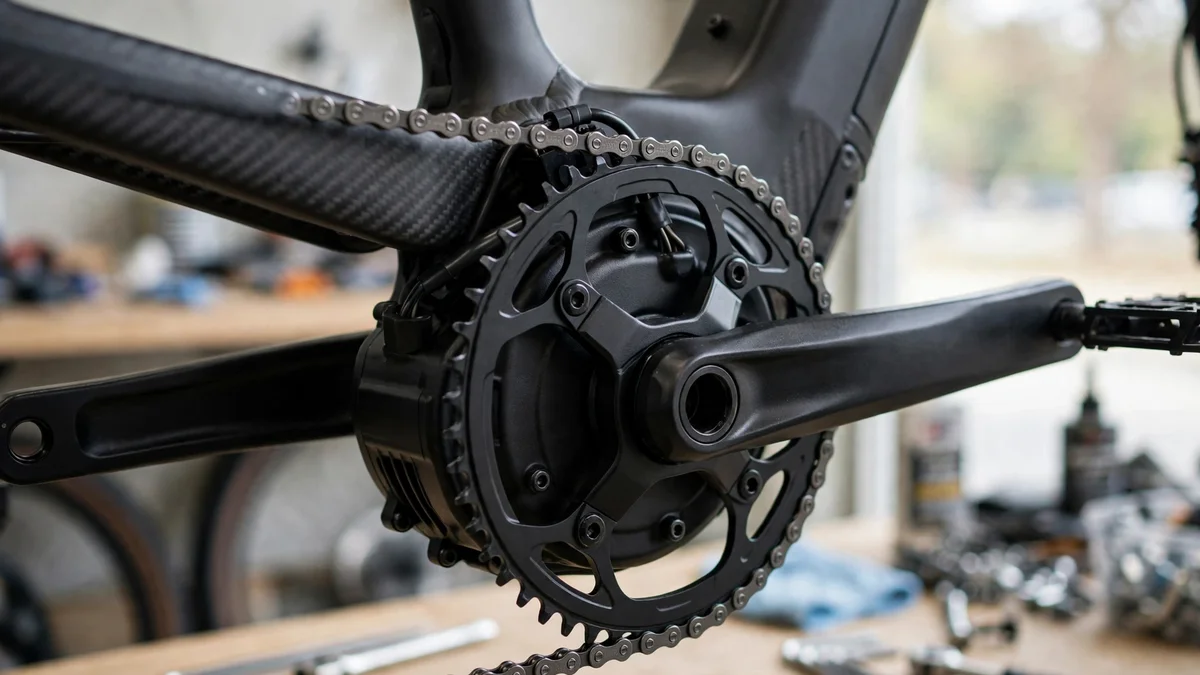
How It Works
The whole system is a conversation between your legs, a set of sensors, a small computer, and an electric motor, repeated dozens of times a second. Here is what takes place, step by step.
1. You push the pedals
Everything starts with you. When you press on a pedal, a torque sensor inside the motor unit measures how hard you are pushing, and a cadence sensor measures how fast you are turning the cranks. Together they tell the controller exactly how much effort you are putting in. A gentle spin on flat ground reads very differently from a standing climb.
2. The controller decides how much help to give
The controller is the motor’s brain, a small circuit board sealed inside the housing. It takes the sensor readings, checks the assistance level you selected, and checks the battery. Then it calculates how much power to add. Most systems multiply your effort: in a low mode you might get half as much power again, in a high mode three or four times your own effort. Assistance is capped by law in many countries, commonly at 250 watts and 25 kilometres per hour, after which the motor fades out.
3. The electric motor spins up
Inside the housing is a compact brushless electric motor, usually a permanent-magnet design of the kind explained in our guide to how electric motors work. Current from the battery flows through its windings in a precisely timed sequence, and the magnetic fields pull the rotor around. With no carbon brushes to wear out, it can spin at thousands of revolutions per minute while staying small enough to fit between your feet.
4. Gears trade speed for torque
A motor spinning at thousands of revolutions per minute is far too fast to drive a crank directly, so a reduction gearbox sits between the motor and the crankshaft, stepping the speed down and multiplying the twisting force, or torque. A typical mid-drive motor produces 50 to 90 newton-metres of torque at the crank, several times what a strong rider can sustain. That torque is what gets a loaded bike up a steep hill. The gears run in grease inside a sealed magnesium or aluminium case, which is why a good mid-drive motor is so quiet.
5. Power joins yours at the crank
The geared-down motor drives the same shaft your cranks are attached to, so its torque and yours are added together before they reach the chain. A one-way clutch sits in the drivetrain so the motor can drive the cranks but the cranks never drive the motor backwards. When you coast, the pedals stay still, and you never have to fight the motor’s resistance. If the battery runs flat, you can still pedal home, just without assistance.
6. The gears multiply the motor’s work
Here is the mid-drive’s greatest trick. Because its power flows through the chain and the rear cassette, the motor benefits from the bike’s gears just as you do. On a steep climb you shift down, and the motor’s torque is multiplied again by the low gear, letting it spin fast and efficiently while the wheel turns slowly. A hub motor, fixed to one wheel, has no such advantage. This is also why mid-drive bikes are so good on range: the motor spends more of its time in its efficient zone, stretching every charge further. You can read more about what decides that distance in our guide to e-bike range beyond battery size.
7. Heat is managed, and the loop repeats
All that work makes heat, and heat is the enemy of efficiency. Mid-drive housings are finned and made of heat-conducting metal so warmth can escape, and the controller watches temperature constantly, trimming power before anything can overheat. The cooling challenge is a familiar one in high-performance machines, as our look at cooling for sustained performance explains. Then the loop begins again, dozens of times a second, for as long as you ride.
Specs: What the Numbers Mean
| Specification | Typical mid-drive motor | What it means for you |
|---|---|---|
| Continuous power | 250 W (EU/UK legal limit) | Steady assistance the motor can sustain |
| Peak power | 500–750 W | Short bursts for climbs and starts |
| Torque | 50–90 Nm | Climbing force at the crank |
| Weight | 2.5–4 kg | Low and central, so handling stays natural |
| Assistance cut-off | 25 km/h (EU/UK) | Motor fades out above this speed |
| Gear range used | Full cassette | The motor uses every gear you have |
| Motor type | Brushless permanent magnet | Quiet, efficient, long-lived |
| Housing | Sealed magnesium or aluminium | Weatherproof, sheds heat |
Torque is the number that matters most when you compare motors. Power tells you how fast the motor can work; torque tells you how hard it can push. A motor rated at 85 newton-metres will haul a loaded cargo bike up a hill that leaves a 50 newton-metre motor struggling, even at the same 250 watts. Placement matters too: the motor’s mass sits low and central, exactly where a bike wants its weight.

What Does It Cost?
Mid-drive motors are rarely sold on their own; they arrive as part of a complete e-bike. As a rough guide, an e-bike with a quality mid-drive motor typically costs from around $2,000 to $3,000 for a commuter or trekking model, $3,500 to $6,000 for a capable electric mountain bike, and $6,000 or more for premium models. These are estimates, not fixed prices, and they vary with brand, battery size, and components. A replacement motor unit alone is generally estimated at $500 to $1,200 plus fitting. The motor is built to last, with many units rated for tens of thousands of kilometres.
A Rare Fact
The mid-drive idea is far older than the e-bike boom. In the 1890s, inventors were already patenting bicycles with motors driving the cranks, and in 1897 Hosea Libbey patented an electric bicycle with a motor mounted at the crank. The idea waited more than a century for batteries light enough and electronics clever enough to make it work.
That is the quiet charm of the mid-drive motor. It does not shout or shove, and it does not try to replace the rider. It simply takes the oldest part of the bicycle, the crank, and gives it a second source of strength, measured, geared, and timed so precisely that the hill stops mattering.


