An electric ferry has a simple problem. Its batteries take time to charge, and a ferry earns its money by moving, not by sitting at a pier plugged in. On a short crossing with a sailing every twenty minutes, even a fast charge can eat into the timetable. Battery swapping offers a different answer: instead of waiting for the battery to fill up, take the empty one out and put a full one in.
That is the whole idea in one sentence. A ferry arrives with depleted packs, a dockside system lifts them out, charged packs go in their place, and the ferry leaves minutes later. The slow work of charging happens ashore, while the boat is already on its next crossing.
The Problem Swapping Solves
A ferry battery is not a car battery scaled up a little. A large electric ferry can carry several megawatt-hours of storage, split across packs that each weigh tonnes. Charging that much energy through a plug takes time, even with megawatt-level shore power, and the time grows with the size of the pack. A ferry that crosses a fjord or a harbour in fifteen minutes may need to charge for most of its turnaround, leaving no slack for late passengers or a slow loading ramp.
Swapping breaks that link between sailing and charging. The ferry only needs the few minutes a swap takes, and the charging happens on land, at whatever pace the grid allows. A shore station can charge packs slowly overnight, when electricity is cheaper, or steadily through the day, spreading the load so the local grid never sees a huge spike. The ferry keeps its schedule, and the grid gets a steadier customer.
What Actually Gets Swapped
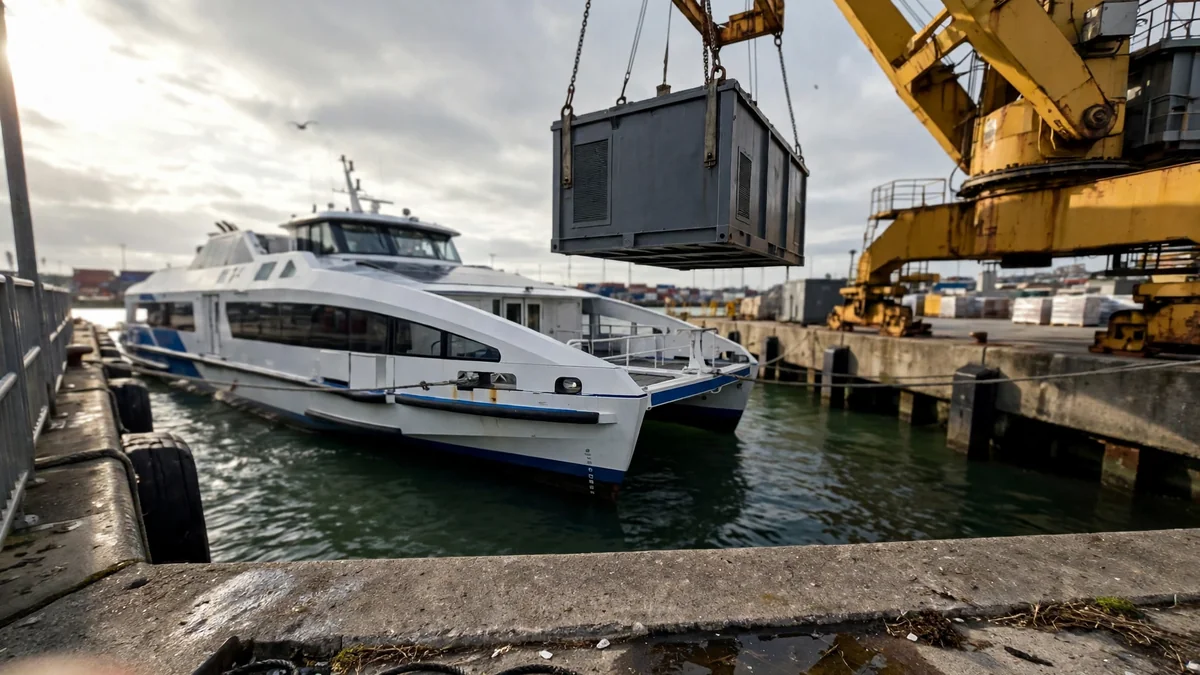
There are two different things a ferry can swap, and they are often confused. The first is a battery module: a self-contained pack with its own casing, cooling connections and high-voltage plug, designed to slide in and out of a rack inside the hull. The second is a whole battery container, a box the size of a small shipping container that sits on deck or in a dedicated hold and is lifted on and off by crane. The container is heavier and cruder, but it is also simpler, because the crane and the container do not need precision rails or alignment systems.
Both approaches share the same hard parts. The pack must connect to the ferry’s power system through a connector that can be mated and unmated hundreds of times without wearing out or letting in salt water. It must be cooled, because a large battery generates heat, and the cooling connection must also disconnect cleanly. And the whole unit must be secured against the motion of a ship, which rolls, pitches and slams in ways a road vehicle never does. A loose tonne of battery in rough water is a danger, not an inconvenience.
Standardisation is the quiet difficulty underneath all of it. A swap station only works if every ferry that uses it carries the same packs, the same connectors and the same lifting points. That is easy inside one operator’s fleet and very hard across an industry. Electric ferry battery specs show how varied pack sizes and voltages already are, and every variation makes a shared swap station harder to build.
How a Swap Works, Step by Step
The ferry comes alongside and the crew makes fast, as on any other arrival. Before the swap begins, the battery system is shut down and isolated, so no current is flowing through the connectors. This is the same safety logic as unplugging anything powerful, scaled up to thousands of volts and hundreds of amps. Sensors confirm the pack is dead before anything moves.
Then the old pack comes out. In a container system, a dockside crane hooks onto the container and lifts it clear, setting it down on a charging rack ashore. In a module system, the pack slides out on rails, either pulled by a shore-side handler or pushed out by a mechanism built into the ferry. The new pack, already charged and checked, goes in by the reverse route. Connectors mate, cooling lines click home, and latches lock the pack against the ship’s motion.
Finally, the system is checked before the ferry moves. The crew runs a short test: voltage, temperature and communication between the battery management system and the ferry’s controls. Only when every reading is normal is the ferry cleared to sail. A rushed check would be worse than a slow charge, because a fault discovered mid-crossing is far harder to deal with than one found at the pier.
Where the Spare Packs Live
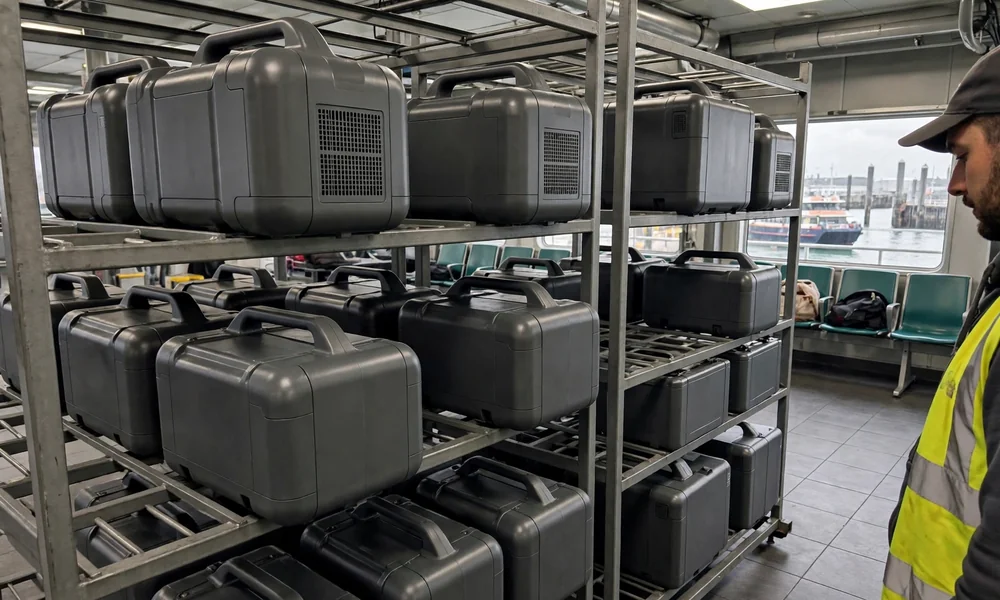
A swap system needs more batteries than the ferry carries, and that is its biggest cost. Each ferry needs at least one spare set ashore, and a busy route may need two or three, so the operator is buying and maintaining far more battery capacity than the boat itself uses. Batteries are the most expensive part of an electric ferry, so doubling or tripling that cost is not a small decision.
The shore station is a battery facility in its own right. It needs racks to hold the packs, chargers to fill them, cooling to keep them safe while they charge, and a fire system designed for the one thing every battery operator fears: a pack that catches fire while sitting on land. That is manageable on shore, where firefighters and space are available, and it is one of the arguments for swapping — a problem pack can be dealt with ashore, not on a crowded boat.
Swapping Against Fast Charging
The honest comparison is with fast charging, because that is what most electric ferries actually do. How electric ferry charging works shows the other route: huge shore connections, batteries topped up at every stop, and timetables built around charging time. For most routes, that is enough, and it needs no spare packs, no cranes, and no standardised swap hardware.
Swapping wins when the timetable cannot bend. If a ferry must turn around in five minutes, all day, every day, no charger can keep up, and swapping is the only electric option that preserves the schedule. It also wins when the grid is weak, because the shore station can charge slowly and steadily instead of demanding a huge surge at every arrival. But it loses on cost and complexity almost everywhere else, which is why charging, not swapping, is the standard for electric ferries today.
The comparison is familiar from smaller vehicles. Battery swapping on electric motorcycles works for the same reason — a quick change beats a long wait — but a motorcycle pack weighs a few kilos and a ferry pack weighs tonnes, so the engineering gap between the two is enormous.
The Limits, Stated Plainly
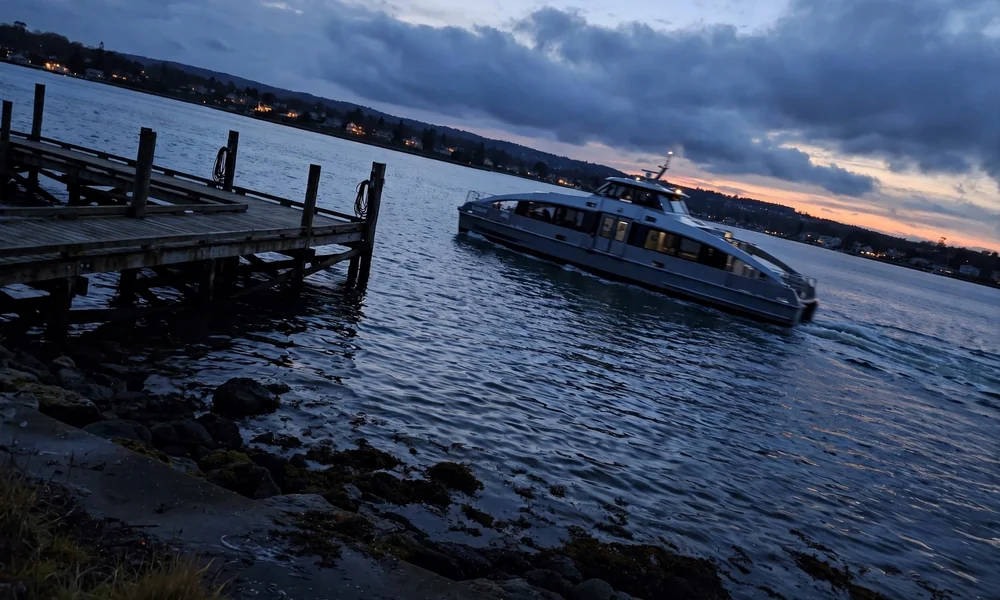
Full-scale ferry battery swapping is still rare. Most electric ferries in service charge at the dock, and swapping exists mainly in trials, pilot projects and smaller harbour craft, where the packs are lighter and the engineering is simpler. No large ferry fleet runs on swapping today, and anyone describing it as the settled future of ferries is ahead of the evidence.
That niche is real, though. Short crossings with relentless schedules, island links where the grid cannot support megawatt charging, and harbour ferries that never stop long enough to plug in are all places where a five-minute swap changes the maths. The technology does not need to beat charging everywhere. It needs to win on the routes where charging cannot work, and on those routes, it already makes sense.


