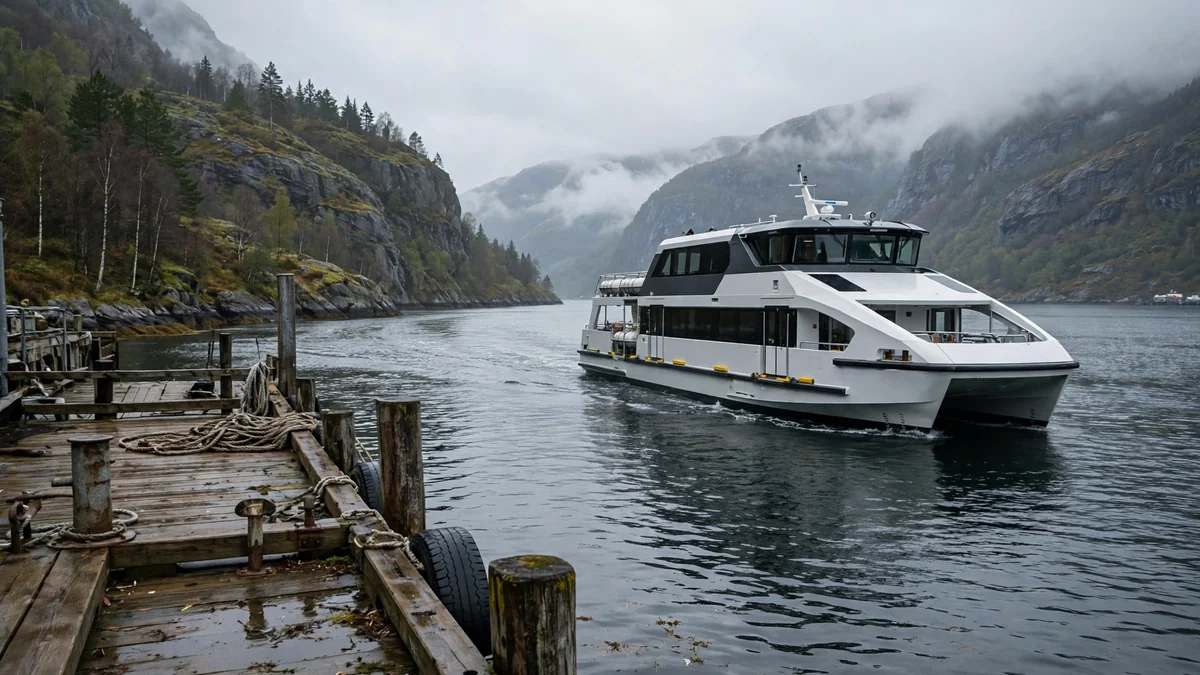
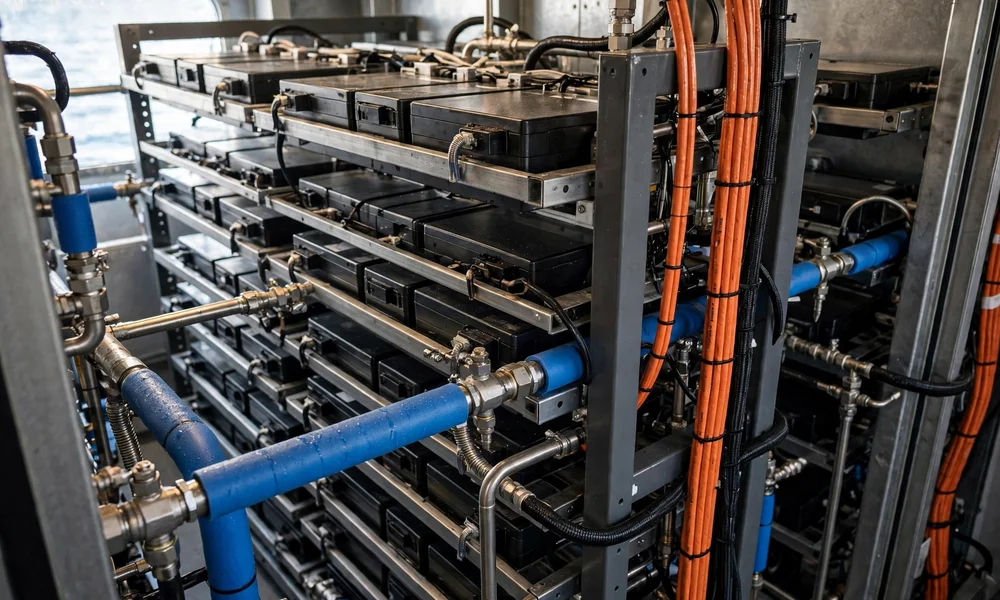
The ferry leaves the pier in Bergen on a grey morning, and the first thing you notice is what you do not hear. There is no diesel rumble shaking the deck, no plume of exhaust drifting over the fjord, no vibration in the handrail. The boat simply glides away, quiet as a lift, while the passengers settle into their seats. Below the car deck, where a diesel engine used to take up a whole compartment, there is a room full of batteries — hundreds of them, packed into racks, cooled by liquid, and watched over by a computer that never sleeps. This is the electric ferry, and its battery is the largest moving battery most people will ever ride on.
The idea is older than it looks. Ferries have always been good candidates for electric power: they run the same short route all day, they return to the same pier every hour, and they spend much of their time idling at the dock. Ten years ago the packs were too heavy and too small; today a ferry can cross a fjord, load cars, cross back, and charge for ten minutes while the passengers board. The numbers behind that are worth understanding, because they decide which routes can go electric and which still need diesel.
What the Key Specs Actually Mean
The first number on any electric ferry spec sheet is battery capacity, usually quoted in megawatt-hours, and most modern ferries carry 1 to 5 megawatt-hours. A megawatt-hour is a thousand kilowatt-hours, and a typical family electric car holds about 75 kilowatt-hours, so a ferry carries the equivalent of 15 to 65 cars’ worth of batteries. That sounds enormous until you do the maths: a ferry pushing a thousand tonnes through water at twelve knots needs about 1 to 2 megawatts of power, so a 4 megawatt-hour pack gives it roughly two to four hours of running — enough for a morning of crossings, but not a whole day without charging.
The second number is charging power, and it is the one that decides whether the schedule works. A ferry that charges at 1 megawatt takes an hour to refill a 1 megawatt-hour pack; a ferry that charges at 4 megawatts, through an automated plug that connects as the boat docks, can take on a useful charge in the ten minutes it spends loading cars. The fastest systems now push past 5 megawatts, more than a small town uses, through a cable as thick as your arm. The dock needs its own substation, and that is often the most expensive part of the whole project.
The third spec is the battery chemistry, and nearly every electric ferry today uses lithium iron phosphate, or LFP. It holds less energy per kilogram than the nickel-rich chemistry in a sports car, but it is far harder to set on fire, it lasts for many more charge cycles, and it tolerates being charged to full and drained to empty every day without complaint. On a ferry that charges dozens of times a day, that durability matters more than squeezing in extra range.
The last number to decode is energy consumption per crossing, usually quoted in kilowatt-hours. A short crossing of twenty minutes might use 300 to 500 kilowatt-hours, while a longer route can use two or three times that. Operators watch it the way airlines watch fuel burn, because it decides how many crossings the ferry can make before it needs a longer charge. The same thinking about moving big hulls efficiently shows up across the shipping world, and the guide to the top ship propulsion systems puts electric drive in context alongside the diesels and gas turbines it is starting to replace.
The Numbers That Matter
| Specification | Typical Value |
|---|---|
| Battery capacity | 1 to 5 megawatt-hours |
| Battery chemistry | Lithium iron phosphate (LFP) |
| Charging power | 1 to 5 megawatts at the dock |
| Charging time per crossing stop | 10 to 15 minutes |
| Energy per crossing | 300 to 500 kilowatt-hours |
| Propulsion power | 1 to 2 megawatts |
| Service speed | 10 to 13 knots |
| Battery lifespan | 8 to 12 years, thousands of cycles |
The number passengers notice is the noise, or rather the lack of it. An electric ferry is so quiet that you can hear the water against the hull and the gulls over the fjord, and the crew say the biggest change is not the silence but the air: no diesel smell on the car deck, no soot on the paintwork, and no vibration shaking the coffee cups. The payoff is a boat that is cheaper to run, since electricity costs far less than marine diesel per crossing, and far easier to maintain, since an electric motor has one moving part where a diesel has hundreds. The same quiet, clean thinking is spreading to other vessels too, and the guide to what a rotor sail is shows how wind power is coming back to help big ships burn less fuel.
What an Electric Ferry Costs
A new electric ferry costs roughly 15 to 30 million dollars as an estimate, depending on size and capacity, which is about 30 to 50 percent more than a comparable diesel ferry. The battery pack alone accounts for several million dollars of that, and the shoreside charging station — the substation, the cables, the automated plug — can add another 2 to 5 million dollars. It is a big upfront bill, and it is the reason many operators waited. But the running costs tell a different story: electricity is cheaper than diesel, and maintenance is far lower.
Operators who have made the switch report fuel savings of 60 to 80 percent and maintenance savings of around half, so the extra purchase price is usually paid back within five to eight years. After that, the electric ferry is simply cheaper to run than the diesel it replaced, and quieter and cleaner besides. The hull and the engine room still need the same steel and the same care, and the guide to cruise ship engine materials shows what goes into building a marine engine room that lasts for decades at sea.
A Rare Fact Worth Knowing
Here is the detail that surprises even the engineers: some electric ferries charge faster than a Formula E race car, and they do it with a plug the size of a dustbin. The automated charging arm swings down from the pier as the ferry docks, locks onto a socket on the hull, and starts pushing megawatts within seconds, all without a single person touching a cable. The crew do not even have to think about it; the system charges while the cars drive on and off, and disconnects itself as the boat pulls away.
The electric ferry is a reminder that the most important technology is often the boring kind: a battery, a cable, and a timetable that lets them meet every ten minutes. There is no new physics here, just a steady improvement in batteries until they became good enough for a boat that runs the same route all day. The fjords of Norway now have dozens of these ferries, and the model is spreading to rivers and harbours around the world. The diesel ferry is not dead yet, but on short routes the future is already quiet.


