You press the accelerator of an electric car and the car simply goes — no gear changes, no engine note rising through the revs, just a smooth, silent surge. What you do not feel is the electrical argument happening underneath the floor. The battery holds its energy as direct current, steady and one-directional, but the motor wants alternating current, flipping direction hundreds of times a second. The device that settles that argument is the inverter — and the newest ones are built from a material that barely existed in cars a decade ago.
That material is silicon carbide, a crystal so hard it is used to grind steel, and so good at handling heat and voltage that it has quietly rewritten what an electric drivetrain can do. A silicon carbide inverter wastes less energy as heat, switches faster, and lets a car go further on the same battery. This is how it works.
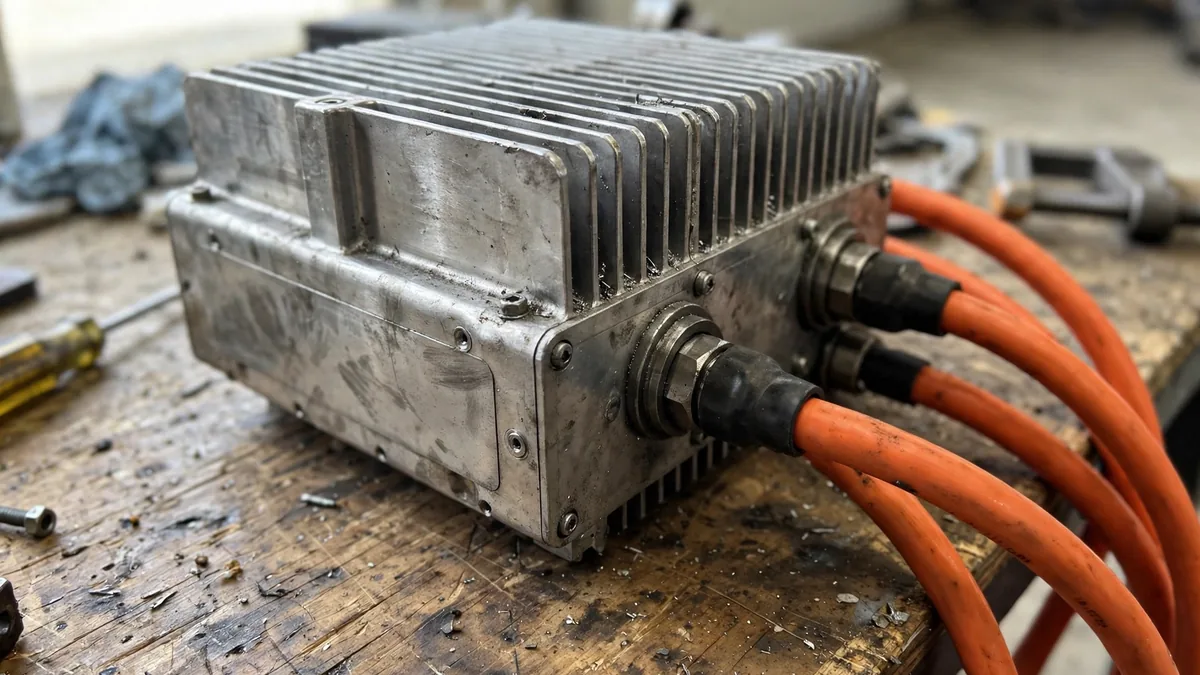
How an EV Silicon Carbide Inverter Works
Step 1: Direct current arrives from the battery
Everything starts at the battery pack, which stores energy as direct current, or DC, at around 400 or 800 volts. It travels to the inverter through thick orange cables built to carry hundreds of amps without melting. Inside the inverter, the DC first passes through a capacitor bank that smooths out ripples in the voltage. Without those capacitors, every switch of the transistors downstream would send a voltage spike back toward the battery. The inverter sits at the heart of the drivetrain, and the wider system it belongs to is explained in how an EV inverter works, which follows the same power from the charge port to the wheels.
Step 2: Silicon carbide transistors switch the current
The heart of the inverter is a set of power transistors, usually six of them arranged in three pairs, one pair for each phase of the motor. Each transistor is a switch that opens and closes in a few billionths of a second, chopping the steady DC into pulses that mimic alternating current. This is where silicon carbide earns its keep. Ordinary silicon transistors start to leak and waste energy as they get hot, but silicon carbide can run far hotter, handle far higher voltages, and switch far faster while wasting a fraction of the energy. The crystal is grown in furnaces at more than 2,000 degrees Celsius, sliced into wafers, and etched with transistor structures finer than a hair — a process covered in EV silicon carbide inverter materials engineering, from the raw crystal to the finished module.
Step 3: Pulse-width modulation shapes the wave
Chopping DC into pulses does not by itself make the smooth sine wave a motor wants. The trick is pulse-width modulation: the transistors switch on and off thousands of times a second, and the controller varies how long each pulse lasts. Long pulses average out to high voltage, short pulses to low voltage, and by changing the pattern over time the inverter traces out a wave that rises and falls like mains alternating current. The motor’s coils smooth the pulses further into a clean rotating magnetic field. Because silicon carbide switches so fast, the pulses can be far finer than in an older silicon inverter, which means a smoother wave, less vibration, and a quieter motor.

Step 4: Three phases drive the motor
An EV motor does not run on a single wave. It needs three alternating currents, each a third of a cycle out of step with the others, feeding three sets of coils arranged around the rotor. The inverter produces all three at once, and the timing between them creates a magnetic field that rotates inside the motor, dragging the rotor around with it. To make the car go faster, the controller raises the frequency of the waves; to slow down, it lowers it. Reverse is not a gear at all — the controller simply runs the sequence backwards. A microcontroller reads the position of the rotor thousands of times a second and adjusts the switching pattern in real time.
Step 5: Regenerative braking runs the process in reverse
When you lift off the accelerator, the inverter runs backwards. The motor, still spinning, becomes a generator, and the alternating current it produces flows back into the inverter, which rectifies it into direct current and feeds it into the battery. In city driving, a good system can recover a fifth of the energy that would otherwise be lost to the brakes as heat. Silicon carbide helps here too, because the same low losses that make it efficient when driving make it efficient when recovering energy. The rest of the drivetrain has to keep up with this two-way flow, and the materials behind the surrounding components are laid out in EV inverter materials engineering.
Step 6: Heat is carried away before it can do damage
Even the best inverter wastes some energy as heat, and at hundreds of amps a small percentage is still a lot of watts. The silicon carbide chips are soldered onto a copper baseplate, cooled by a liquid loop shared with the battery and motor — water and glycol pumped through channels in the housing. Temperature sensors watch the chips constantly, and if they run too hot the controller quietly limits the power rather than risk damage. Because silicon carbide tolerates higher temperatures than silicon, the cooling system can be smaller and lighter, one of the quiet reasons modern EVs have become so efficient.

EV Silicon Carbide Inverter Specifications
| Specification | Typical figure |
|---|---|
| Battery voltage | 400 V or 800 V DC |
| Power output | Roughly 150 to 350 kW per inverter |
| Switching frequency | Up to around 40 kHz |
| Peak efficiency | About 98 to 99 percent |
| Semiconductor material | Silicon carbide (SiC) MOSFETs |
| Cooling | Liquid cooling, water-glycol loop |
How Much Does an EV Silicon Carbide Inverter Cost?
Industry estimates put a silicon carbide inverter at roughly $800 to $1,500 per unit in volume, against roughly $400 to $800 for an older silicon equivalent — these are estimates, not list prices. The premium pays for itself in the car: a more efficient inverter means a smaller battery for the same range, and the battery is by far the most expensive part of an EV.
A Rare Fact About the EV Silicon Carbide Inverter
Here is something few people realise: silicon carbide is one of the rarest minerals on Earth in its natural form. It occurs naturally as moissanite, a crystal so scarce that it was first found in a meteor crater in Arizona in 1893, and almost every piece ever used has been made in a furnace rather than mined. The crystals for an inverter are grown by heating silicon and carbon to more than 2,000 degrees Celsius until they fuse into a single crystal, a process that takes days and can be ruined by a single speck of dust. A speck of stardust, grown in a furnace, is what lets your car accelerate in silence.
So the next time an electric car pulls away without a sound, remember what is happening under the floor: a battery pushing direct current into a bank of capacitors, silicon carbide switches chopping it into pulses thousands of times a second, three waves spinning a magnetic field around a rotor, and the whole process running in reverse the moment you lift your foot — cooler, faster, and further than silicon alone could manage.


