Press the accelerator in an electric car and the response is instant. There is no engine to rev up, no gearbox to choose a gear, just a smooth surge of power that arrives the moment your foot moves. The part that makes that possible is not the battery and not the motor. It is the inverter, a box of electronics that turns the direct current from the battery into the alternating current the motor needs, and it does it hundreds of times a second.
The inverter is one of the hardest-working parts of an electric car. The materials inside it are chosen to survive that punishment, to switch fast without wasting energy, and to keep working for the life of the car.
Those materials are a mix of semiconductors, metals, and ceramics, and they have changed more in the last ten years than any other part of the car. Here is what they are, and why each one earned its place.
The Materials Behind the EV Inverter
1. Silicon carbide, the semiconductor that changed everything
The most important material in a modern EV inverter is silicon carbide, usually shortened to SiC. The power switches in the inverter, the transistors that turn the current on and off, were once made from silicon, but silicon carbide can handle higher voltages, higher temperatures, and faster switching, all at the same time. Silicon carbide is made by growing a crystal at very high temperatures, then slicing it into wafers and building the transistors on top, a process that is far more expensive than making silicon chips. The full process of building that inverter is described in how an EV inverter is made, from growing the crystal to assembling the finished unit.
2. Copper busbars, the highways for the current
The current inside an inverter is carried by copper busbars, flat strips of copper that connect the battery, the power modules, and the motor. Copper is chosen because it has the lowest electrical resistance of any practical metal, which means it wastes the least energy as heat, and because it is easy to shape and join. The busbars are often laminated, with thin layers of copper separated by insulation, which reduces the inductance and lets the inverter switch faster without voltage spikes. A busbar in an EV inverter can carry several hundred amps, and it has to do it without getting hot enough to damage the insulation around it.
3. The aluminium heatsink, the part that keeps it cool
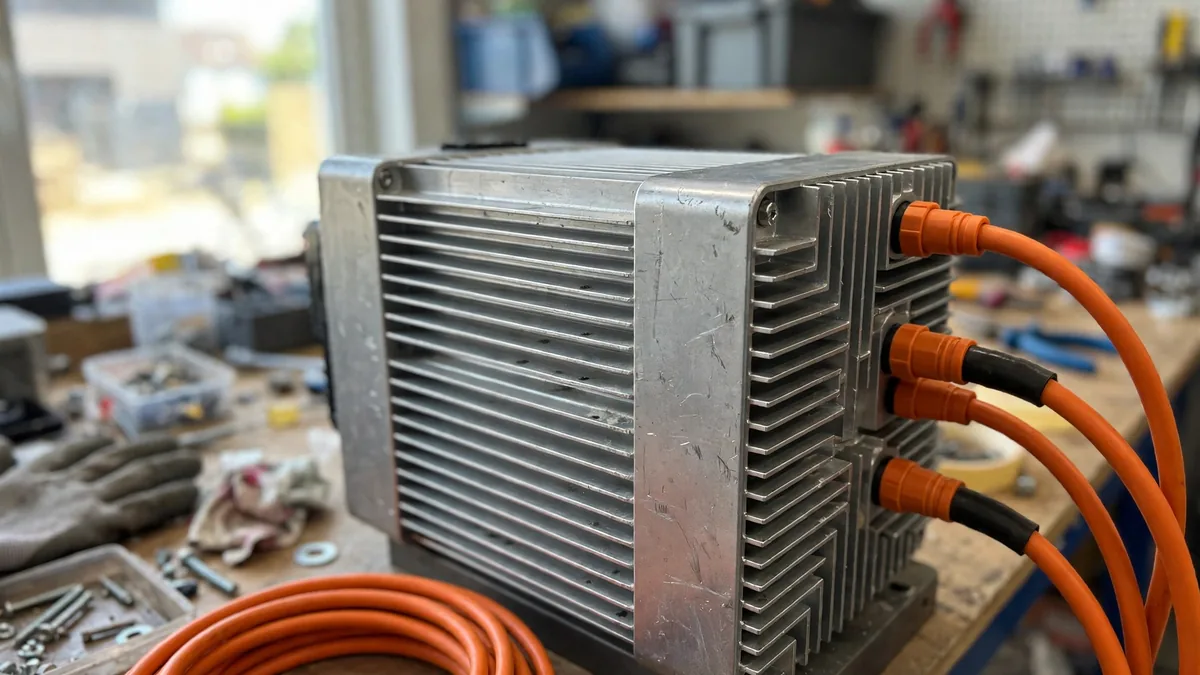
The power modules are mounted on an aluminium heatsink, a block of aluminium with fins or channels that carry the heat away to a liquid cooling system. Aluminium is chosen because it conducts heat well, it is light, and it can be extruded or cast into the complex shapes the cooling channels need. The interface between the power module and the heatsink is critical, and it uses a thermal interface material, usually a silicone-based paste or pad filled with ceramic particles, to fill the microscopic gaps and let the heat flow. The way the heat flows through that system is part of how an EV inverter works, including why the cooling system is as important as the electronics.
4. Ceramic substrates, the board the switches sit on
The power switches do not sit on an ordinary circuit board. They sit on a ceramic substrate, usually aluminium nitride or alumina, bonded to a copper layer on each side. The ceramic is an electrical insulator, so it keeps the high voltage away from the heatsink, but it conducts heat well, so the heat from the switches flows through it to the cooling system. The substrate is made by a process called direct bonded copper, where the copper is bonded to the ceramic at high temperature in a controlled atmosphere, creating a joint that survives the constant heating and cooling of the inverter. That matching is one of the hardest materials problems in the whole inverter.
5. Capacitors, the parts that smooth the power
Between the battery and the power switches sits a large capacitor, usually a film capacitor made from metallised polypropylene, that smooths the voltage and supplies the sudden bursts of current the switches need. The capacitor has to handle high voltage, high current, and high temperature, and it has to do it for the life of the car without drying out or losing capacity. Film capacitors are chosen because they are self-healing: if a small defect causes a short, the metal film around it vaporises and isolates the fault, so the capacitor keeps working. The battery that feeds all of this power is built from its own set of demanding materials, and the EV battery pack materials show how the two systems are designed to work together.
6. The housing and the connectors, the parts that keep it safe
The inverter lives in a housing, usually cast from aluminium alloy, that protects the electronics from water, dust, and vibration, and that also acts as part of the cooling system. The housing is sealed with a gasket, usually made from silicone rubber, and the high-voltage connectors are sealed with O-rings made from fluorocarbon rubber, which resists heat and the coolant.
EV Inverter Materials
| Material | Where it is used | Why it is chosen |
|---|---|---|
| Silicon carbide | Power switches | High voltage, high temperature, low switching losses |
| Copper busbars | Current paths | Lowest practical resistance, easy to shape |
| Aluminium heatsink | Cooling | Conducts heat well, light, easy to form |
| Aluminium nitride or alumina ceramic | Power module substrate | Insulates electrically, conducts heat |
| Metallised polypropylene film | DC-link capacitor | Self-healing, survives heat and age |
| Aluminium housing, silicone and fluorocarbon seals | Enclosure and connectors | Protects against water, dust and vibration |
What Does an EV Inverter Cost?
An EV inverter is estimated to cost roughly $800 to $2,000 in volume production, depending on the power rating and whether it uses silicon or silicon carbide. A silicon carbide inverter is estimated at roughly $300 to $600 more than a silicon inverter of the same power, because the wafers are more expensive and harder to make. A replacement inverter outside warranty is estimated at roughly $2,000 to $5,000 including labour, which is why the inverter is designed to last the life of the car.
A Rare Fact
Silicon carbide was first found in a meteorite. In 1893, the chemist Henri Moissan discovered tiny crystals of silicon carbide in a meteorite crater in Arizona, and the mineral was named moissanite after him. Natural moissanite is so rare that almost all silicon carbide used today is made synthetically, by heating sand and carbon to more than 2,000 degrees Celsius.
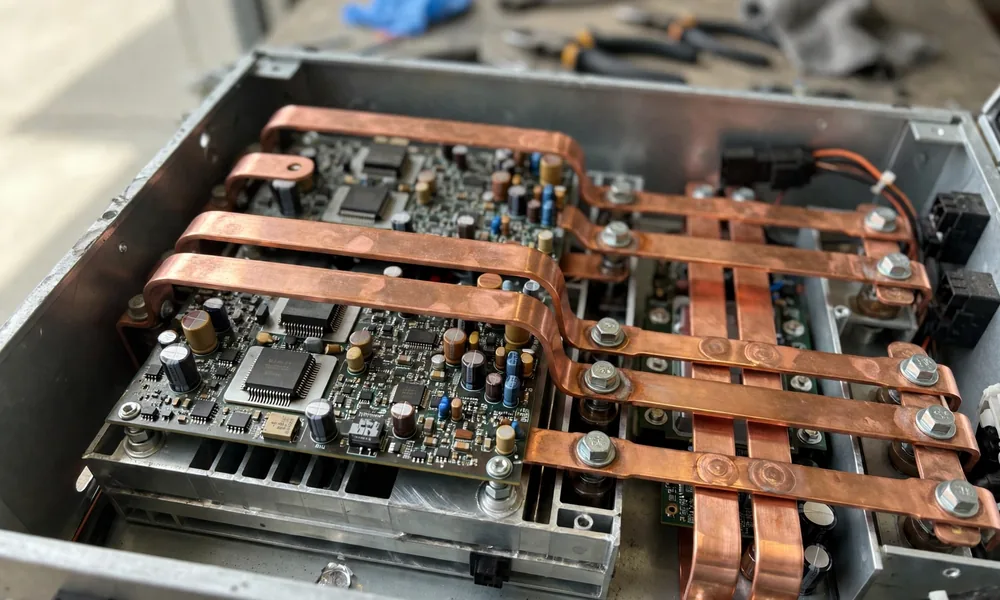

An EV inverter is a box that most drivers will never see, but it is the part that decides how far the car goes, how fast it accelerates, and how long the battery lasts. The silicon carbide switches, the copper carries, the ceramic insulates, and the aluminium cools, and together they turn a battery’s steady current into the pulsing power a motor needs.


