Open a foldable phone and you open a problem that no ordinary phone has. A normal smartphone holds one big, flat, rigid battery that fills most of the frame. A foldable phone folds in the middle, and a rigid battery cannot fold with it. Bend a lithium-ion cell and you damage it, possibly dangerously. So engineers split the battery in two, put one half on each side of the hinge, and taught the two halves to behave as a single battery.
That split shapes everything about a foldable phone’s battery life. Two thin cells hold less energy than one thick one, the hinge steals space that a normal phone gives to the battery, and the two screens of a book-style foldable demand more power than a single screen. The result is a phone that charges cleverly, balances its two cells constantly, and still usually ends the day with less capacity than a slab phone of the same price.
This guide explains how a foldable phone battery works, from the split cells to the charging that keeps them in step.
How a Foldable Phone Battery Works
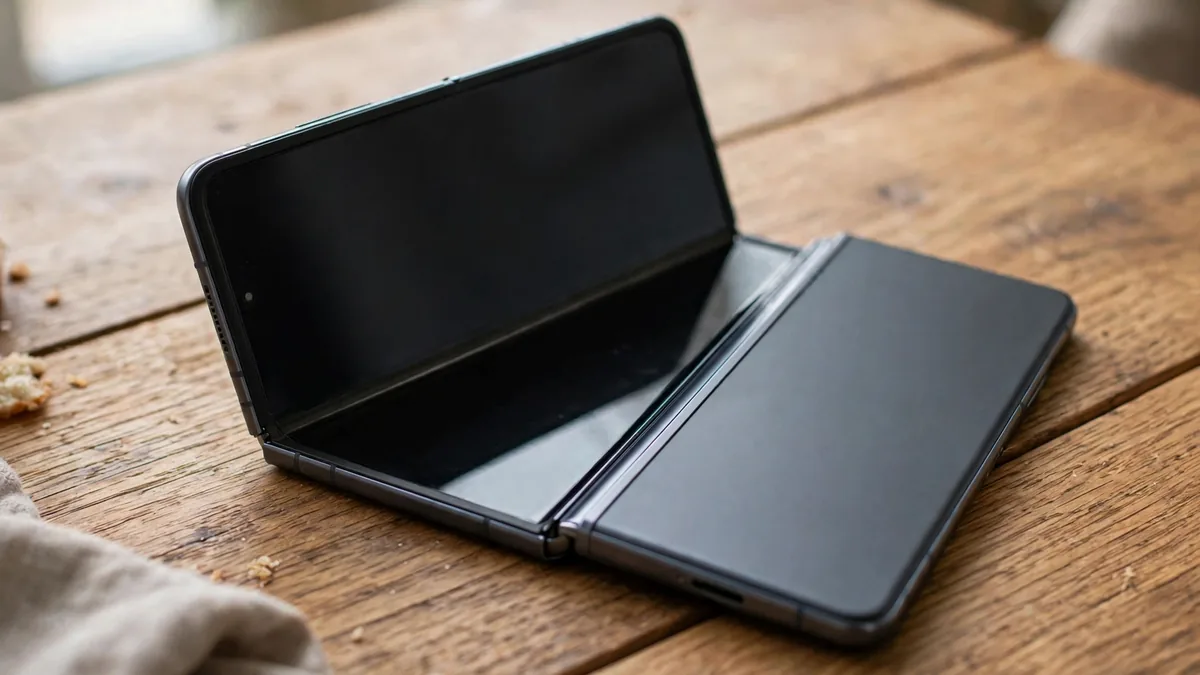
A foldable phone battery works as two separate lithium-ion cells wired together as one power system. Each half of the phone holds its own cell, shaped to fit the space around the hinge, the cameras, and the processor, and a power management chip treats the pair as a single battery for charging and discharging. When you use the phone, both cells drain together. When you plug it in, both cells charge together. The phone never asks you to think about which cell is doing what, and that invisibility is the engineering achievement.
Step 1: The battery is split in two
The split is forced by geometry. A book-style foldable is two thin slabs joined by a hinge, and each half is only around 5 millimetres thick once the screen, frame, and electronics are accounted for. A single rigid cell cannot cross the fold, so each half gets its own thin, flat pouch cell. The two cells are rarely the same size: one side holds the main processor and its cooling, so its cell is shaped around those parts, while the other side has more free space. On one recent foldable the two cells measured 2,962 and 1,921 milliamp-hours, adding up to 4,883 milliamp-hours in total. A flip-style foldable does the same thing on a smaller scale. The split is the defining fact of foldable battery design, and every other decision follows from it.
Step 2: The two cells are balanced as one
Two cells that are different sizes and sit in different thermal environments will not naturally drain at the same rate. One side runs hotter because it holds the processor. The power management chip therefore monitors the voltage and temperature of each cell separately and balances them during charging and discharging, shifting load so neither cell is overworked or left behind. If one cell were allowed to empty while the other still held charge, the phone would shut down early and the empty cell would age faster. Balancing is what makes the pair feel like one battery, and it runs continuously in the background.

Step 3: Power crosses the hinge on a flex cable
Power has to travel between the two halves, and it does so across the hinge on a flexible printed circuit, a ribbon of polyimide plastic with microscopic copper traces that bends every time the phone folds. The charging port sits on one half, so the far cell charges through that flex cable, and the processor on one side draws from the cell on the other side through the same route. These ribbons are engineered to survive hundreds of thousands of folds without a trace cracking, and they carry both power and data: the display signals, the camera signals, and the battery management data all cross the hinge on flexible circuits.
Step 4: The chemistry squeezes more into less space
Because the split cells are thin and the total volume is small, foldable makers have been early adopters of silicon-carbon battery chemistry. In a conventional graphite anode, lithium ions slot between layers of graphite. A silicon-carbon anode can hold far more lithium ions in the same volume, raising energy density — one recent foldable generation gained roughly 5 percent in volumetric energy density and nearly 9 percent in total capacity from the switch. Silicon swells as it absorbs lithium, though, which stresses the cell over hundreds of cycles, so the silicon content is kept modest and the cell is engineered to contain the expansion.
Step 5: Charging is fast because capacity is small
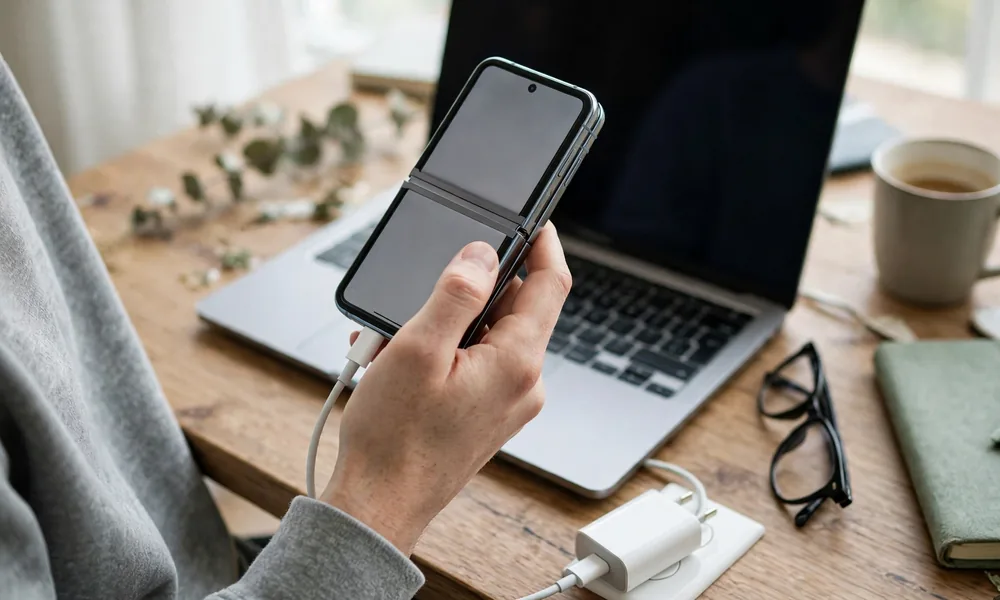
Foldable phones lean on fast charging to make up for smaller batteries. A book-style foldable with a 4,400 milliamp-hour battery and 25-watt wired charging is common, while some rivals push 66 or 80 watts to refill a larger dual-cell pack in under an hour. Fast charging generates heat, and heat is the enemy of a thin phone with two cells pressed against two screens, so the power management chip throttles the charge rate as the cells warm up and as they approach full. The charging curve is a compromise between speed, heat, and the lifespan of two cells working in a tight thermal space.
Step 6: The battery is glued in, and hard to replace
Repairability is the weak point of the split design. Both cells are glued into their halves, and reaching one of them often means removing a display first. Some makers have improved the adhesive so a small electric current releases it, which teardown specialists have praised, but the job is still a specialist one. The cells also sit close to the flexible display and the hinge, so a careless repair can damage parts worth far more than the battery.
Why Foldable Battery Life Lags Behind
Put the pieces together and the shortfall is easy to see. A foldable has less battery volume than a slab phone, because the hinge and the folding mechanism take space. It has more screen to power, because the inner display of a book-style foldable is roughly twice the area of a normal phone screen. And its two cells run warmer and age less evenly than a single cell would. The best foldables now reach 5,600 or 5,800 milliamp-hours by using silicon-carbon chemistry and thinner frames, but the thinnest models still ship with around 4,400, because thinness won the argument inside the design team. Battery life on a foldable is therefore a system result: the cells, the chemistry, the hinge, the screens, and the software that decides when the big screen sleeps all matter as much as the milliamp-hour number on the box.
The split battery is not a stopgap. It is the architecture foldables will keep, because no battery can fold and no foldable can be built without a hinge. What will change is the chemistry inside the two cells and the efficiency of everything around them.
To see the other half of the foldable engineering puzzle, read how foldable smartphone displays work and bend without breaking, how a foldable phone hinge works to protect the screen it carries, and how a solid-state battery works as a possible next step beyond today’s lithium-ion cells. The battery in a foldable is two batteries pretending to be one, and the pretence is the whole point.