Every electric car on the road today carries a battery that is, in a sense, a controlled chemical fire waiting for its moment. The liquid inside a lithium-ion cell can catch fire if the cell is damaged, overcharged or overheated, and car makers spend enormous effort keeping that liquid calm. The solid-state battery promises to remove the risk at its root: take out the flammable liquid, replace it with a solid, and keep all the energy.
A solid-state battery stores energy the same way any rechargeable battery does, by shuttling charged particles between two electrodes. In today’s batteries the road is a liquid; in a solid-state cell it is a thin layer of ceramic, glass or polymer that conducts ions but blocks electrons. That one change could mean more energy, faster charging and a battery that does not burn. This is how the solid-state battery works.

How It Works
Step 1: Moving lithium ions through a solid
At the heart of the cell sits the solid electrolyte, a layer often thinner than a sheet of paper, made from a ceramic such as a garnet or sulphide glass, or from a solid polymer. When the battery charges, lithium ions leave the cathode, travel through this solid layer, and arrive at the anode. When it discharges, they travel back, and the flow of electrons through the outside circuit is the current that powers the car.
Step 2: Using a lithium metal anode
Today’s lithium-ion batteries store lithium inside graphite, a material that holds the ions in layers but adds bulk and weight. A solid-state cell can use a slab of pure lithium metal as the anode instead, because the solid electrolyte is stiff enough, in theory, to keep it safe. Lithium metal holds far more energy per gram than graphite, so the same battery can store more range in the same space, or the same range in a smaller, lighter pack. This is where the big energy density promises come from: prototype cells have demonstrated well over 400 watt-hours per kilogram, against roughly 250 to 300 for the best current lithium-ion cells.
Step 3: Keeping the layers in contact
A solid cannot flow, so the contact between the solid electrolyte and the electrodes has to be engineered. Worse, the electrodes swell and shrink as lithium moves in and out, which can crack the solid layer or peel it away over hundreds of cycles. Makers fight this with pressure, holding the cell stack squeezed together inside the pack, and with soft interlayers that flex as the electrodes breathe. Keeping the layers touching for thousands of charges is the quiet engineering battle behind every solid-state headline, and it is the same battle that shapes how a solid-state battery is made, from the first coating to the final seal.
Step 4: Stopping dendrites, the tiny metal spikes
The greatest enemy of a lithium metal anode is the dendrite, a needle of lithium metal that grows across the electrolyte during charging, like frost spreading on a window. If a dendrite reaches the other electrode, it short-circuits the cell, and the battery fails, sometimes violently. In practice, dendrites find grain boundaries and tiny cracks in the ceramic and grow along them anyway. Makers now attack the problem from several directions at once: purer ceramics with fewer defects, thin protective coatings on the anode, and charging routines that slow down before dendrites can form.
Step 5: Charging fast without breaking the cell
One of the most attractive promises of solid-state batteries is faster charging, because a solid electrolyte is stable at higher voltages and temperatures than a liquid. Real packs will charge as fast as their weakest layer allows, and that limit will be set by the contact between the layers and the cooling that keeps them even. Managing heat remains essential even without a flammable liquid, as the work of EV battery cooling shows in today’s liquid cells, and the same thermal care will follow the solid-state pack.
Step 6: Sealing and stacking the cells
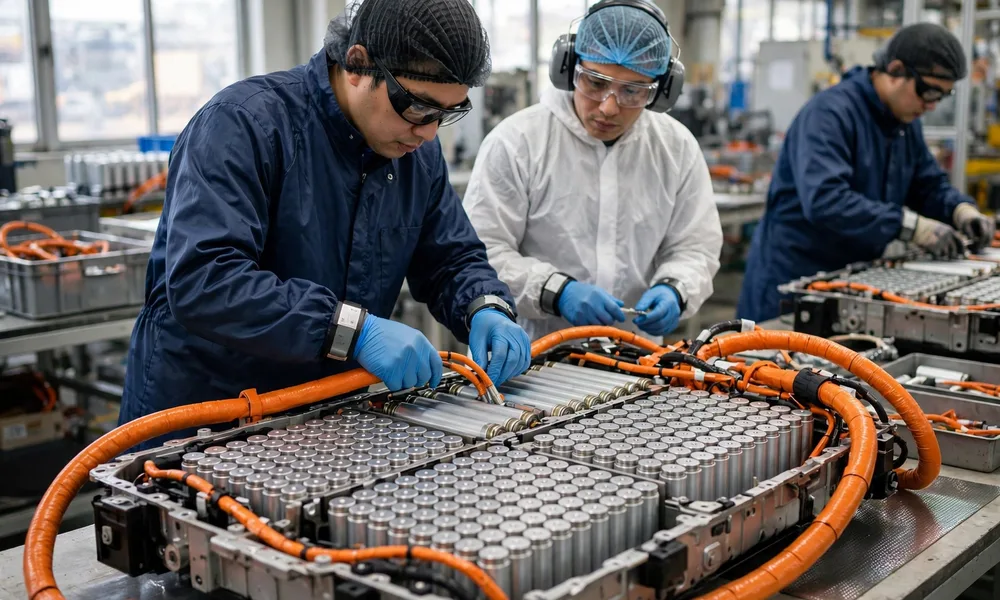
Individual cells are stacked into modules, and modules into packs, just as in today’s electric cars. The difference is in what the pack does not need: with no flammable liquid to contain, the fire walls and cooling channels between cells can be lighter, and some of the safety structure can be removed. But the pack gains a new job instead: it must keep the cells under steady pressure for their whole life, so the layers stay in contact as they age. The cells themselves are compared in the same terms as every battery before them, and the EV battery cell specs show how engineers measure energy, power and life across chemistries.

Step 7: Proving it on the road
The final step is the slowest: proving that a solid-state battery can survive thousands of charges, hot summers, cold winters and a decade of daily use. Toyota, which has said it aims to put solid-state batteries into production cars in the late 2020s, and other makers including QuantumScape, Samsung and Solid Power, are all working through the same proving ground: small production lines, test fleets and long cycle tests. The first cars to carry solid-state batteries will probably be expensive models, where the cost matters less than the range and the charging speed.
Specs
| Specification | Typical figure |
|---|---|
| Electrolyte | Solid ceramic, glass or polymer, no liquid |
| Anode | Lithium metal, instead of graphite |
| Energy density, prototypes | Over 400 Wh per kg in lab cells |
| Energy density, current lithium-ion | About 250 to 300 Wh per kg |
| Flammability | No flammable liquid electrolyte |
| Main failure mode | Lithium dendrites piercing the electrolyte |
| Charging claim, lab cells | Hundreds of km of range in about 10 minutes |
| Production target | First cars aimed for the late 2020s |
Price
No solid-state battery is yet sold in a mass-market car, so there is no retail price to quote. As an estimate, industry analysts generally expect early solid-state cells to cost several times as much per kilowatt-hour as today’s lithium-ion cells, with costs falling as production scales — these are estimates, not prices. For scale, a lithium-ion pack in an electric car currently costs roughly $100 to $150 per kilowatt-hour at pack level, also an estimate.
A Rare Fact
In the 1830s, the scientist Michael Faraday noticed that solid silver sulphide could conduct electricity when heated, the first observation of ions moving through a solid. Faraday had no battery to build with it and no car to put it in, but he had found the phenomenon that every solid-state battery depends on. The technology now heading for the road in the late 2020s rests on an effect first seen in a London laboratory almost two hundred years ago.
From a thin ceramic layer to a pack that could take an electric car further and charge it faster, the solid-state battery works by changing the road the ions travel on, not the journey itself. And the companies racing to make it real are not racing against each other so much as against the dendrites, the cracks and the contact problems that have held the idea back for decades. When they solve those, the battery that does not burn will finally be the battery that drives.


