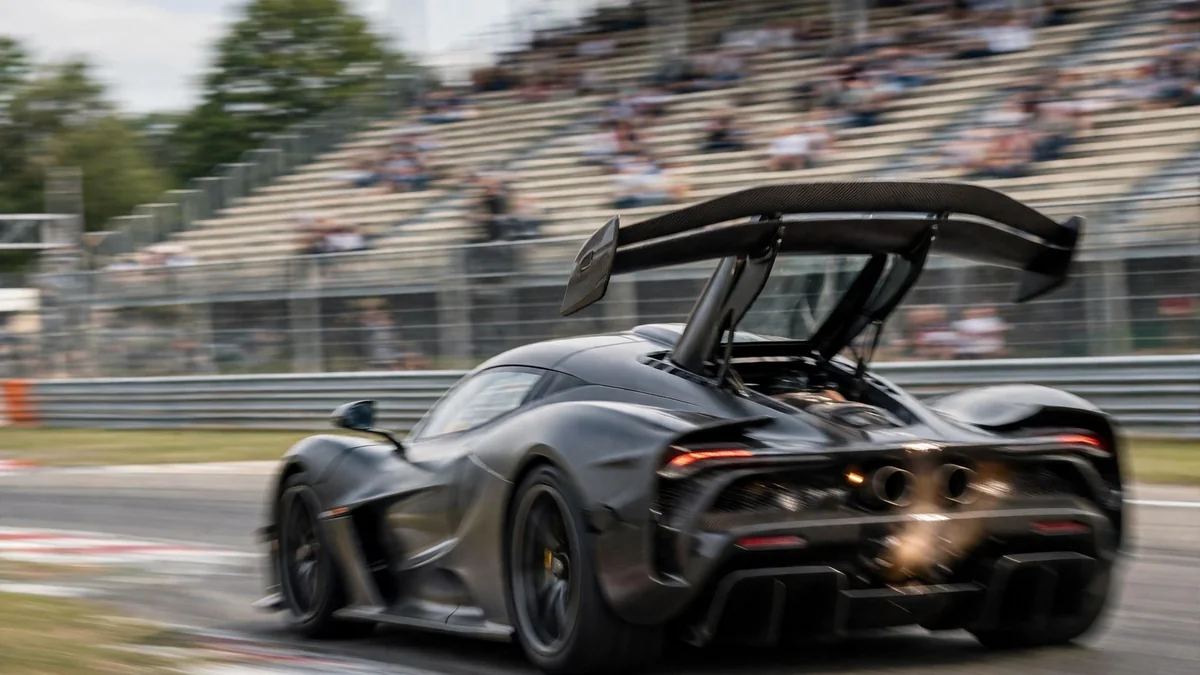
Watch a hypercar attack a fast corner and you will see something strange happen to the wing on its tail. At low speed it sits flat and quiet, almost polite. Then, as the car brakes hard for the bend, the wing tilts up like a hand held out of a car window, and the whole rear of the car seems to hunker down onto the road. A moment later, on the straight, the wing flattens again and the car surges forward as if the air had simply stepped aside.
That wing is not decoration. It is a spoiler — an upside-down aeroplane wing whose job is to press the car into the tarmac — and on a modern hypercar it is a living thing, changing shape dozens of times a lap in answer to speed, steering, and braking. A good spoiler can add more than a tonne of downforce at top speed, which is why a hypercar can corner at speeds that would throw an ordinary car off the road. This is how it works.
How It Works
Step 1: Fast air meets an upside-down wing
Everything starts with the shape. A spoiler is an aerofoil turned upside down: its upper surface is curved and its lower surface is flatter, the opposite of an aircraft wing. As air rushes over it, the air travelling over the curved top surface has further to go, so it speeds up and its pressure drops, while the air beneath stays slower and at higher pressure. The difference pushes the wing downward, and because the wing is bolted to the car, that push presses the rear tyres into the road. More grip means the car can brake later, corner faster, and put its enormous power down without the wheels spinning.
Step 2: The angle of attack is set for the corner
Downforce grows with the wing’s angle of attack — the tilt of the wing against the oncoming air. A steep angle grabs more air and makes more downforce, but it also makes more drag, slowing the car on the straights. Engineers therefore tune the angle for each track: a twisty circuit gets a steep, aggressive setting, while a fast circuit with long straights gets a flatter one. On some cars the driver or the team can change this angle in the pits with a few turns of a wrench; on others, the car does it by itself, lap after lap, as the next step explains.
Step 3: Actuators move the wing in real time
A modern hypercar spoiler is not fixed. Small hydraulic rams or electric motors — the actuators — pivot the wing on its mounts, and they can move it in a fraction of a second. The car’s computer watches speed, steering, throttle, and brake pressure, and commands the wing to match. Under hard braking, the wing rises steeply to act as an air brake, adding drag that helps slow the car. In a fast corner, it holds a high-downforce angle to glue the rear tyres down. On a long straight, it flattens to slice through the air. The driver feels none of this directly; they simply feel a car that always seems to have grip to spare.

Step 4: Sensors feed the brain
The wing is only as smart as the information it receives. Wheel-speed sensors, accelerometers, a gyroscope, and ride-height sensors report what the car is doing many times a second, and a dedicated aerodynamic control unit turns those readings into wing commands. If the car starts to slide, the system adds rear downforce to settle it. Accelerating hard in a straight line, it trims the wing flat to cut drag. Some systems read the road ahead, using speed and steering to predict the next corner and set the wing before the driver turns in. It is a conversation between the air and the electronics, held at two hundred miles an hour.
Step 5: Drag is traded for grip, lap after lap
Every gram of downforce costs something in drag, and the spoiler’s real skill is knowing when the trade is worth it. Through a corner, downforce is priceless: the extra grip lets the car carry more speed and power out earlier. On a straight, downforce is mostly a burden, pushing the car down and holding it back. The active wing balances this trade hundreds of times per lap, steep in the corners and flat on the straights, so the car is fast everywhere instead of fast in only one place. Some systems add a drag-reduction mode, flattening the wing almost completely on the straight, much like the DRS flap used in Formula 1.
Step 6: The wing works with the whole car
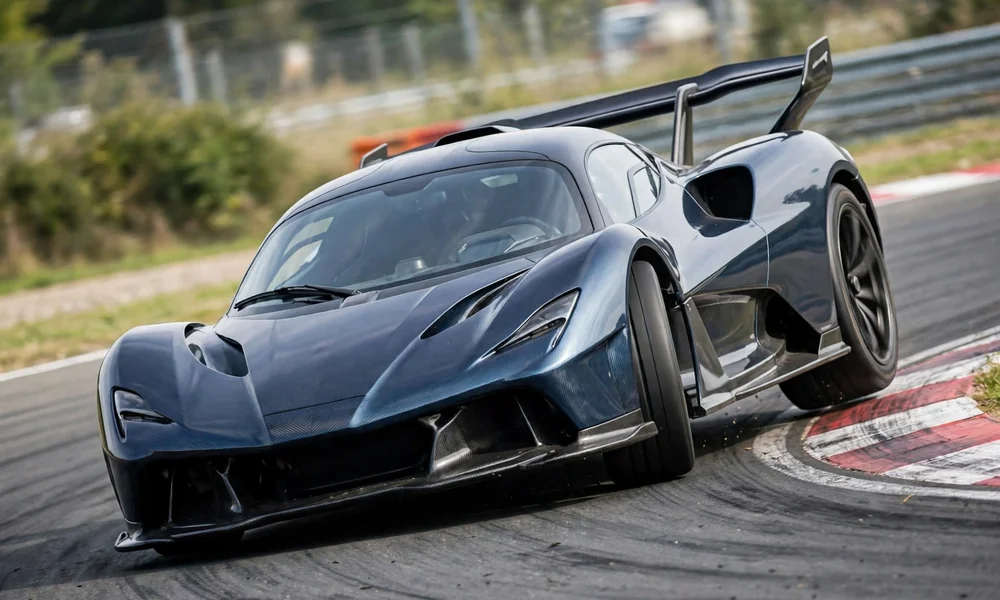
A spoiler never works alone. The air that leaves it flows on to shape the wake behind the car, and the front of the car must balance it: too much rear downforce without matching front downforce makes the car understeer, while too little makes the tail nervous. So the spoiler is tuned with the front splitter, the underbody diffuser, and the vents cooling the brakes and engine. Even the wing’s endplates matter, stopping high-pressure air from spilling around the tips and cancelling the downforce. When the whole package is right, the car feels planted and calm at speeds where the air is trying its hardest to tear it off the road.
Specs
| Specification | Typical figure |
|---|---|
| Material | Carbon fibre, often with a titanium or aluminium frame |
| Peak downforce | Roughly 500–1,000 kg at top speed, depending on the car |
| Actuation | Hydraulic rams or electric motors |
| Adjustment speed | Full movement in well under a second |
| Angle range | Often 0–30 degrees or more |
| Control inputs | Speed, steering, throttle, brake pressure, ride height |
| Air-brake mode | Wing rises steeply under hard braking |
| Typical weight | Roughly 10–25 kg for wing and mounts |
| Drag-reduction mode | Wing flattens on straights to cut drag |
Price
An active rear spoiler system for a hypercar typically costs roughly $15,000 to $80,000 as an estimate, depending on the materials, the actuator system, and how much of it is bespoke carbon fibre — these are estimates, and the final price depends on the manufacturer and whether the wing is replaced alone or with its control unit and mounts. A single carbon wing element can cost several thousand dollars by itself, and a damaged actuator or sensor can add thousands more. The craft behind the wing is told in how a hypercar spoiler is made, the reason for the steep bill is explained in why a hypercar spoiler costs so much, and the structure it bolts onto is covered in how a hypercar chassis is made.
A Rare Fact
At top speed, some hypercars generate so much downforce from spoiler and underbody that, in theory, they could drive upside down on a tunnel ceiling — the aerodynamic push would exceed the car’s weight. No one has ever tried it, for obvious reasons, but the numbers are real: more than a tonne of invisible hand pressing the car into the road, conjured from nothing but shaped air and a wing that knows exactly when to move.
From a flat blade on a straight to a steep air brake in a corner, the hypercar spoiler is a wing that thinks. It trades drag for grip a hundred times a lap, and the driver never has to ask.