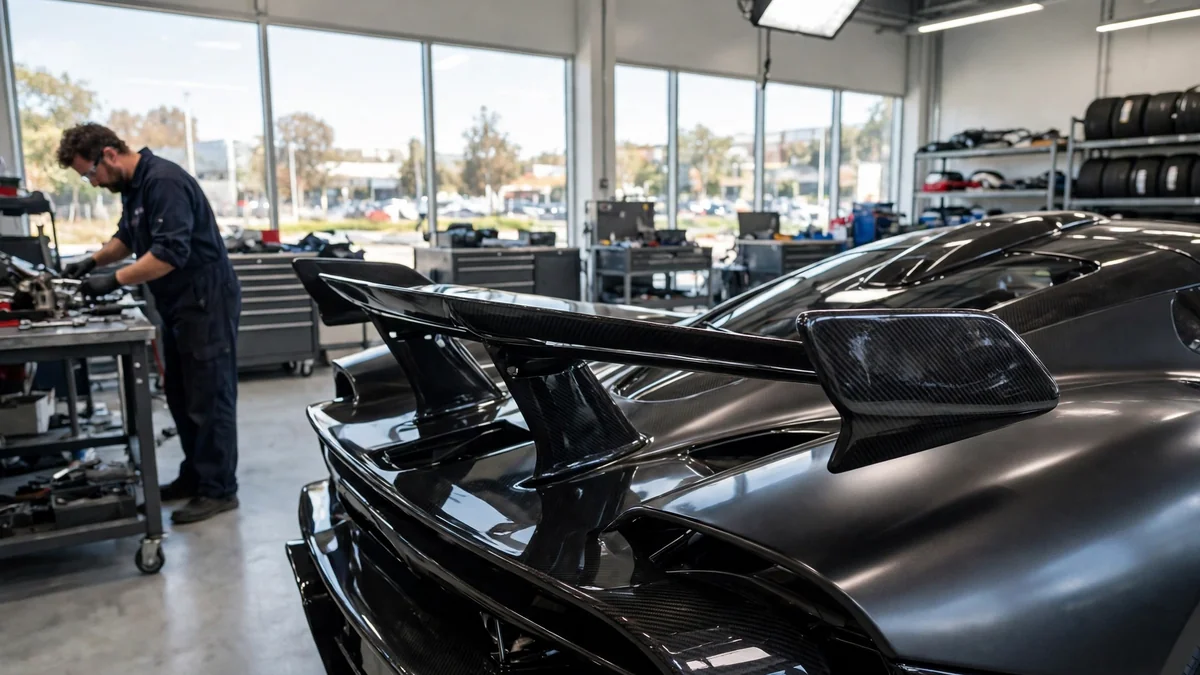
Picture a hypercar braking from 320 kilometres an hour into a tight corner. The nose dives, the tyres scream, and the whole car seems to crouch — as if an invisible hand were pressing it down onto the tarmac. That hand is real, and it is bolted to the back of the car. It is the rear spoiler, a wing that turns rushing air into grip, and on a modern hypercar it is one of the most precisely engineered parts on the entire machine.
A spoiler is not decoration. At speed, a car without one generates lift, like an aircraft wing turned the wrong way, and lift is the enemy of grip. A well-made hypercar wing does the opposite: it pushes the rear axle down with hundreds of kilograms of force, letting the tyres bite harder exactly when the driver needs it most. Some active wings tilt, rise, and flatten themselves in fractions of a second, acting as an air brake one moment and a slippery low-drag blade the next.
Making one is a study in contradiction. It must be strong enough to survive the force of a small car pressing on it at full speed, yet light enough to weigh less than a suitcase. The answer is carbon fibre, laid by hand, cured under pressure, and finished like a piece of jewellery. This is how that wing is made.
How It’s Made
Step 1: Designing the wing in the wind tunnel
Every spoiler begins as mathematics. Aerodynamicists shape the wing’s profile on computers, simulating how air will flow over and under it at every speed the car can reach. The goal is a precise balance: enough downforce to grip, but not so much drag that top speed suffers. Once the digital shape looks right, a full-size prototype is tested in a wind tunnel, where smoke and sensors reveal exactly where the air separates and stalls. Only when the numbers and the smoke agree does the design move to the factory floor. The same obsession with airflow shapes the rest of the car, as seen in how the McLaren W1’s aerodynamics are made.
Step 2: Cutting the carbon-fibre cloth
The wing is built from sheets of carbon-fibre cloth, each one a weave of hair-thin carbon strands pre-impregnated with resin. Technicians cut the cloth into patterns — called plies — using computer-guided cutters that follow the design to the millimetre. Different plies run in different directions, because a wing must be stiff along its span, flexible enough to absorb vibration, and strong where the mounting pylons bolt through. A single wing can contain dozens of plies, and the exact stacking order is a closely guarded secret at every hypercar maker.
Step 3: Laying up the wing by hand
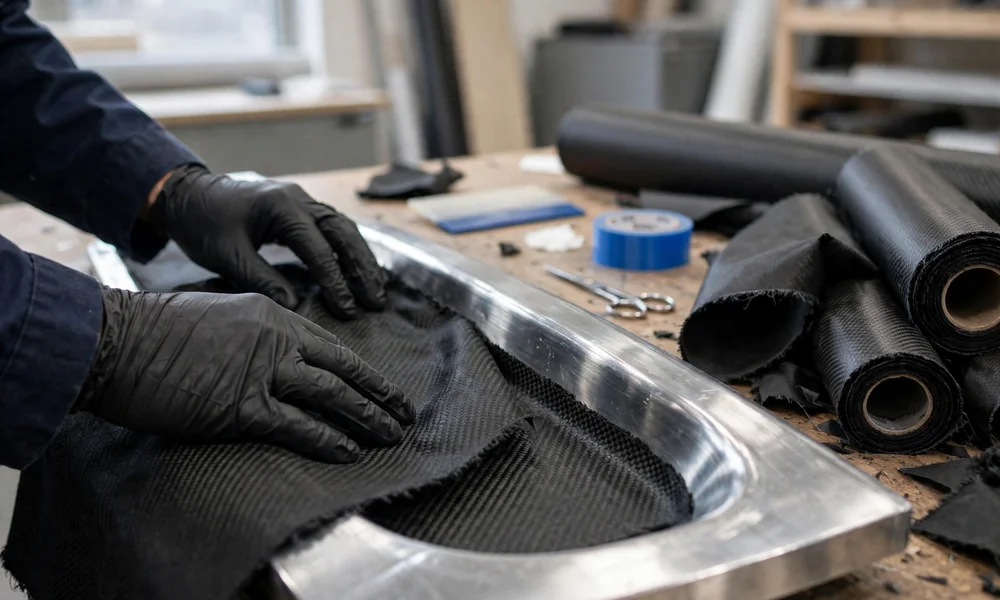
The plies are laid, one by one, into a polished metal mould shaped like the wing’s skin. This is skilled handwork: each layer must sit perfectly flat, with no wrinkles, bubbles, or gaps, because any flaw becomes a weak spot. Technicians use rollers and heat guns to press each ply into the mould’s curves, building up the upper and lower skins separately. Between them goes a lightweight core — often aluminium honeycomb or structural foam — that gives the wing its thickness and stiffness without adding much weight. It is the same sandwich principle behind hypercar aerodynamic body production, where lightness and strength must coexist.
Step 4: Curing in the autoclave
Once laid up, the mould is sealed inside a vacuum bag and placed in an autoclave — a giant oven that is also a pressure chamber. Inside, the temperature climbs to around 120 to 180 degrees Celsius while the pressure squeezes the layers together at several times atmospheric pressure. The heat cures the resin, turning the soft cloth into rigid carbon composite, while the pressure squeezes out trapped air. A typical cure takes several hours, and the wing emerges as a single stiff, feather-light shell, its surface already showing the distinctive carbon weave.
Step 5: Machining, bonding, and fitting the mechanism
The cured shell is trimmed on a five-axis milling machine, which cuts the trailing edge and mounting points to tolerances finer than a human hair. The upper and lower skins are bonded together, the endplates and pylons are attached, and — for an active wing — the hydraulics or electric actuators are installed. These are the muscles that tilt the wing: a small hydraulic ram or a fast electric motor, linked to the car’s computer, can swing the wing through its full range in well under a second. Every bolt hole is drilled with jigs, because a wing that is a millimetre out of alignment will pull the car sideways at speed.
Step 6: Painting, testing, and final inspection
The finished wing is sanded, primed, and painted — often in the same paint shop as the car itself, so the colour matches exactly. Then comes testing: the wing is bolted to a rig and loaded with forces greater than it will ever see on the road, while engineers check for flex, creaks, or cracks. Only after passing every test is the wing fitted to the car, aligned with lasers, and driven at speed to confirm it behaves exactly as the wind tunnel predicted. The wheels it works with are just as specialised, as hypercar carbon wheels show.
| Main material | Carbon-fibre composite over a honeycomb or foam core |
| Typical weight | About 5 to 12 kilograms for the wing alone |
| Downforce produced | Several hundred kilograms at top speed |
| Curing temperature | Around 120 to 180 degrees Celsius in an autoclave |
| Active adjustment | Hydraulic or electric actuators, moving in under a second |
| Surface tolerance | Within a fraction of a millimetre of the design shape |
| Mounting | Twin pylons bolted through the body to the chassis |
| Finish | Painted to match the car, often with exposed carbon weave |
What Does a Hypercar Spoiler Cost?
There is no catalogue price for a hypercar spoiler, because each one is designed for a single model and built in tiny numbers. A fixed carbon-fibre wing for a limited-production hypercar is estimated at roughly $15,000 to $40,000, while an active wing with hydraulics, sensors, and its own control software is estimated at $50,000 to $100,000 or more. These are estimates only, and they exclude the wind-tunnel time and engineering behind the design. For the owner, the real cost appears later: a damaged wing usually means ordering a replacement from the factory and waiting weeks for it to be made.
A Rare Fact
The first cars to use wings were not road cars at all, but 1960s racing machines — and they were so effective that some early wings were mounted on tall struts directly to the suspension, so the downforce pressed on the tyres without compressing the springs. Regulators soon banned the tallest designs after a few spectacular failures, but the idea never went away. Today’s hypercar wings are descendants of those wild experiments, tamed by carbon fibre, computers, and a half-century of wind-tunnel science.

A hypercar spoiler is easy to admire and easy to misunderstand. It looks like a styling flourish, but it is a working surface — a wing that flies upside down, built by hand from cloth and resin, and tuned to keep a thousand-horsepower car glued to the road. The next time one rises as a hypercar brakes, remember the mathematics, patience, pressure, and heat behind it.


