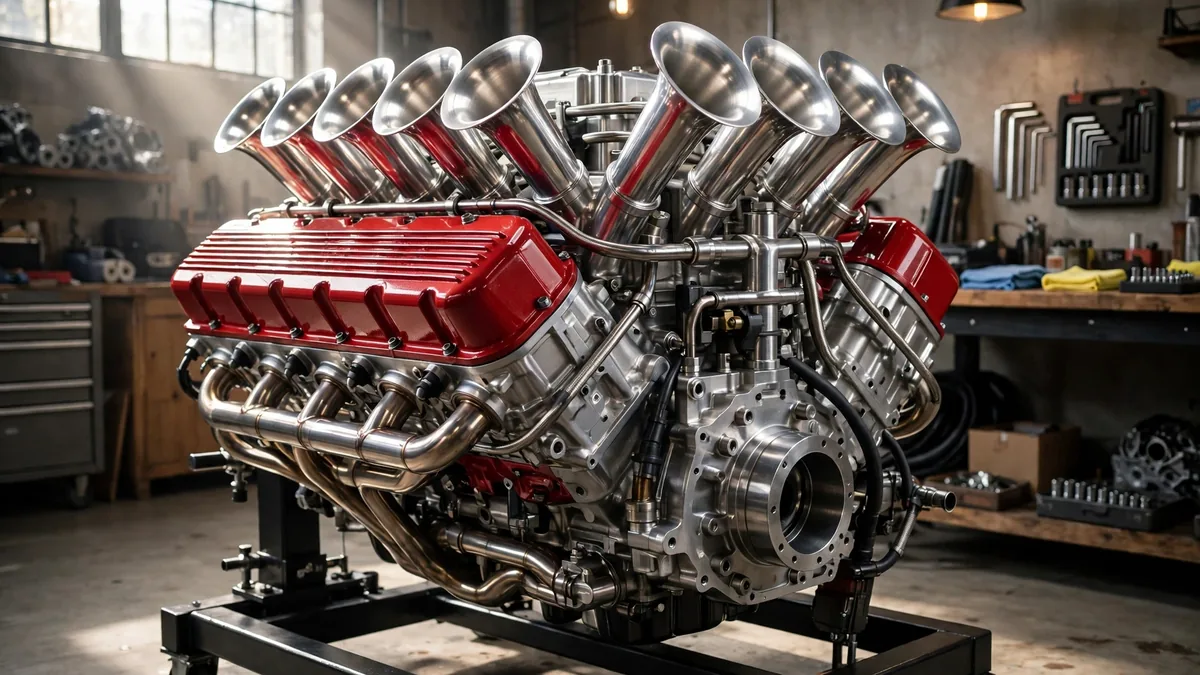
There is a room in every great hypercar factory where the noise stops. No robots, no conveyor belts, no rush. Just a bench, a set of tools laid out in a row, and one person building an engine from start to finish. The engine is a V12, twelve cylinders in a V, and it is the last of its kind: no turbochargers, no hybrid assistance, just displacement, revs, and craftsmanship. A modern V12 hypercar engine takes days to build, and when it is done, the person who built it signs it.
The V12 has survived because nothing else sounds or feels like it. Smaller engines can match its power with turbos, and electric motors can beat its acceleration, but neither can copy the way a V12 gathers speed: smooth, endless, and loud in a way that seems to come from everywhere at once. That character is not an accident. It is the result of dozens of parts, each made to tolerances a human hair would fail, fitted together by hand. This is how a hypercar V12 is made.
How It’s Made
Step 1: Casting the block
Every V12 begins as molten metal. The engine block, the great aluminium casting that holds the cylinders, is poured into a sand mould and left to cool slowly so its structure sets evenly. Once cool, the casting is heat-treated to harden it, then left to age so internal stresses settle out. A block that is rushed at this stage will warp later, when it is hot and under load, so the foundry gives it time. The finished casting is heavy, rough, and grey, and it looks nothing like an engine yet. Lightweight structure matters everywhere in a hypercar, and the same obsession drives the car’s body, as our guide to carbon monocoque production explains.
Step 2: Machining the block and heads
The rough casting goes to a machining centre, where cutters bore the twelve cylinder liners, face the decks flat, and drill the oil and coolant passages. The cylinder heads, which carry the valves and camshafts, are machined the same way. Tolerances here are measured in microns: a bore a fraction too wide and the piston rings will never seal; a deck a fraction out of flat and the head gasket will fail at full throttle. Each block is measured with probes and bore gauges, and the numbers are recorded against that engine’s serial number for life.
Step 3: Forging the moving parts
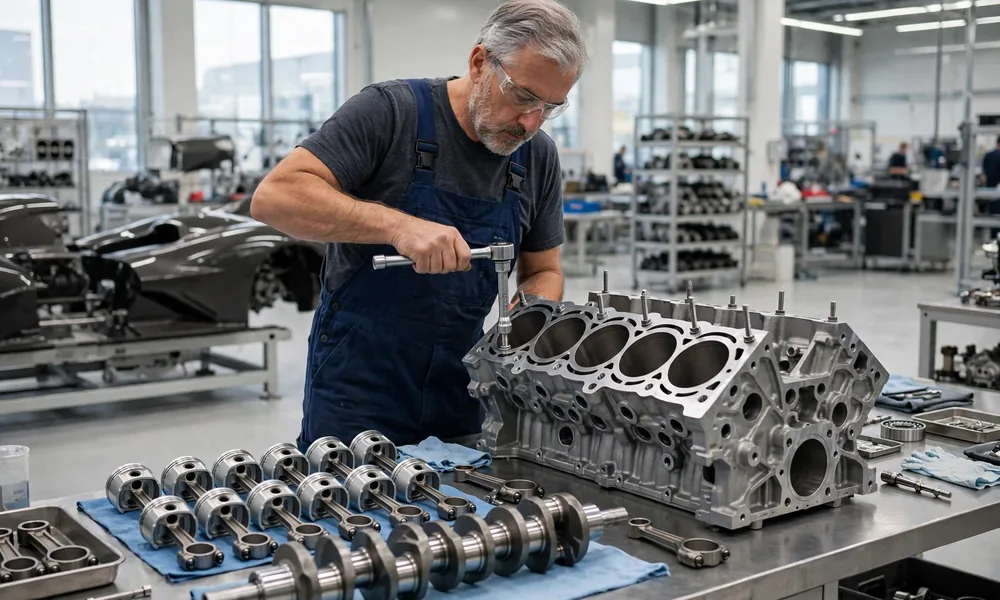
While the block is being machined, the parts that move inside it are made separately. The crankshaft is forged from steel, then ground and balanced until it spins true. The pistons are forged from aluminium alloy, light enough to change direction thousands of times a minute. The connecting rods, which join pistons to crankshaft, are often made from titanium in a V12 hypercar, because titanium is strong, light, and able to survive the enormous forces at 9,000 rpm and beyond. Each piston and rod is weighed and matched into sets, so that all twelve cylinders pull with exactly the same force.
Step 4: Balancing
A V12 is one of the few engine layouts that is naturally balanced. Its pistons are arranged so their vibrations cancel each other out, which is part of why a V12 feels so smooth. Even so, every rotating part is balanced on a machine before assembly, and the crankshaft is checked again with its flywheel and clutch attached. A tiny imbalance at idle becomes a destructive shake at the redline, so nothing is left to chance. The smoother the engine, the harder it can be pushed, and the more of its power reaches the road.
Step 5: Hand assembly
Now the engine comes together, and this is the step no machine does. A single master technician builds each V12 from start to finish: fitting the crankshaft and its bearings, sliding in the pistons, torquing the cylinder heads, setting the valve clearances, and timing the camshafts. Every bolt is tightened with a torque wrench to a figure in the build manual, and many are marked with paint so any movement is visible later. The work takes days, not hours, and at the end the builder fits a small plaque bearing their name to the engine. One person, one engine, one signature.
Step 6: Testing on the dyno
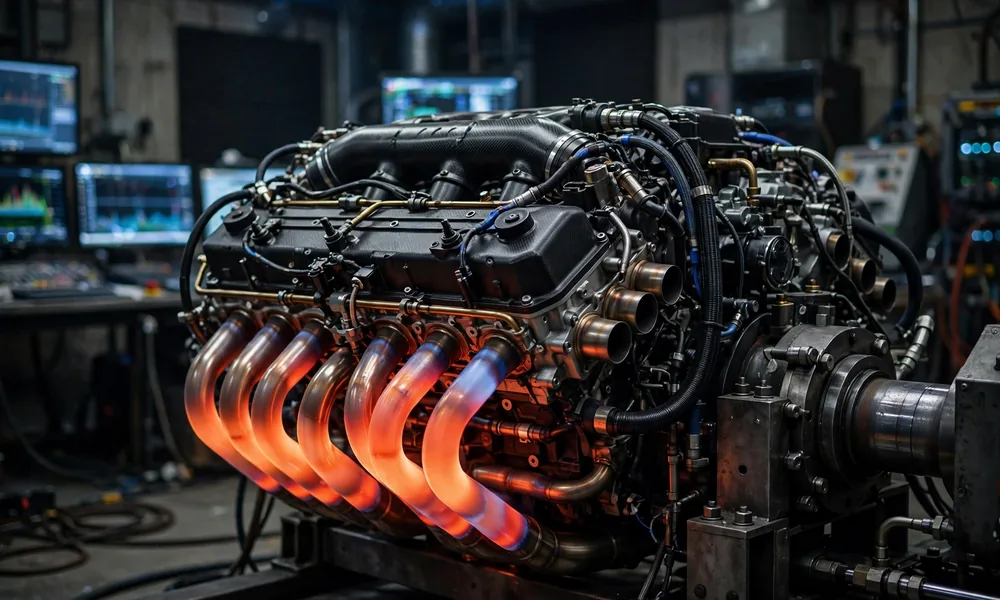
A finished V12 is not trusted until it has proved itself. It is bolted to a dynamometer, a machine that loads the engine as if it were driving a car, and run through its rev range while engineers watch power, temperatures, oil pressure, and vibration. The engine is run in gently at first, then pushed to full power. If anything is wrong, a noise, a temperature spike, a drop in pressure, the engine comes off the dyno and goes back to the bench. Only when it passes every test is it crated and sent to the car. All that power then has to be managed at speed, which is where the car’s active aerodynamics come in, and it is a reminder of how far engines have come from the simple motors described in our guide to how the electric motor works.
Specs
| Specification | Detail (typical modern naturally aspirated V12 hypercar) |
|---|---|
| Configuration | 60° V12, four valves per cylinder |
| Displacement | 6.0 to 6.5 litres |
| Power | Approximately 800 to 1,000 hp |
| Redline | Approximately 8,500 to 11,000 rpm |
| Aspiration | Naturally aspirated, no turbochargers |
| Block material | Cast aluminium alloy |
| Connecting rods | Titanium, forged pistons |
| Build | Hand-assembled by a single technician over several days |
Price
A hand-built V12 is among the most expensive engines in the world to make, and it is fitted only to hypercars built in tiny numbers. Modern V12 hypercars typically cost from around $400,000 to several million dollars (estimate, based on typical pricing of current V12 hypercars). The engine alone accounts for a large share of that figure: days of skilled hand labour, exotic materials, and hours of dyno testing for every single unit.
Rare Fact
The V12’s greatest trick is that it needs no balance shafts at all. In most engines, engineers add spinning counterweights to cancel out vibration. A V12 cancels its own shaking by geometry alone: the twelve pistons are timed so that for every piston moving one way, another is moving the opposite way with the same force. It is one of the very few engine layouts that is naturally, almost perfectly balanced, and it is the reason a V12 at full throttle feels less like a machine shaking itself apart and more like a turbine gathering speed.


