In 1997, the chairman of the Volkswagen Group was riding a bullet train in Japan when he sketched an engine on the back of an envelope. Three banks of six cylinders, eighteen in all, arranged in a W. His engineers talked him down to sixteen, and that sketch became the most extreme engine ever fitted to a production car. It would power the Veyron, then the Chiron, and it would stay in production for two decades.
The Bugatti W16 is two narrow-angle V8 engines joined on a single crankshaft, with four turbochargers, ten radiators, and more power than two supercars combined. It is also hand-built, one at a time, in a small atelier in Molsheim, France, by a team of technicians who assemble each engine over the course of days. There is no production line here, no robot doing the delicate work, only people, torque wrenches, and checklists.
Building a W16 is less like building a car engine and more like building a watch the size of a washing machine. Every part is measured, every bolt is tightened to an exact figure, and the finished engine is run on a test bench before it ever meets a car. Here is how it is made.
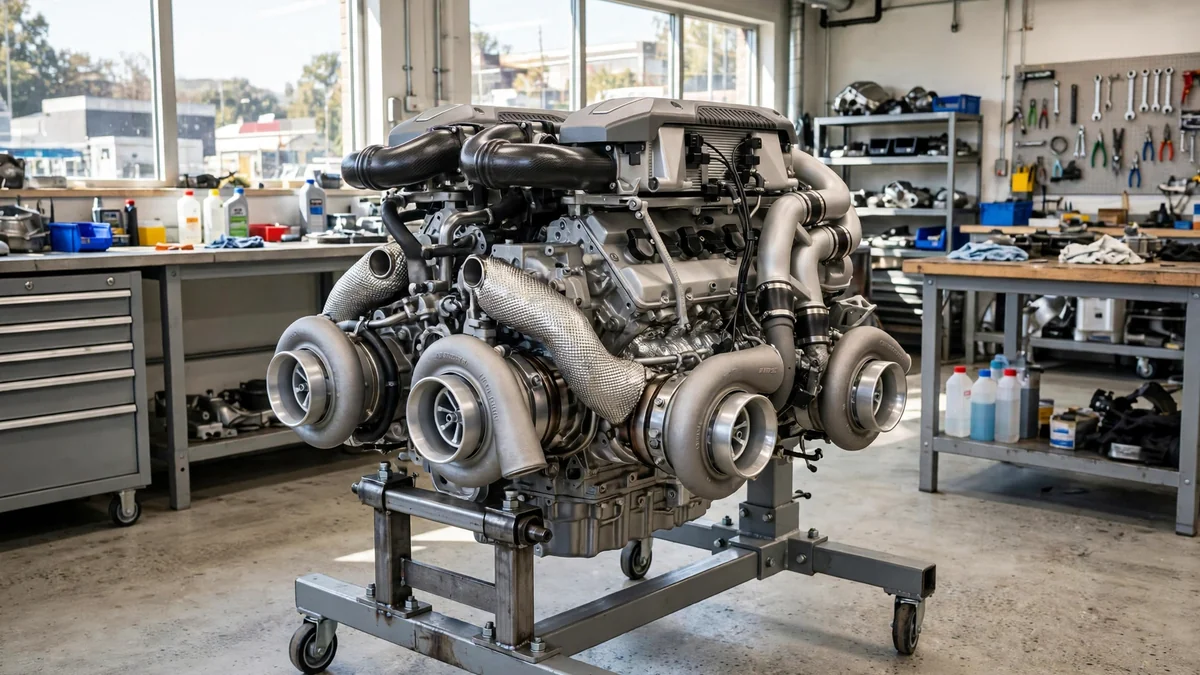
How a Bugatti W16 Engine Is Made
Step 1: Casting the aluminium block
The engine begins as molten aluminium alloy, poured into a sand mould to form the crankcase that holds the two banks of cylinders. The W layout means the block is wide and complex, with cooling passages and oil galleries cast inside it, and the mould must be exact, because a flaw buried in the casting would only show up later, under load. Once cool, the casting is cleaned, X-rayed for hidden voids, and aged in an oven to stabilise the metal. Blocks that fail inspection are scrapped, because there is no repairing a casting that will hold sixteen pistons at full boost. Only a perfect block moves on to machining.
Step 2: Machining the block and heads
The raw casting is clamped into a computer-controlled machining centre, where cutters bore the sixteen cylinder liners, mill the mating faces flat, and drill the oil and coolant passages to their final sizes. Tolerances are measured in hundredths of a millimetre, and each bore is honed to a mirror finish so the piston rings can seal against it at high pressure. The four cylinder heads are machined the same way, with seats cut for 64 valves, four per cylinder.

Step 3: Fitting the crankshaft and pistons
Next comes the rotating heart of the engine. A forged steel crankshaft, the single spine that all sixteen pistons share, is lowered into the block and checked for free rotation. The pistons, forged from aluminium alloy, are fitted with rings and connected to the crankshaft with steel connecting rods, eight per bank, in a sequence that balances the firing forces. Each bolt is tightened to a precise torque and angle, then marked with paint so that any movement later is visible at a glance. The crankshaft is balanced to a fine tolerance, because at 6,000 revolutions per minute even a tiny imbalance would shake the whole engine apart. This is slow work, done by hand, and it cannot be rushed.
Step 4: Adding the four turbochargers
With the short block assembled, the four turbochargers are fitted, two per bank, along with the exhaust manifolds and the intercoolers that chill the pressurised air. The turbos are precision instruments in their own right, with turbine wheels that spin at well over 100,000 revolutions per minute, and they are balanced individually before fitting. The pipework around them is a maze of heat-wrapped tubes, and each joint must seal perfectly, because a leak in the boost system would cost power and could overheat the engine.
Step 5: Wiring, plumbing, and the cooling system
The engine is then wired and plumbed. Injectors, sensors, and ignition coils are fitted to all sixteen cylinders, and the wiring loom is routed and clipped by hand, because there is no room for a loose cable in an engine bay this tight. The cooling system is connected next, a network of hoses feeding ten radiators in the finished car, with around 40 litres of coolant circulating through the engine, the intercoolers, the oil, and the gearbox. Two fuel pumps and a dry-sump oil system are fitted, the dry sump keeping oil flowing even under the savage forces the car generates. Every connection is checked, pressure-tested, and checked again.
Step 6: Bench testing and fitting to the car
Before it meets a car, every W16 is run on a test bench. It is started, warmed up, and run through its full rev range while engineers watch power, torque, temperatures, and pressures, listening for any knock, leak, or vibration. The engine must produce its rated power smoothly, and any engine that does not is stripped down and investigated. Only after it passes is the engine lifted into the car, where it bolts directly to the carbon-fibre monocoque and the seven-speed dual-clutch gearbox. The numbers behind the finished engine are laid out in the Bugatti W16 engine specs explained, the gearbox it drives is covered in the dual-clutch gearbox specs explained, and the older twelve-cylinder hypercar engine it succeeded is covered in how a hypercar V12 engine is made.
Bugatti W16 Engine Specs
| Specification | Typical range |
|---|---|
| Configuration | W16, quad-turbocharged, 64 valves |
| Displacement | 7,993 cc (8.0 litres) |
| Block material | Cast aluminium alloy |
| Power output | 1,001 to 1,578 hp, depending on model |
| Torque | 1,250 to 1,600 Nm |
| Turbochargers | 4, staged in pairs |
| Cooling | 10 radiators, about 40 litres of coolant |
| Weight | Around 400 kg |
What Does a Bugatti W16 Engine Cost?
Bugatti has never published a price for the W16 alone, but the numbers around it tell the story. A replacement engine is estimated at roughly $500,000 to $850,000 before labour, and a routine Veyron service is estimated at around $20,000 to $30,000. The Veyron launched at an estimated $1.7 million, later versions above $2.5 million, and the Chiron from an estimated $3 million. All prices are estimates only and vary widely by model, condition, and market. The engine alone costs more than most houses, and it was never meant to be sensible.
A Rare Fact
The W16 began life as a sketch on an envelope. In 1997, Ferdinand Piëch, then chairman of the Volkswagen Group, was riding a Shinkansen bullet train in Japan when he sketched an 18-cylinder engine on the back of an envelope. His engineers talked him down to sixteen cylinders, and the W layout was born. That sketch became the Veyron’s engine, and the W16 powered every Bugatti hypercar for two decades until the Chiron’s successor arrived with a hybrid V16. Few engines in history can trace their origin to a train journey and a pen.

The W16 is gone now, replaced by a hybrid era, and that is what makes it worth understanding. It was the last engine built with no regard for efficiency targets, only for how much a road car could do. No engine will ever again be quite so gloriously excessive, a sixteen-cylinder answer to a question nobody else thought to ask.


