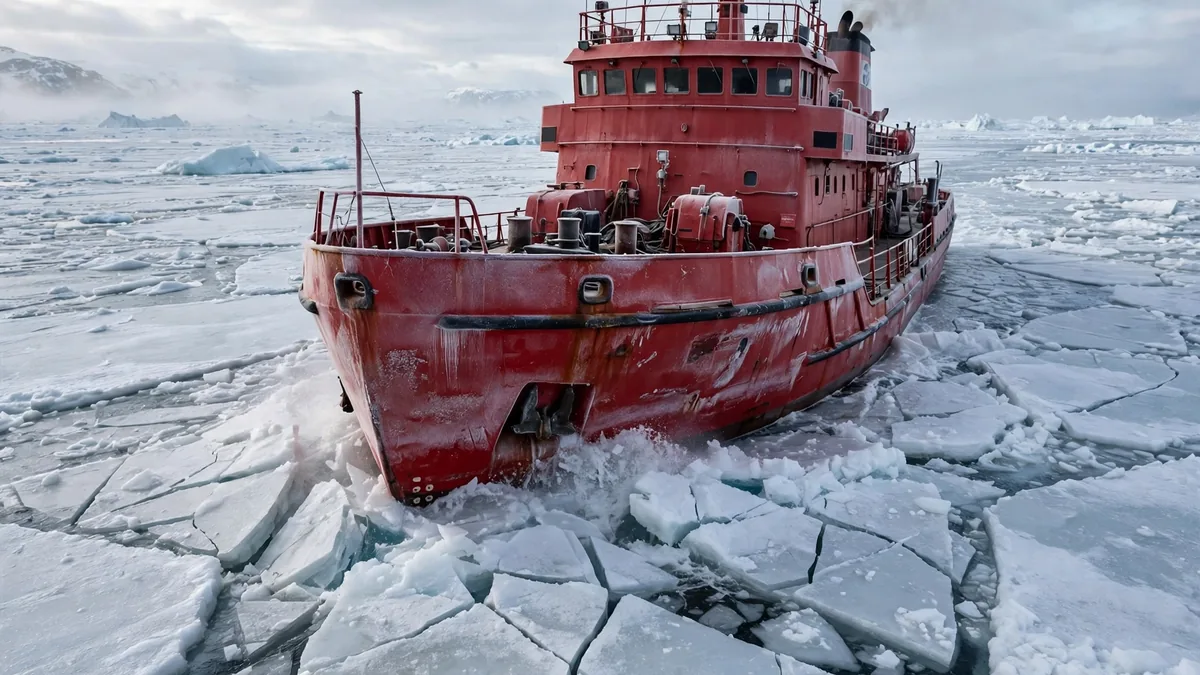
The ice was a metre thick, white and unbroken to the horizon. The bow rose, the hull groaned, and then — with a crack like a gunshot — the ship climbed onto the ice and its own weight broke through, tons of frozen sea splitting aside as the vessel pressed on. This was not a ship that avoided ice. It was an icebreaker, and its hull was built for a job no ordinary ship would attempt: to break the sea itself.
An icebreaker’s hull does not cut through ice like a knife. It defeats it the way a person breaks a frozen puddle by standing on it — by riding up onto the ice and letting gravity do the work. Ice is strong when you push against its edge, but weak when you press down on its surface, and an icebreaker’s hull is shaped to exploit exactly that. Its bow slopes like a spoon, its steel is far thicker than a normal ship’s, and its whole structure is built to take impacts that would cripple an ordinary vessel.
How It Works
Step 1: The spoon-shaped bow rides up onto the ice
The secret of the icebreaker is the shape of its bow. Where an ordinary ship’s bow is a near-vertical edge, an icebreaker’s bow slopes back at around 30 degrees, like the front of a spoon. When the ship meets the ice edge, the sloping bow slides up and over it, lifting the front of the ship onto the ice sheet. The ship’s weight then presses down on the ice from above. Ice can resist a horizontal push, but it is brittle under a vertical load, and it cracks in great slabs. The ship sinks back into the water through the broken ice, advances, and repeats the process.
Step 2: Extra-thick steel takes the punishment
Climbing onto ice is violent work, so the hull is built far heavier than a normal ship’s. The steel plating at the bow and along the waterline — the ice belt — is typically 30 to 50 millimetres thick, roughly twice a cargo ship’s plating, and made from high-strength steel that stays tough in extreme cold. Behind the plating, the frames are spaced much closer together, so an impact spreads across many supports. The steel is coated with low-friction paint, so the ice slides past rather than gripping the hull.
Step 3: The hull shape pushes broken ice aside and under
Breaking the ice is only half the job — the ship also has to get rid of it. The icebreaker’s hull is rounded in cross-section, without the flat sides and sharp corners of a normal ship, so broken ice is pushed down and under the hull rather than piling up along the sides. The stern lets broken ice flow past the propellers, and the channel left behind is wide enough for the vessels following it. In the worst conditions, when ice presses in from both sides, the rounded hull lets the ship be squeezed upward rather than crushed. That shape is the difference between an icebreaker and an ordinary hull, and the container ship hull built for open water shows how different the two jobs are.

Step 4: Power and propellers built for ice
Breaking ice takes enormous power. A large icebreaker can have 30,000 kilowatts or more driving its propellers — ten times a cargo ship of similar size — and its propellers are made from thick stainless steel or nickel-aluminium bronze, strong enough to chew through ice without shattering. Many icebreakers use azimuth thrusters, propellers that rotate 360 degrees, so the ship can push sideways, turn in its own length, and even go astern to ram the ice backwards. Some also have a bubbler system, which pumps air under the hull to reduce friction, and a heeling system that pumps water from side to side to rock the ship free.
Step 5: Backing and ramming when the ice wins
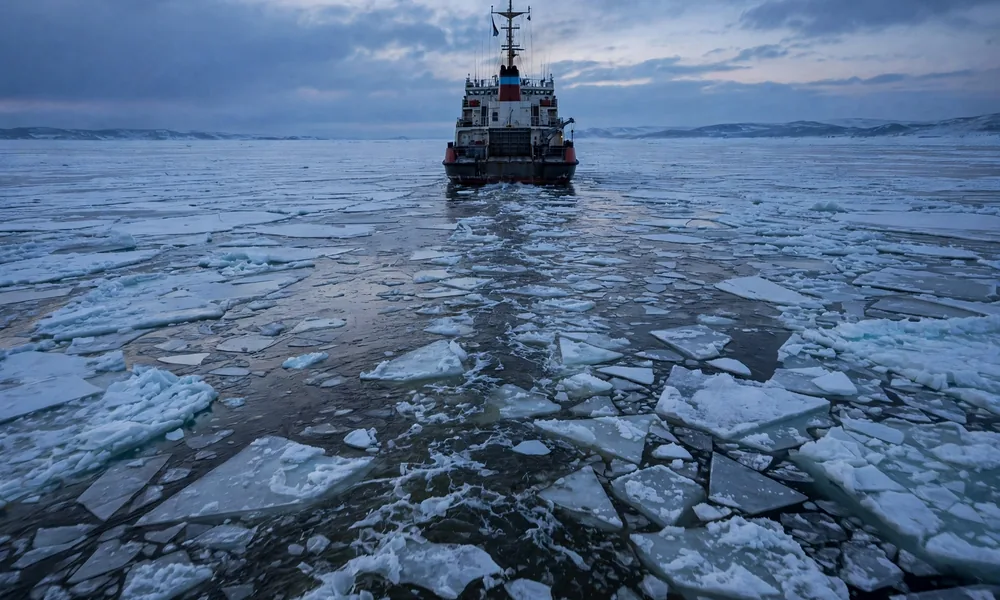
Sometimes the ice is too thick to break in a single pass, and the ship stops dead. The crew’s answer is backing and ramming: the ship reverses into the open channel behind it, then charges forward at full speed and slams into the ice edge, using its momentum to break through. It is slow and noisy — but it works, a few metres at a time, through ice two metres thick or more. The reinforced stern is built to take the reverse impact too, because an icebreaker often has to ram backwards to free its propellers.
Step 6: The hull protects the ship inside the ice
An icebreaker spends months surrounded by ice, and its hull has to protect everything inside it. The fuel tanks, ballast tanks, and engine room are all set back from the outer plating, with double hulls in the most vulnerable areas, so a dent in the outer steel does not flood the ship. The ship carries its own workshops, spare propeller blades, and steel plate for repairs at sea. The crew’s cabins are insulated against the cold and the noise of ice scraping along the hull. The hull is not just a tool for breaking ice; it is the crew’s shelter in one of the most hostile places on Earth. Other hulls face gentler seas, and the ferry hull built for daily crossings is a study in a different kind of strength — but nothing else afloat is asked to ram the sea and win. Below the waterline, the same obsession with strength shapes the most extreme hulls of all, including the submarine pressure hull built to resist crushing depth.
Specs
| Specification | Typical figure |
|---|---|
| Ice belt plating | Typically 30–50 mm thick |
| Bow angle | Around 30 degrees from horizontal |
| Icebreaking capability | 1–2 metres of level ice at slow speed |
| Propulsion power | Up to 30,000 kW or more on large icebreakers |
| Propellers | Thick stainless steel or nickel-aluminium bronze |
| Hull shape | Rounded cross-section, spoon-shaped bow |
| Steel type | High-strength steel, tough at low temperatures |
| Special systems | Air bubbler, heeling tanks, azimuth thrusters |
| Length | Typically 100–170 metres for polar icebreakers |
| Displacement | Roughly 10,000–25,000 tonnes |
Price
An icebreaker is one of the most expensive ships per tonne ever built. As an estimate, a large polar icebreaker costs roughly $500 million to $1.5 billion to build, while a smaller Baltic or Great Lakes icebreaker costs roughly $100 million to $300 million — these are estimates, and the real figure depends on size, ice class, and the country building it. The cost comes from the thick steel, the enormous power plant, and the fact that so few are built: there is no production line for icebreakers, and every one is close to a one-off.
A Rare Fact
The most powerful icebreakers in the world are nuclear-powered, and the largest can break through ice three metres thick — yet they still cannot break ice by cutting it. Even a nuclear icebreaker defeats ice the same way a wooden one did a century ago: by climbing onto it and letting its weight do the work. And the ice has one last trick: when an icebreaker is squeezed by moving ice from both sides, its rounded hull can lift the whole ship clear out of the water. Sailors call it being “nipped”, and a ship that survives it has done exactly what its hull was designed to do — refuse to be crushed, and rise instead.


