The ferry pulls away from the pier just after dawn, and for a moment the whole harbour seems to hold its breath. Cars and lorries are parked in neat rows on the vehicle deck, passengers are finding seats by the windows, and below them all, invisible in the grey water, is a steel shape doing a job most people never think about. The hull is the reason the ferry floats, the reason it stays upright when the wind picks up, and the reason it arrives at all. Without it, everything above the waterline is just cargo waiting to sink.
A ferry hull looks like a simple steel box with a pointed end, but it is one of the most carefully shaped objects on the water. Every curve is a compromise between speed, stability, carrying capacity, and fuel burn, and the compromises are different for every route. A short harbour crossing needs a different hull from a long open-sea run, and the engineers who design them think in decades: a ferry hull is expected to work hard for thirty years or more.

How a Ferry Hull Works
1. Buoyancy lifts the weight of the whole ship
The first job of the hull is the oldest one in shipbuilding: it must displace enough water to support its own weight. Archimedes worked out the rule more than two thousand years ago. A body in water is pushed upward by a force equal to the weight of the water it pushes aside, so a hull shaped to enclose a large volume of air floats, even though it is made of steel. A typical large ferry displaces several thousand tonnes of water, and the waterline is the visible mark of that balance: load more cars aboard and the hull sits deeper, displacing more water until the forces balance again.
2. The bow cuts the water instead of pushing it
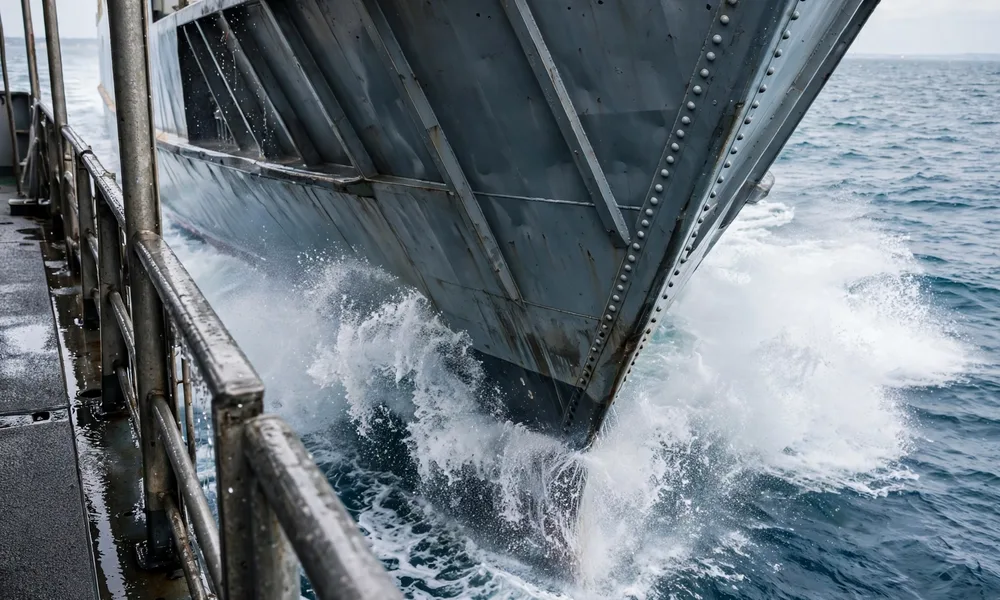
The pointed bow is the part everyone recognises, and its job is to split the water cleanly so the ship does not waste energy shoving it aside. Below the waterline, most modern ferries carry a bulbous bow, a torpedo-shaped swelling at the very front that creates its own wave. That wave cancels out part of the wave the hull itself makes, which reduces drag and saves fuel. It is a strange idea, fighting a wave with a wave, but it works so well that almost every large ferry has one.
3. The hull form keeps the ship stable
Stability is the hull’s second great job, and it is a matter of geometry. When a ferry rolls to one side, the shape of the hull under the water changes, and the centre of buoyancy shifts towards the low side. That shift creates a righting force that pushes the ship back upright. The wider and flatter the hull, the stronger that force, which is why ferries are broad and flat-bottomed compared with a yacht. But too much stability makes a ship snap back violently and throw passengers around, so designers aim for a gentle roll, strong enough to be safe and soft enough to be comfortable.
4. The stern and propellers turn power into motion
At the back of the hull, the shape narrows and rises so water can flow smoothly to the propellers. Most ferries have two propellers, one on each side of the centreline, driven by engines deep inside the hull. The propellers sit in tunnels or behind the hull’s skegs, protected from damage and fed with clean, undisturbed water. Many ferries also have bow thrusters, small propellers mounted sideways in a tunnel through the bow, which let the captain push the front of the ship sideways when docking. Together they give a ferry the manoeuvrability to berth in a tight harbour without tugboats, a trick that saves time on every crossing.
5. Compartments keep a damaged hull afloat
A hull is not one empty shell. Inside, watertight bulkheads divide it into separate compartments, so that a hole in one section floods only that section. This is the principle that keeps ships afloat after a collision or a grounding, and it is enforced by international safety rules. Ferries must be able to survive flooding in at least one main compartment and still stay afloat and upright. Pumps, alarms, and watertight doors are part of the same system. The hull is designed to fail gracefully, which is a strange thing to design for, but it is the reason ferry accidents so rarely end in a sinking.
6. Paint and steel fight a constant battle with the sea
The last job is survival. Seawater is one of the most corrosive environments on earth, and a steel hull would rust through in a few years without protection. The hull is coated with layers of paint, including antifouling paint below the waterline that stops barnacles and weed from growing and slowing the ship. Sacrificial anodes, blocks of zinc bolted to the hull, corrode instead of the steel, protecting it electrically. And every few years the ferry goes into dry dock, where the whole hull is inspected, blasted clean, and recoated.
Ferry Hull Specs at a Glance
| Specification | Typical range |
|---|---|
| Length overall | About 100 to 220 metres |
| Beam (width) | About 18 to 32 metres |
| Gross tonnage | About 10,000 to 60,000 tonnes |
| Service speed | About 18 to 25 knots |
| Vehicle capacity | About 100 to 600 cars |
| Passenger capacity | About 500 to 2,000 people |
| Hull steel thickness | About 10 to 25 millimetres |
Building a hull like this is a major industrial project. A new large ferry is estimated to cost about 80 to 250 million dollars, and the hull steelwork and its outfitting account for a large share of that total. A full dry-dock overhaul, including hull blasting and recoating, is estimated at about 1 to 5 million dollars, and it happens every few years for the life of the ship. Prices are estimates and vary widely by shipyard, size, and market.
The hull is only part of the story. The container ship hull specs explained guide compares how a cargo ship’s hull differs from a ferry’s, the cruise ship engine specs explained guide looks at the power plants that drive large ships, and the yacht keel specs explained guide explains the smaller cousin of the ferry hull’s stability system.

A Rare Fact About Ferry Hulls
Here is something few passengers ever learn: many modern ferries have a hull shape that is deliberately asymmetrical below the waterline. The twin propellers turn in opposite directions, and each side of the stern is shaped slightly differently to feed clean water to its own propeller. From above, the ship looks perfectly symmetrical. From below, it is not. The asymmetry is invisible to everyone except the engineers and the divers who clean the hull.
The next time you stand on a ferry deck and feel the gentle roll of the ship, think about the steel below your feet. It is holding back the sea, balancing thousands of tonnes, cutting the water cleanly, and doing it all with a shape that was argued over in design offices years before the ship ever touched the water. The hull never asks for attention. It just works, crossing after crossing, year after year.