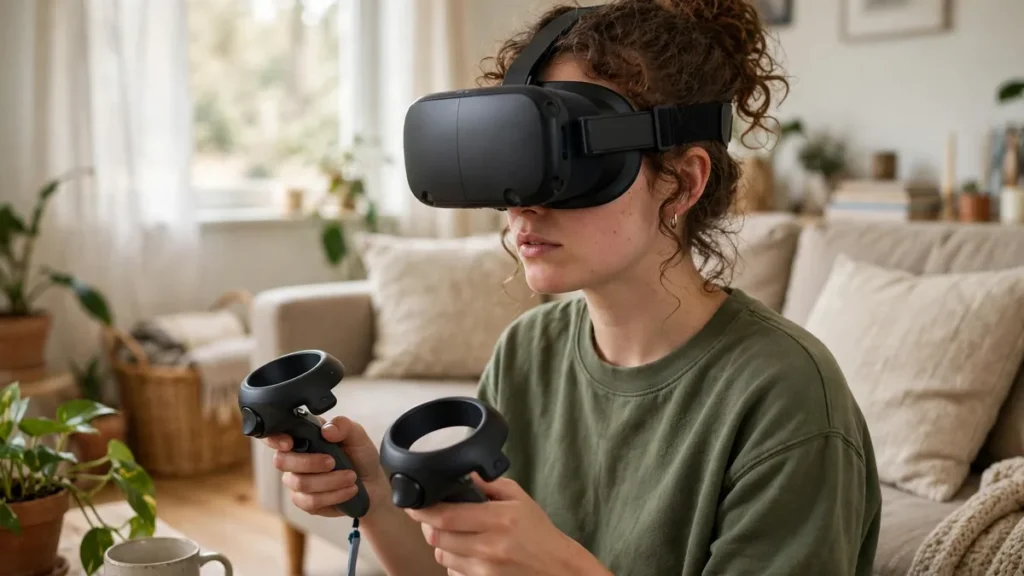
She is standing at a street corner wearing what looks like an ordinary pair of slim glasses, and she is reading a map that is not there. The map floats in the air in front of her, arrows turning with the street, while the traffic and the shopfronts show straight through it. That is the trick of luxury AR glasses: they add a layer to the world without covering it up.
This is how luxury AR glasses work, from the tiny projector in the arm and the etched waveguide in the lens to the cameras that anchor the picture to the real world, and the battery that keeps it all running for hours.

Step 1: The projector paints a tiny picture
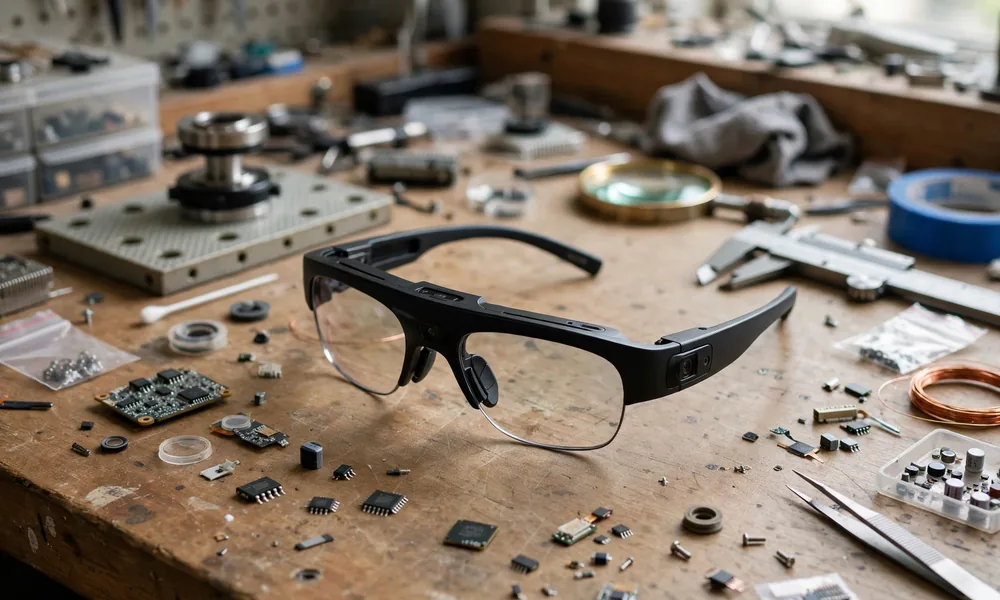
Everything the wearer sees starts in the arm of the frame, where a projector smaller than a grain of rice makes a picture on a display no bigger than a postage stamp. The display is usually micro-OLED or micro-LED, bright enough to be seen in daylight, and a small lens focuses its image into the edge of the lens. How that picture is built in the first place is a story of its own, and the guide to how luxury AR glasses are made follows the glasses from a sheet of glass to a finished frame.
Step 2: The waveguide bends the light to your eye
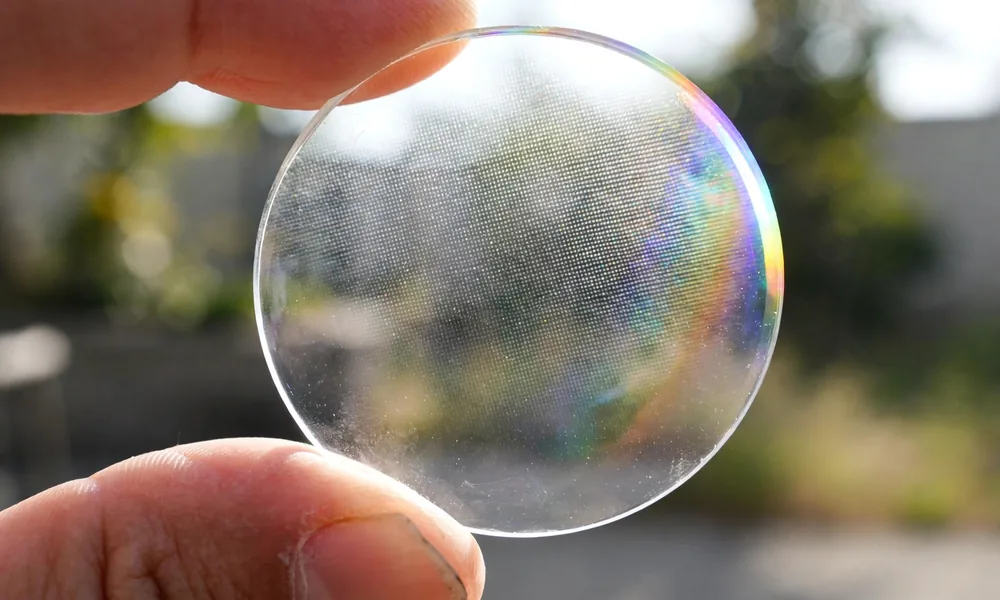
From the projector, the light enters the lens, and the lens is not an ordinary lens at all. It is a waveguide, a thin sheet of glass with a pattern of microscopic grooves etched into its surface, and it works by trapping light inside the glass and guiding it along to the wearer’s eye, the way a fibre optic cable guides light around a corner. The science of the waveguide decides how wide the picture feels and how bright it stays, and the guide to how an AR glasses waveguide works sets out the grooves, the angles and the trade-offs in full. The grooves are so fine that a finished waveguide looks like plain glass to the naked eye, and only a tilt against the light gives the pattern away.
Step 3: The cameras map the world around you
While the projector paints, the cameras watch. Tiny cameras in the bridge and the arms track the wearer’s hands, read the room, and follow the motion of the head, so the floating picture can be anchored to a real object instead of drifting across the view. If the wearer turns their head, the picture stays fixed to the wall or the table it belongs to, because the cameras and the motion sensors have already measured the turn and moved the image to match.
Step 4: The processor decides what to show
Between the cameras and the projector sits the processor, a small chip that decides what the wearer should see and when. It takes the map from the cameras, the position of the head, and the app the wearer is running, and it works out where each label, arrow or object should sit in the world. The simpler cousins of AR glasses work in a similar way but with far less to anchor, and the guide to how luxury smart glasses work shows how a small screen in the corner of the view differs from a picture fixed to the world.
Step 5: The battery and the frame carry it all
All of this runs on a battery hidden in the arms of the frame, split into two thin cells, one in each arm, so the weight balances across the ears. The battery is the reason the glasses last four to six hours rather than all day, because a bigger battery would make the frame too heavy to wear, and the frame itself is part of the machine: titanium or carbon composite, shaped to hold the projector steady, because a projector that shifts by a hair throws the whole picture off.
Step 6: The picture and the world line up
The final test of AR glasses is not on a bench but on a street. The wearer walks, turns, looks up at a sign and down at a menu, and the floating picture must stay where it belongs, sharp in daylight and steady when the head moves fast. If the picture lags behind the turn, the wearer feels seasick, so the glasses predict the motion a fraction of a second ahead, moving the image before the head has finished turning. When the alignment holds and the brightness matches, the wearer forgets the glasses are there, and the map simply becomes part of the street. A tester who feels even a hint of lag sends the glasses back for recalibration, because a picture that swims is worse than no picture at all.
The spec sheet at a glance
| Specification | Typical luxury figure | What it tells you |
|---|---|---|
| Display | Micro-OLED or micro-LED | How bright and sharp the image is |
| Optics | Waveguide with etched grating | How the picture reaches your eye |
| Field of view | 40–60 degrees | How large the floating image feels |
| Tracking | Cameras plus motion sensors | How the image stays fixed to the world |
| Eye tracking | Infrared gaze sensors | Whether the picture follows your eyes |
| Frame | Titanium or carbon composite | How light and tough the glasses are |
| Weight | Under 50 grams | How they feel after hours of wear |
| Battery | 4–6 hours of use | How long the picture stays on |
| Brightness | 1,000–5,000 nits | Whether the image survives sunlight |
What good AR looks like
Well-made AR glasses give themselves away in small details. The floating image should be centred and sharp, not doubled or drifting to one side, and it should stay fixed to the world when you turn your head, not swim after it.
What it costs
Luxury AR glasses typically cost an estimated $1,500 to $3,500, depending on the waveguide, the brightness of the display and whether the processing is built into the frame or carried in a separate puck. The estimate covers the glasses and their case alone, not any phone or subscription. The price is mostly in the optics: the etched waveguide and the tiny projector cost far more to make than the frame, the battery or the cameras put together.
A rare fact
One detail few wearers ever learn is that the picture in AR glasses is not projected onto the lens at all, but into it. The light travels inside the glass, bouncing from wall to wall like a voice down a corridor, and it only escapes where the etched grooves let it out, a few photons at a time, across the whole lens. That is why the lens can stay perfectly clear when the glasses are off, and why a scratch on the surface can throw a faint smudge into the middle of the view that no software update will ever remove.
From a projector smaller than a grain of rice to a picture that stays fixed to a street corner, luxury AR glasses work by bending light through glass, watching the world through tiny cameras, and guessing where your head will be a fraction of a second from now. When every part does its job, the machine disappears.