Put on a pair of augmented reality glasses and the world does not change. The street is still the street, the room is still the room. Then a small arrow floats above the pavement ahead of you, pointing left at the turning you would otherwise have missed, and a name tag hovers beside the person walking towards you. Nothing is on a screen. The images are simply there, drawn on the world itself.
The trick is not in the glasses’ frame or its tiny projector. It is in the lens, a piece of glass thinner than a credit card that carries light sideways through itself and then drops it gently into your eye. That lens is called a waveguide, and it is the reason AR glasses can look like ordinary spectacles instead of a helmet.

How an AR Glasses Waveguide Works
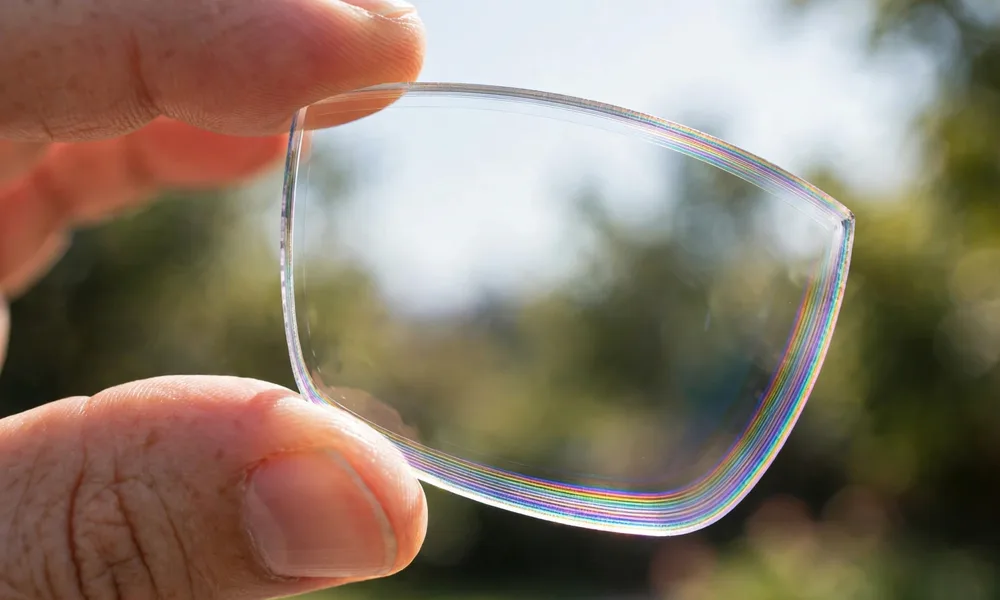
A waveguide is a thin, flat piece of glass or plastic that guides light along inside itself, the way a fibre optic cable guides light down its length. A tiny projector at the edge of the lens injects an image into the glass, the light bounces along inside it by total internal reflection, and microscopic gratings then release the light towards the wearer’s eye, a little at a time. The wearer sees the digital image overlaid on the real world, while anyone looking at them sees an ordinary pair of glasses.
Step 1: The projector makes a tiny image
Everything starts with a microdisplay, a screen so small it would fit on a fingernail, usually a micro-LED panel or a liquid crystal display lit by LEDs. It shows the image the wearer is meant to see: an arrow, a message, a map. The image is only a few millimetres across, far too small to look at directly, so a small lens magnifies it and aims it into the edge of the waveguide. The specifications of an AR glasses waveguide start with that projector.
Step 2: Light enters the glass at an angle
The projector’s light enters the waveguide through a small patch called the in-coupler, a grating of microscopic lines etched into the glass. The grating bends the light sharply, to an angle steep enough that it cannot escape the glass again. This is the same trick that keeps light inside a fibre optic cable: once light hits glass at a shallow enough angle, it reflects perfectly instead of passing through.
Step 3: The light bounces along inside the lens
Inside the glass, the light travels by total internal reflection, bouncing from one face of the lens to the other like a ball down a corridor, without losing energy at each bounce. The lens is only one or two millimetres thick, yet the light may bounce dozens of times on its way from the temple to the centre of the lens. Because the reflection is total, almost no light escapes along the way.
Step 4: The out-coupler releases the light to the eye
Halfway across the lens, the light meets the out-coupler, a second grating that does the opposite of the first: it bends the light back out of the glass, towards the wearer’s eye. It does not release it all at once. Instead it leaks the light out gradually, a little at each bounce, so the image stays evenly bright across the whole viewing area. That gradual release is also what creates the eyebox, a small volume of space in front of the lens where the eye must sit to see the full image. The lenses of a VR headset solve the same problem differently, with big curved optics, which is why a headset is bulky and AR glasses can stay slim.
Step 5: The eye sees the image floating in the world
The light leaving the out-coupler enters the pupil, and the eye focuses it onto the retina, just like light from any real object. Because the waveguide also lets ordinary daylight pass straight through, the wearer sees the digital image and the real world at the same time, the image appearing to float a metre or two away. That is the waveguide’s real achievement: it does not show you a picture of the world, it adds light to the world itself.
Step 6: The frame carries the computer
The lens may be the star, but the frame does the work around it. The projector, the battery, the processor and the sensors hide in the arms of the glasses, kept small and balanced so the glasses sit like ordinary spectacles. Cameras track the hands and the room, an inertial sensor tracks the head, and a small chip decides what to show and where. The micro-LED display that feeds the projector is one of the reasons the image can be bright enough to see outdoors, where sunlight would wash out a dimmer screen.
Step 7: The image stays locked to the world
The final step is tracking. For an arrow to stay glued to the pavement as you turn your head, the glasses must know exactly where your head is, many times a second. Cameras and motion sensors map the room, anchor the image to a fixed point in it, and re-aim the projection as you move. The delay between moving and the image following must be under about twenty milliseconds, or the image visibly lags and the illusion breaks.
| Specification | Typical value |
|---|---|
| Waveguide thickness | About 1 to 2 millimetres |
| Field of view | About 30 to 50 degrees diagonal |
| Eyebox size | About 10 to 15 millimetres across |
| Display type | Micro-LED or liquid crystal microdisplay |
| Image brightness | About 500 to 3,000 nits at the eye |
| Glasses weight | About 40 to 80 grams |
| Battery life | About 2 to 6 hours of use |
Price is the hardest part of AR glasses to pin down, because the waveguide is made in small numbers with expensive tooling. A pair of consumer AR glasses with a waveguide display typically costs 500 to 1,500 US dollars (estimate) at the time of writing, and the waveguide lens alone can account for a third of that. High-end enterprise glasses with wider fields of view cost 2,500 to 3,500 dollars (estimate). The cost is the gratings: etching lines a fraction of a wavelength apart, with yields that are still improving. Those are estimates (estimate), not list prices.
A rare fact: the grating inside a waveguide is made with the same tools that print computer chips. The microscopic lines that bend the light are etched by lithography, the process used to make processors, with features smaller than the wavelength of visible light. A waveguide lens is, in a real sense, a computer chip you can see through. The first ones were made for military helmet displays, where pilots needed information floating in front of their eyes without looking down.
The AR glasses waveguide works because glass, light and a few million microscopic lines agree to carry an image sideways through a lens and drop it into your eye, leaving the world visible behind it. It is a piece of optics that behaves like a cable, a screen and a window all at once. When it works well, you stop seeing the technology at all, and simply see a world with a little more in it.


