Walk into the shed where a carbon fibre yacht hull is being built and the first thing you notice is the quiet. There is no clang of steel, no shower of sparks, and no smell of hot metal. Instead there is a huge black mould, smooth as glass, and a small team in white suits laying sheets of black cloth into it by hand, smoothing each layer flat with their palms as if they were making a bed. The cloth looks soft, almost like fabric, and it is hard to believe that it will become the hull of a yacht worth millions, a shell so stiff and so light that it can outrun boats twice its size.
A carbon fibre hull is not built the way a steel or wooden hull is built. It is woven, glued, baked, and polished, and every layer of cloth has to go in the right direction, in the right place, and with the right amount of resin, or the hull will be weak where it most needs to be strong.
How It’s Made
Step 1: A mould is machined, polished and waxed
Every carbon fibre hull starts with a mould, a full-size negative of the hull, usually milled from a solid block of tooling foam or built up in fibreglass and then machined to shape by a computer-controlled cutter. The mould is sanded and polished until its surface is almost perfect, because every mark on the mould will show on the finished hull, and then it is coated with a release wax so that the cured hull can be lifted out without sticking. A mould like this can cost as much as a small house, and it is used for only a handful of hulls before it is retired.
Step 2: The first layers of carbon cloth are laid by hand
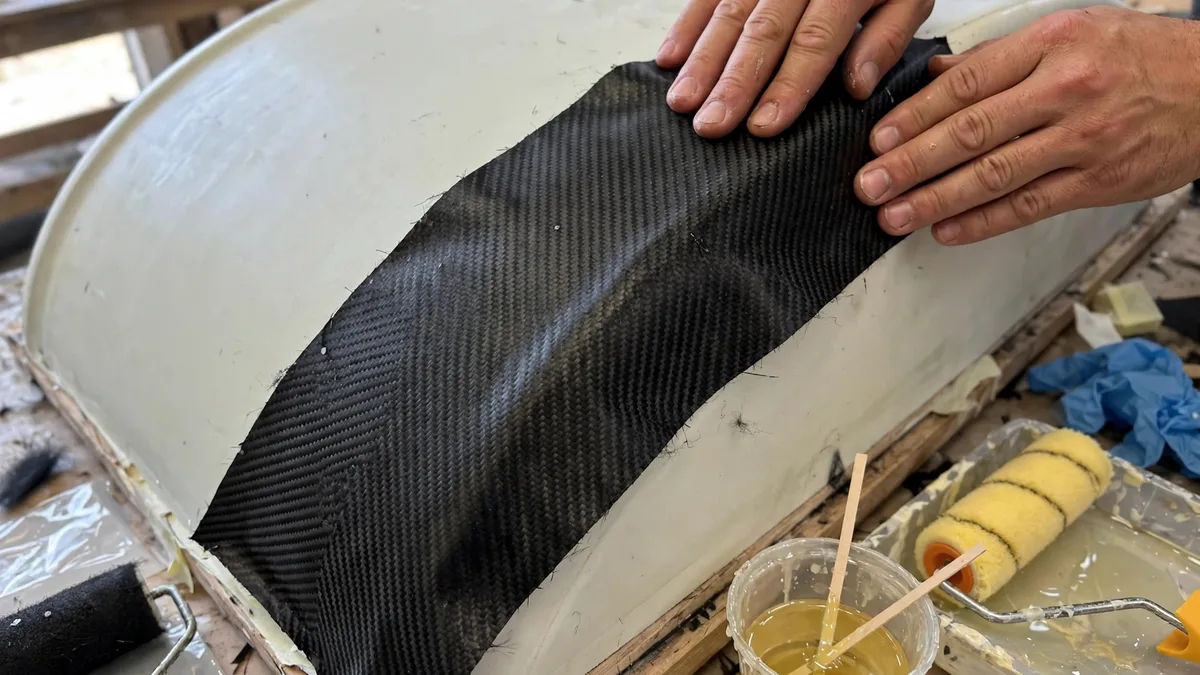
With the mould ready, the laminators begin laying carbon fibre cloth into it, one layer at a time, and this is the slowest and most careful part of the whole build. Each sheet is cut to a pattern, laid into the mould, and smoothed flat by hand, and the direction of the weave matters, because carbon fibre is strong along the fibres and weak across them, so layers are laid at different angles to spread the strength in every direction. Extra layers go where the loads are highest, around the keel, the chainplates, and the mast step, and thinner layers go where the hull can be light. The care taken here is the same care that goes into any twin-hulled yacht, and the way two hulls share the load, as how a luxury catamaran works shows, starts with the same question of where the strength must go.
Step 3: Resin is infused and the hull is vacuum-bagged
Once the dry cloth is in place, the builders seal the mould under a plastic vacuum bag and pump the air out, pressing the layers tightly together, and then resin is drawn through the cloth by the vacuum, soaking every fibre. This is called resin infusion, and it gives a far more even result than brushing resin on by hand, because the vacuum pulls out trapped air and the resin flows to every corner of the mould. The builders watch the resin front move across the hull through the clear bag, and if it stalls or leaves a dry patch, they adjust the feed lines before it is too late.

Step 4: The hull is cured in a giant oven
The mould, with the hull still inside it, is rolled into an oven large enough to hold a whole yacht hull, and the temperature is raised slowly to about 80 degrees Celsius and held there for many hours. The heat finishes the chemical reaction in the resin, hardening it into a solid that bonds the carbon fibres into a single stiff structure, and the slow ramp up and down matters, because heating too fast can crack the resin or warp the hull. When the doors finally open, the hull is a single black shell, stiff enough to ring when it is tapped, and light enough that two people can lift a section of it.
Step 5: The hull is lifted out, trimmed and faired
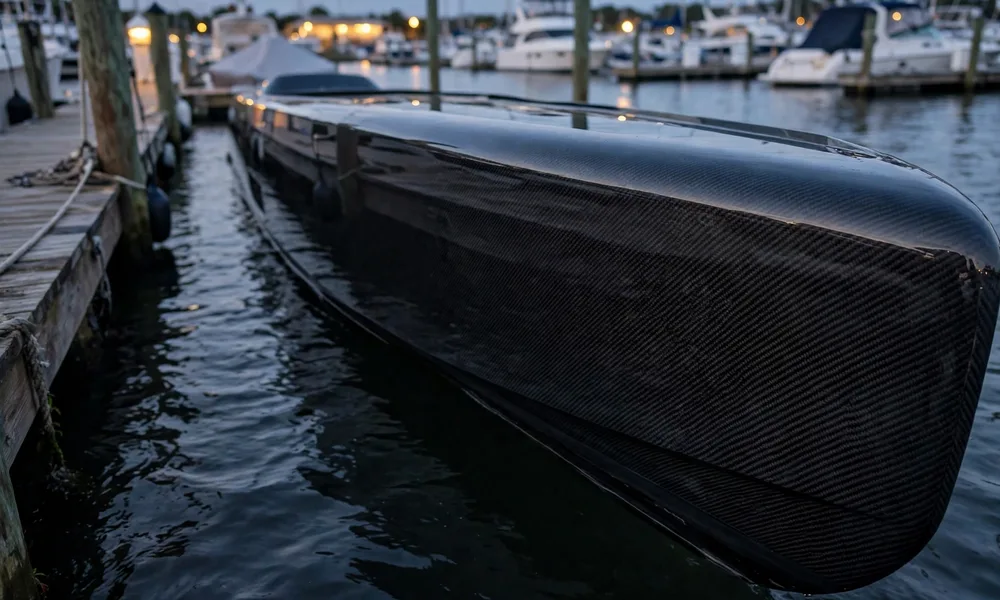
With the cure finished, the hull is lifted out of the mould with a crane, and the builders see the finished outside for the first time, a glossy black surface that still needs work. The edges are trimmed with a diamond saw, the deck flange is fitted, and the hull is faired, which means filling any small dips and sanding the whole surface smooth, a job that can take weeks of patient hand sanding. The fairing stage is where a good hull becomes a beautiful one, and the standards for it are the same ones used on any fine yacht, as the yacht hull fairing specs show, because a hull that is fair to the eye is also fair to the water, and a fair hull is a fast hull.
Step 6: The deck is joined, the hull is painted and launched
The last stage is joining the deck to the hull, painting, and launching. The deck, built in the same carbon fibre process, is lowered onto the hull and bonded with structural adhesive, and the joint is reinforced from the inside so that the hull and deck act as one piece. The outside is primed and painted, usually in a deep colour that shows off the fairness of the surface, and the fittings, the mast step, and the keel are bolted on. The cost of all this hand work and oven time explains the price of the finished yacht, as why a luxury carbon fibre yacht hull is so expensive shows, because a carbon hull is not manufactured, it is made, layer by layer, by people who cannot afford a single careless afternoon.
Carbon Fibre Yacht Hull Specifications
The figures below describe a typical large luxury carbon fibre yacht hull, about fifteen metres long, built by resin infusion and oven cure. Smaller and larger hulls differ, but the working principles are the same.
| Specification | Typical value |
|---|---|
| Length | About 14 to 18 metres |
| Hull weight | About 2,500 to 4,000 kg |
| Hull material | Carbon fibre, epoxy resin |
| Cure temperature | About 80 degrees Celsius |
| Layers in the hull | About 8 to 20, by area |
| Build time | About 10 to 16 months |
What It Costs
A carbon fibre yacht hull alone costs an estimated $1,500,000 to $4,000,000, depending on size and the number of layers, and the finished yacht costs several times that once the deck, rig, and interior are added. Those are estimates, not quotes, and they reflect months of hand lay-up, the cost of the carbon cloth and the resin, and the price of the mould and the oven time.
A Rare Fact
Here is a detail most people never guess. Carbon fibre is so stiff that a carbon hull barely flexes in a wave, and that stiffness is both its greatest strength and its greatest weakness, because a hull that does not flex cannot absorb a shock the way a wooden hull can, so the builders have to design the structure to spread every load, or a single hard grounding can crack a hull that would have only dented in steel.