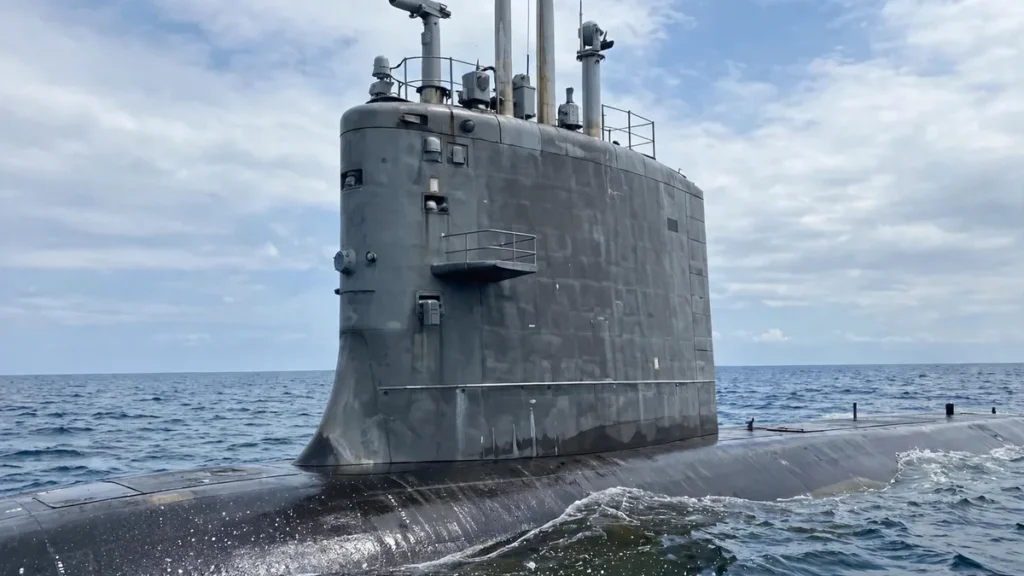
From the deck of a harbour boat, a submarine looks almost featureless: a long hull slipping through the water, low and quiet, with nothing above it but a single fin rising from the middle like the dorsal fin of a whale. That fin is the conning tower, and it is the one part of a submarine that still lives partly in the open air.
Inside that fin are the eyes, the ears and the lungs of the boat. It holds the periscopes the captain looks through, the masts that carry the radar and the radio, the hatch the crew climb through, and the small bridge where the captain stands when the boat is on the surface. When the submarine dives, the tower is the last part to go under, and when it surfaces, the tower is the first part to break the water.

How It Works
Step 1: The hatch and the climb
Everything in the conning tower starts with the hatch, the round steel door at the top that the crew climb through to reach the bridge. The hatch is a thick disc of steel with a rubber seal and a wheel that clamps it shut, and it must close in seconds, because a submarine that cannot seal its hatch cannot dive. The crew practise opening and closing it until the movement is automatic, even in the dark and even with gloves on.
Step 2: The periscope
The periscope is the conning tower’s most famous instrument, and it works on a beautifully simple idea. It is a long tube with a mirror or a prism at the top and another at the bottom, so that light coming in at the top is bent down the tube and out at the bottom, where the captain’s eye waits. The captain can see the surface while the boat stays hidden below it, which is the whole point of a submarine.
A modern periscope is far more than a tube with mirrors. It carries cameras, a rangefinder that measures how far away a ship is, and sensors that can see in the dark, and it can be raised and lowered in seconds. The tube must stay perfectly straight and perfectly sealed, because even a tiny bend would blur the image, and the way a luxury submarine periscope is made shows how much care goes into a slender tube that must do such a delicate job.
Step 3: The masts and antennas
Through the roof of the tower run the masts: the radar mast, the radio antennas, the satellite mast and the snort mast that lets the engines breathe while the boat is just below the surface. Each mast slides up and down through a sealed tube, raised when it is needed and lowered flush when the boat dives deep, so that nothing sticks out into the flow of water.
Step 4: The bridge on the surface
When the submarine is on the surface, the captain stands on the bridge, a small open platform at the top of the tower with a low windscreen and room for two or three people. From here the captain can see the whole horizon, judge the weather, and guide the boat into harbour, and it is the only place on the submarine where a sailor can stand in the open air and feel the wind.
The bridge is fitted with a compass, a voice pipe down to the control room, and rails to hold on to in a rough sea, and everything on it is made to be used with gloves on in the dark. The hatch below is the boat’s front door, and the way a luxury submarine hatch works shows the same obsession with sealing, where a single door must hold back the whole ocean.
Step 5: Diving and surfacing
Diving is the moment the conning tower earns its keep. The order is given, the hatch is closed and clamped, the masts are lowered, and the boat’s tanks fill with water until it slips beneath the surface. The tower is the last part to go under, and for a few seconds the bridge is still in the open air while the hull is already underwater, which is a strange and wonderful sight for anyone standing on it.
Step 6: Staying quiet and staying safe
The last job of the conning tower is to keep the boat quiet. Its outer surface is smooth and curved, so water flows past it without making noise, and it is coated with a dark material that absorbs sound. Every pipe and cable inside the tower is clamped down so nothing rattles, and every hatch and seal is checked, because a submarine that can be heard is a submarine that can be found.
Safety runs through everything the tower does. There are backup seals on the hatch, backup power for the periscope, and a second way out of the tower if the main ladder is blocked. The dive planes that control the boat’s depth work with the tower to keep it level, and luxury submarine dive planes, explained show how the whole boat works as one machine, with the tower as its eyes and the planes as its wings.

| Spec | Detail |
|---|---|
| Structure | Curved steel sail around an inner pressure-hull tube, shaped to keep water flow smooth and quiet |
| Hatch | Thick steel disc with a rubber seal and clamping wheel, closing in seconds so the boat can dive |
| Periscope | Long optical tube with prisms, cameras and a rangefinder, raised and lowered in seconds |
| Masts | Radar, radio, satellite and snort masts, each sliding up and down through sealed tubes |
| Bridge | Small open platform with a windscreen, compass and voice pipe, built to be used with gloves in the dark |
| Coating | Dark sound-absorbing coating in thin sprayed layers, sanded smooth so the tower stays quiet underwater |
What One Costs
A luxury conning tower is an estimated 5,000,000 to 25,000,000 dollars as part of a finished submarine, depending on the size of the boat, the number of masts and how much of the tower is custom built. The steel is only part of the price; the periscopes, the seals and the sound-absorbing coating all cost far more than they look, and the testing at depth adds up too. A small tower for a private submarine sits near the bottom of that range.
A Rare Fact
On some submarines the conning tower is called the sail, and early boats really did carry a small sail on it, a canvas sail that could be hoisted when the engines failed so the boat could limp home on the wind. The name stuck long after the canvas was gone, and sailors still call the tower the sail today.
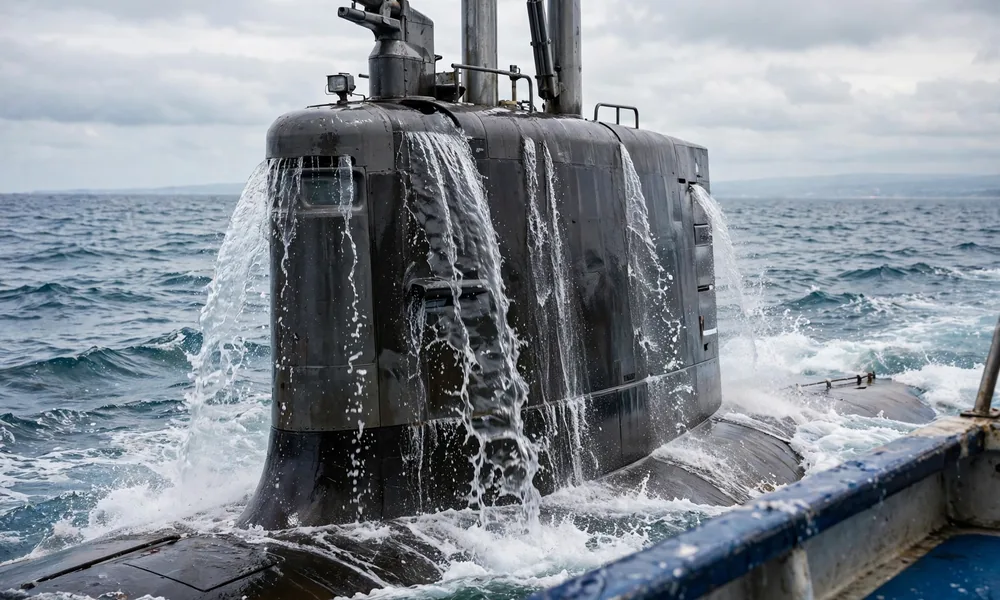
A luxury conning tower is a hatch, a ladder, a periscope, a set of masts and a small bridge, all wrapped in smooth, quiet steel. For the crew, the tower is also the way home, the hatch they climb through at the end of a patrol and the first thing they see of the world above. It is the eyes of the submarine and the one place a sailor can stand in the open air, and it works because every part of it, from the rubber seal on the hatch to the prism in the periscope, does one simple job perfectly.