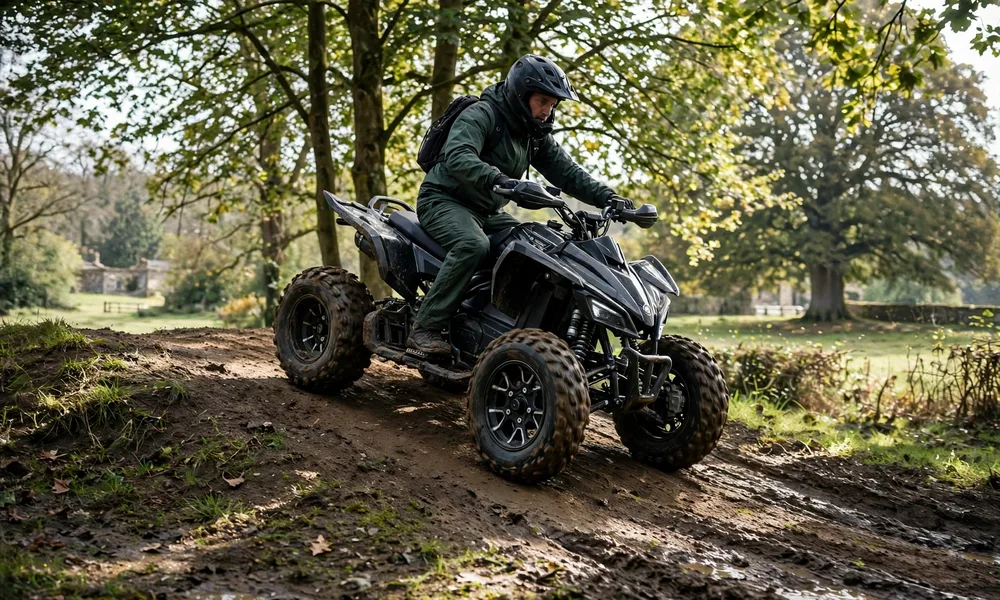
On a country estate at dawn, the only sound on the trail is the crunch of tyres on gravel and the faint whine of a motor working hard. There is no engine growl, no exhaust smell and no vibration shaking the handlebars. A luxury electric quad bike slips through the morning like it belongs there, carrying its rider up a wet slope and across a stream without ever raising its voice.
It looks simple, four wheels and a seat, but the way it works is a careful balance of instant electric torque, clever weight and a suspension that keeps all four tyres on ground that is never flat. Here is how a luxury electric quad bike works, from throttle to trail.

How It Works
Step 1: The throttle and the instant torque
Everything begins at the rider’s right thumb or wrist. The throttle on an electric quad is not a cable pulling a carburettor open; it is a sensor that tells the motor controller how much power the rider wants, and the controller answers in a few thousandths of a second. Twist a little and the bike creeps forward, smooth and silent. Twist hard and the full torque of the motor arrives at once, from a standstill, with no gears to change and no revs to build.
That instant torque is what makes an electric quad feel so different from a petrol one. On a steep slope, the rider does not need to slip a clutch or wind the engine up; the motor simply pulls, steadily, from the first turn of the wheels. The controller also smooths the delivery, so a nervous thumb does not turn into a lurch, and it protects the motor and the battery from a sudden demand that would overheat them. The result is a machine that is easy to ride slowly and surprisingly strong when it is asked to work.
Step 2: Steering with four wheels on the ground
Steering a quad bike is a whole-body job, and the electric quad is set up to make it feel natural. The handlebars turn the front wheels through a simple, direct linkage, and the rider leans into the turn, shifting their weight to the inside, while the wide stance of the four wheels keeps the bike planted. Power steering, fitted on most luxury quads, lightens the bars at low speed, where the tyres are hard to turn, and firms up as the speed rises, so the steering never feels vague on a fast track. The workshop that builds this balance is described in how a luxury electric quad bike is made.
Step 3: The suspension and the ride
A luxury quad’s suspension is tuned for comfort as much as for grip, because its riders are often guests, not racers. The springs are soft enough to soak up a rocky track, and the dampers are firm enough to stop the bike wallowing when it is loaded with a passenger or a trailer. Many luxury quads let the rider adjust the suspension, stiffening it for a heavy load or softening it for a slow ride with a child on the back.
The long travel of the suspension, the distance each wheel can move up and down, is what lets the bike cross ground that would stop a car. A wheel can climb over a rock the size of a loaf of bread while the chassis stays level, and the rider’s hands stay steady on the bars. The fat, low-pressure tyres help too, spreading the bike’s weight over a wide patch of ground, so it floats over soft sand and wet grass instead of digging in.
Step 4: The battery, the range and the ride home
Under the seat sits the battery, and everything about riding an electric quad is shaped by it. The motor draws power in proportion to the work it does: crawling along a flat track sips charge, while towing a trailer up a muddy hill drinks it. The dashboard shows the remaining range, but an experienced rider reads the trail as well as the gauge, knowing that a long climb will cost more than the same distance on the flat.
Regenerative braking helps on the way down: rolling downhill or braking turns the motor into a generator and puts a little charge back into the battery. It never matters much on flat ground, but on a hilly estate it stretches the day. When the battery runs low, the quad eases into a limp mode, giving the rider enough power to get home slowly rather than leaving them stranded. The numbers behind that battery are laid out in the luxury electric quad bike spec sheet, explained, but the rider’s rule is simpler: plan the ride around the battery, and the battery will bring you home.

Step 5: Terrain modes and traction
Most luxury electric quads offer terrain modes, settings that change how the motor, the braking and the traction control behave for the ground ahead. A road or grass mode gives a gentle throttle and saves battery. A mud mode sharpens the throttle and lets the wheels spin just enough to clear the tread. A hill mode holds the bike steady on a slope, so it does not roll back when the rider pauses, and a tow mode gives the motor its full strength at low speed for pulling a trailer.
Traction control watches the wheels and, if one spins, brakes it or sends more power to the others, so the bike keeps moving instead of digging a hole. Four-wheel drive, engaged with a switch on the bars, locks the drive to all four wheels for the worst ground, and a differential lock ties the two wheels on an axle together when one is in the air. The rider does not need to understand any of that: they pick the mode that matches the ground, and the bike does the thinking. The same idea, in a smaller package, is at work in how a luxury electric ATV works, where the trail is the same but the machine is tuned for play rather than work.
Step 6: Stopping, parking and looking after it
Stopping an electric quad is a mix of old and new. The brakes are hydraulic discs, strong enough to hold the bike on a steep slope, and the motor’s regeneration adds a gentle drag the moment the rider rolls off the throttle, so the bike slows smoothly without touching the brakes at all. On a long descent, that drag keeps the speed in check and saves the brake pads for when they are really needed.
When the ride is over, the quad is parked, plugged in and washed down, and that is most of its care. There is no oil to change, no air filter to clean and no exhaust to rust. The rider checks the tyres, the brakes and the battery charge, and the bike is ready for the next morning. It is a machine that asks very little and gives a great deal: a silent morning on a trail, and a trailer pulled without a fuss.
That is the quiet appeal of the electric quad. It does not announce itself, it does not shake its rider, and it does not leave a smell behind it. It simply works, up the hill and down again, until the trail runs out and the rider turns for home, with nothing but the crunch of tyres to show for the miles.