The trail climbed through the forest, muddy after the rain, and the ATV in front of me did something no petrol quad I had ever ridden could do. It climbed the steepest part in complete silence, its tyres gripping the wet earth without a single spin, and when the rider stopped halfway up to look at the view, the machine simply waited, perfectly still, without idling, without shaking, and without filling the quiet forest with exhaust. Then the rider touched the throttle, and the machine moved off as smoothly as if the hill were flat. That is the luxury electric ATV, and it is not a petrol quad with a battery instead of an engine. It is a different machine, designed around the electric motor from the first sketch.

Step 1: The Battery Wakes Up
Everything starts with the battery, which sits low in the frame, under the seat, where its weight keeps the ATV stable. A luxury electric ATV usually carries 10 to 20 kilowatt-hours of battery, which is a small battery by car standards, but it is a large one for a machine that weighs only a few hundred kilograms. The battery is sealed against water and mud, armoured against rocks, and monitored cell by cell by a computer that watches its temperature, its charge, and its health, and shuts it down safely if anything goes wrong. When the rider turns the key, the battery does not start an engine. It simply becomes ready, silently, in a fraction of a second.
Step 2: The Motor Turns Electricity Into Torque
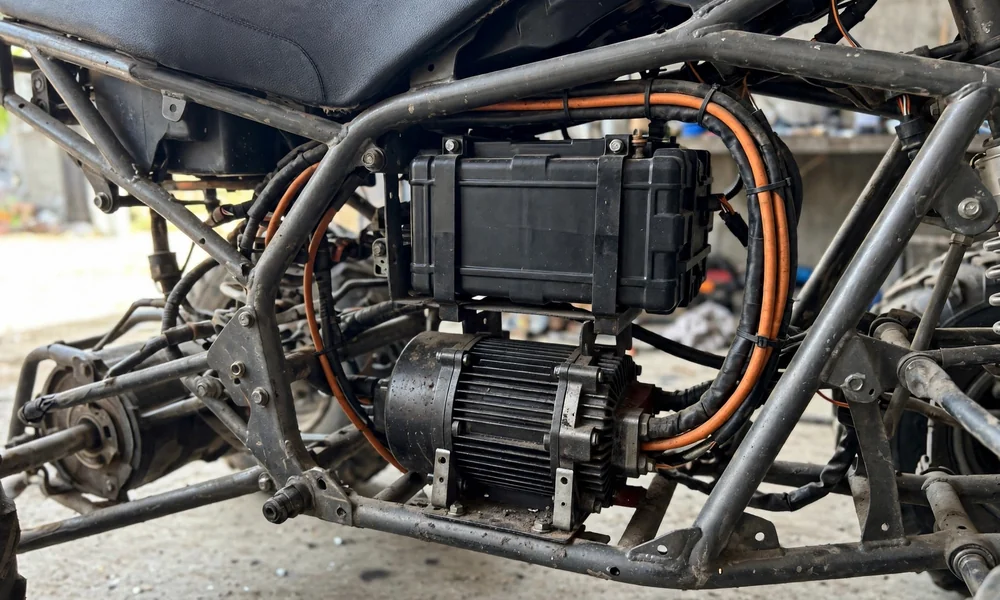
Most luxury electric ATVs use a single motor driving all four wheels through a simple gearbox, while some use a motor on each axle, or even a motor in each wheel. The result is the same: power that arrives smoothly, silently, and exactly when the rider asks for it. There is no clutch to slip, no gears to grind, and no engine braking to fight. The motor simply turns, and the ATV moves. The motor’s instant torque is the same trick that makes larger electric vehicles so quick, and how a luxury ATV works shows how the petrol machine it replaces had to work much harder to do the same job.
Step 3: The Controller Thinks Faster Than the Rider
Between the battery and the motor sits the controller, a computer that decides, many times a second, exactly how much power the motor should receive. When the rider twists the throttle, the controller does not simply send power to the motor. It checks the speed of each wheel, the angle of the machine, the charge in the battery, and the temperature of the motor, and it sends exactly the right amount of power to keep the ATV moving smoothly without spinning a wheel. That is why the electric ATV climbs a wet hill without wheelspin, while a petrol quad would spin its tyres and dig itself in.
The controller also manages the different riding modes. Eco mode stretches the battery by limiting the power, sport mode gives the rider everything the motor has, and a crawl mode delivers a slow, steady pull for crossing rocks or fording a stream. The rider chooses the mode on a small switch, and the controller does the rest. It is the most important computer on the machine, and it is the reason the ATV feels so much cleverer than its simple shape suggests. The control thinking is shared with other small electric vehicles, and the luxury ATV specifications explained shows the numbers behind the power, the weight, and the range.
Step 4: Power Reaches All Four Wheels
From the motor, the power travels to all four wheels, and the way it gets there is one of the electric ATV’s cleverest tricks. A petrol quad sends its power through a gearbox, a driveshaft, and differentials, and every one of those parts steals a little power and adds a little weight. An electric ATV can send its power much more directly, and its controller can decide, wheel by wheel, how much power each tyre should receive. If one wheel is on ice and another is on rock, the controller sends the power to the wheel with grip, and the ATV keeps moving.
Step 5: Suspension and Steering Keep the Rider in Control
The suspension of a luxury electric ATV is built for comfort over long days on rough ground. It has long-travel suspension at each wheel, with shock absorbers that can be adjusted for the rider’s weight and the ground, and it is tuned to soak up rocks and roots without throwing the rider around. The electric motor’s smooth power helps here too, because there is no engine vibration shaking the machine, and no sudden surge of power when the gears change. The rider feels the ground, but the ground does not punish the rider.
Steering is light and precise, with power assistance that adjusts to the speed, so the handlebars are easy to turn at walking pace and steady at speed. The brakes are hydraulic discs on all four wheels, and they work with the motor, which can slow the machine by itself, feeding energy back into the battery every time the rider brakes. That regenerative braking is not just a clever trick. It extends the range, and it means the brakes last far longer, because the motor does much of the slowing down. The small electric runabouts that share the ATV’s thinking are a different world, and how a luxury electric bike works shows the same electric ideas at the smallest possible scale.

Step 6: The Display, the Modes, and the Ride Home
The last step is the one the rider sees most, which is the small display on the handlebars. It shows the speed, the battery charge, the range remaining, and the riding mode, all in a display that can be read in bright sunlight and in the dark. It also shows the warnings that matter: a battery that is getting hot, a tyre that is losing pressure, or a motor that needs a rest. The rider can change the riding mode, the power delivery, and the amount of regenerative braking from the handlebars, without stopping, and the machine responds instantly.
Price, and What You Are Really Paying For
A luxury electric ATV costs around 15,000 to 30,000 dollars, and that is an estimate, not a list price, because every machine is built to order with different tyres, racks, and accessories. That is more than a petrol quad of the same size, and the difference is almost entirely the battery and the electronics. But the running costs tell a different story. Electricity costs a fraction of petrol, the electric motor has far fewer moving parts to wear out, and there is no engine oil, no exhaust system, and no gearbox to service.
A Rare Fact Worth Knowing
Here is the detail that surprises almost everyone who has ridden a petrol quad for years. A luxury electric ATV can cross a stream without any risk to its motor, because the motor has no air intake, no exhaust, and no spark plugs to flood. The battery and the motor are sealed against water, and the machine can wade through water up to its seat without stopping. A petrol quad that tries the same thing will stall in the middle of the stream, and its rider will be pushing it out. The electric ATV simply rides through, silently, and climbs out the other side, dripping but undamaged, ready for the next hill.