Every neat lawn has a ragged edge somewhere, a strip of grass along a fence, around a tree trunk, or against a stone wall where the mower cannot reach. That is where the string trimmer comes in, a long wand with a spinning head that hums along the border and leaves a crisp line behind it. There is no blade to see, just a whirring blur and a faint smell of cut grass, and the edge comes out as clean as if it had been drawn with a ruler.
A string trimmer, also called a strimmer or weed whacker, is a garden tool that cuts grass with a length of nylon line spun at high speed, rather than with a metal blade. The luxury electric versions run on a battery and a brushless motor, which makes them quiet, light and easy to start with a single trigger pull. Understanding how one works means following the power from the battery to the spinning line, and seeing how a piece of plastic string can cut grass as cleanly as steel. This is what happens inside the machine.

How It Works
Step 1: The battery sends power on demand
Everything starts with the battery, a lithium-ion pack that slides into the handle and locks with a click. When the user squeezes the trigger, the battery sends direct current to the controller, a small circuit board that decides how much power the motor gets. A light squeeze spins the head slowly for delicate work around flowers; a full squeeze gives maximum speed for thick grass. The controller also protects the pack, cutting power if it gets too hot or runs too low, so the battery lasts for years. The figures for this kind of garden battery are shared across the maker’s range, and the string trimmer numbers set out the voltage, runtime and weight in detail.
Step 2: The brushless motor spins the head
The power goes to a brushless motor at the bottom of the shaft, directly above the cutting head. Brushless means there are no carbon brushes to wear out: magnets on the rotor are pulled around by coils that switch on and off in sequence, controlled by the same board that manages the battery. The motor spins the head at several thousand revolutions per minute, and because it sits right at the cutting end there is no long drive cable or gearbox to lose power. The motor is sealed against grass, dust and damp, and it is mounted on rubber bushes so the vibration stays out of the user’s hands.
Step 3: The spool feeds out fresh line
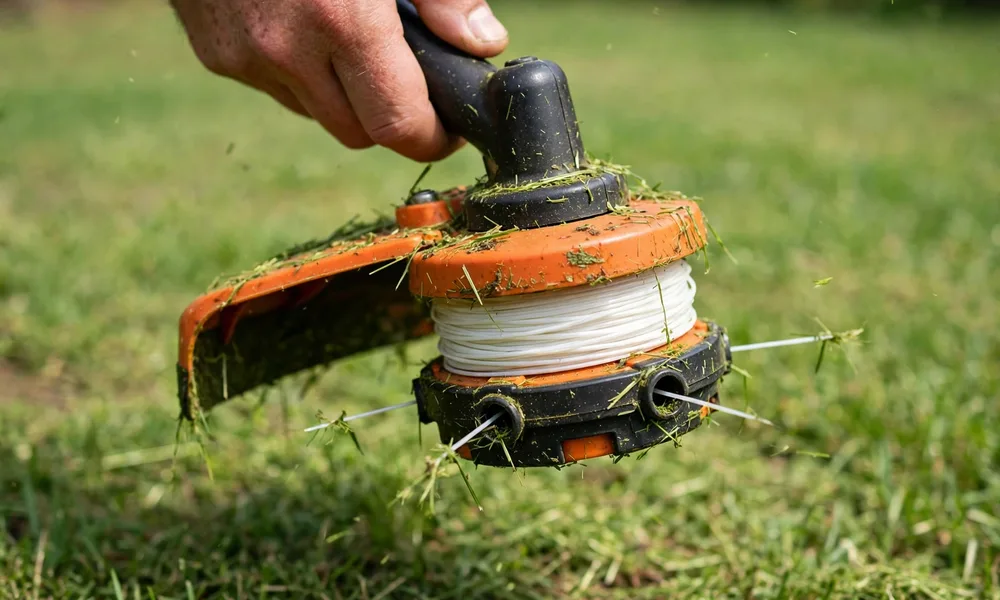
Inside the cutting head is a spool wound with nylon line, like a small reel of fishing line. As the head spins, the line is flung outwards by centrifugal force and held stiff by its own speed, which is what lets a soft plastic cord cut grass. The line wears away as it works, so the head is designed to feed more: on most luxury models a sharp tap of the head on the ground, called a bump feed, releases a short length of fresh line, while others feed automatically when the line gets short. The spool holds several metres of line, and refilling it is a matter of winding a new length onto the spool and threading the ends through the eyelets.
Step 4: The line cuts grass like a whip
The cutting itself is pure speed. A length of line spinning at thousands of revolutions per minute moves so fast that its tip behaves like a blade, slicing through grass stems on contact. Because the line is flexible, it bends around stones, fence posts and tree trunks instead of chipping or throwing sparks the way a metal blade would. The cutting circle is roughly 30 to 40 centimetres across, and the user sweeps the head in slow arcs, letting the line do the work rather than forcing it into the grass. Thick weeds need a slower pass and a thicker line, which is why luxury trimmers come with two or three line thicknesses to choose from.
Step 5: The guard, the shaft and the handle keep it safe
Spinning line throws grass clippings and small stones, so a curved guard sits over the back of the head to shield the user’s legs and to catch the cuttings. The shaft between the handle and the head is made in two parts on many models, so the tool can be split for storage, and a loop handle halfway down lets the user steer with the second hand. The main handle carries the trigger, a safety lock that stops the tool starting by accident, and the battery release, all within reach of the thumb. The leaf blower from the same garden range uses a similar handle and battery layout, and how an electric leaf blower works shows the shared design in a different tool.
Step 6: Cutting, edging and the battery’s end
In use, the trimmer is held with the head flat for cutting grass and tilted on its side for edging along a path, where the spinning line slices a vertical line into the lawn edge. The motor’s speed is matched to the job by the trigger, and the controller keeps the head spinning at a steady speed even as the line meets thicker grass. When the battery runs low, the controller gives a warning and then stops the motor cleanly rather than letting it fade and strain. The pack is then swapped for a charged spare or put on the dock, which refills it in about an hour, and the trimmer is ready for the next edge.
Luxury Electric String Trimmer Specifications
A luxury electric string trimmer is a light, fast-spinning tool. These are the figures makers work to, and its battery and motor ideas are shared with the rest of the maker’s garden range, as the electric leaf blower numbers show.
| Specification | Typical value |
|---|---|
| Cutting head speed | Several thousand revolutions per minute at full trigger |
| Cutting width | Roughly 30 to 40 centimetres per pass |
| Line | Nylon, 1.6 to 2.4 millimetres thick, bump or automatic feed |
| Motor | Brushless electric motor mounted at the cutting head |
| Battery | Lithium-ion pack, typically 36 to 56 volts |
| Runtime | Around 30 to 60 minutes per charge, depending on the grass |
| Weight | Roughly 2.5 to 4 kilograms including the battery |
| Shaft | Two-piece aluminium shaft, often telescopic, with loop handle |
What It Costs
A luxury electric string trimmer is estimated at $200 to $500, depending on the battery size, the cutting width and whether the battery and charger are included. All figures here are estimates, not quotes. The battery pack is the most expensive part, and a spare pack can add a large share to the total. Running costs are small: a spool of nylon line costs little and lasts a season of regular use, and there is no petrol, oil or spark plug to buy. The line itself is the only part that wears out in normal use.
A Rare Fact
String trimmers were invented by accident in the early 1970s, when a Texan named George Ballas watched the spinning nylon bristles of an automatic car wash and realised they could cut grass. He built the first version from a popcorn tin and fishing line, and the idea of cutting grass with a whirling cord has barely changed since.


