A phone used to be a slab. It was a rectangle of glass and metal, and the only thing that changed was how thin the makers could shave it. Then someone asked a rude question: what if the screen itself could fold? The answer is the luxury foldable phone, a device that opens like a book into a small tablet and folds shut to fit in a pocket, its screen bending thousands of times without cracking, creasing or giving up.
Making one is less like building a phone and more like building a watch. The hinge must survive years of opening and closing, the screen must flex like paper and still show a perfect picture, and the whole device must stay slim enough to carry. Here is how a luxury foldable phone is made, from a sheet of glass to the hand that first unfolds it.
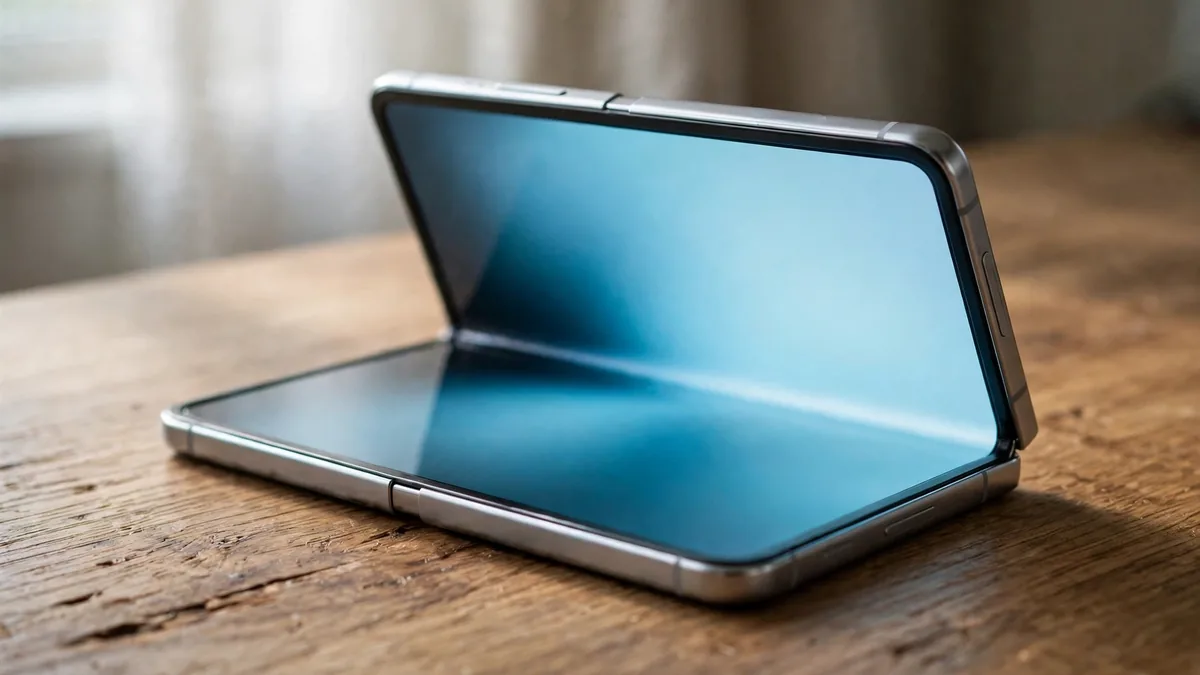
How It Is Made
Step 1: A screen that bends without breaking
The build starts with the flexible display, and it starts in a clean room where the air is filtered and workers wear full suits, because a single speck of dust can ruin a screen. A thin plastic base is coated with layers of light-emitting material, each one only a few atoms thick, then sealed with a barrier film that keeps out water and oxygen. A sheet of ultra-thin glass, thinner than a human hair, is bonded on top to protect the screen while still allowing it to bend. The finished panel is flexed on a machine again and again, and only panels that survive hundreds of thousands of folds with no dead pixels move on to the next stage.
Step 2: The hinge, a watchmaker’s puzzle
The hinge is the heart of a foldable, and it is machined from stainless steel or titanium to tolerances measured in microns. Tiny gears, cams and springs are fitted together so the phone opens smoothly, holds itself steady at any angle, and snaps shut with a satisfying click. The hinge is designed to leave a teardrop-shaped gap when the phone is folded, so the screen curves gently instead of creasing sharply at the fold. Each hinge is tested on a robot that opens and closes it tens of thousands of times, and engineers listen for clicks, watch for looseness, and measure the force at every angle before the design is approved.
Step 3: Two halves, one phone
The phone is built as two halves joined by the hinge. Each half gets its own aluminium or titanium frame, machined from a solid block and polished until the edges feel seamless in the hand. One half holds the main processor and the cameras, the other holds a second battery and the wireless charging coil, so the weight balances when the phone is open. Flexible ribbon cables run through the hinge to connect the two halves, and they are routed with slack and shielding so they can flex with every fold without wearing out. The halves are joined on a precision jig, and the gap between them is measured to a fraction of a millimetre.
Step 4: Batteries, cameras and the small parts
With the frame complete, the small parts go in. Two slim batteries are fitted, one in each half, wired together so the phone draws from both at once. Camera modules are mounted on tiny springs, so a drop does not crack the lenses, and the speakers, antennas and sensors are placed around them in whatever space is left. The fingerprint reader, the charging port and the speaker grilles are sealed against dust and water as far as a folding phone allows. Workers fit these parts under microscopes, because the inside of a foldable is packed tighter than almost any other gadget on sale.
Step 5: Software that knows it folds
Before the phone is closed up, its software is loaded and taught to fold. The operating system must know when the phone is open, half open or shut, and rearrange the screen for each state, moving apps from the small outer display to the big inner one without losing your place. The hinge sensor is calibrated, the cameras are tuned, and the screen is colour-checked panel by panel, because a foldable has two displays that must match perfectly. Test software runs the phone through its paces, opening apps, switching screens, and folding and unfolding while the phone works, to catch any fault before the phone leaves the line.
Step 6: Assembly, sealing and the drop test
The two halves are closed up, the screens are bonded to their frames, and the phone is sealed as tightly as a folding design allows. Each finished phone is weighed, measured, and checked under bright lights for gaps, scratches or dust under the screen. Then it faces the drop test. Sample phones are dropped onto concrete from pocket height, folded and unfolded, and bent gently to make sure the hinge still feels right. Phones that pass are wiped, charged, and boxed with their charger and case, ready for a customer who will fold their phone a hundred times a day without ever thinking about the engineering inside.

Key Specifications
The figures below describe a typical current luxury foldable phone; individual models vary.
| Specification | Typical figure |
|---|---|
| Main display | 7.6 to 8.0 inches, flexible OLED |
| Cover display | 6.2 to 6.5 inches, OLED |
| Thickness folded | 11 to 13 millimetres |
| Weight | 240 to 270 grams |
| Fold rating | 200,000 to 400,000 folds |
| Battery | 4,400 to 5,000 mAh, dual cell |
| Cameras | Triple rear, up to 50 megapixels |
| Frame material | Titanium or armour aluminium |
How Much Does It Cost?
A luxury foldable phone typically costs from around $1,800 to $2,500, depending on the maker, the storage and the finish. That is an estimate based on current flagship models, and the price can rise further with more storage, a special edition finish or a bundled case and stylus. Most of the cost sits in the flexible display and the hinge, which are far more expensive to make than a normal screen and frame. To see the device in daily use, read how a luxury foldable phone works once it is in your hand. If the price raises an eyebrow, why a luxury foldable phone is so expensive explains what buyers are paying for. And the luxury foldable tablet specs explained breaks down its bigger folding cousin’s numbers in plain language.

A Rare Fact
Here is something few owners ever learn: the screen of a foldable phone is not really glass at all, at least not in the way you think of it. The ultra-thin glass that protects the display is so thin that it bends, and it only survives because it is bonded to a flexible plastic layer that carries the strain. The whole stack is less than a tenth of a millimetre thick, yet it is expected to fold and unfold more than a hundred times a day for years. Engineers test it by folding a panel continuously for weeks on a machine, and the panels that pass are the ones where every layer bends together, like the pages of a book, instead of fighting each other at the crease.
A luxury foldable phone is a small miracle of patience. From the clean room where the screen is grown layer by layer, to the hinge that must work perfectly a hundred times a day, every part is made to bend without breaking. When you open one for the first time and the screen lights up across the fold, seamless and bright, the years of testing disappear into a single smooth motion, and a slab of glass and metal becomes a book you can carry in your pocket.