The man in the shop opened the tablet like a book, and the whole counter seemed to lean in. One moment it was a phone-sized slab of glass and metal; the next it was a full tablet, the screen unfolding with a soft click and no visible seam.
Then came the spec sheet, and the smile faded a little. Folded thickness, unfolded thickness, crease depth, hinge cycles, peak brightness, pixel density, refresh rate, stylus latency and a battery number that looked small next to an ordinary tablet.
This guide takes the spec sheet apart, number by number, in plain English, so you can tell a genuinely good foldable tablet from one that simply folds.
How to Read a Luxury Foldable Tablet Spec Sheet
Screen size: folded, unfolded and in between
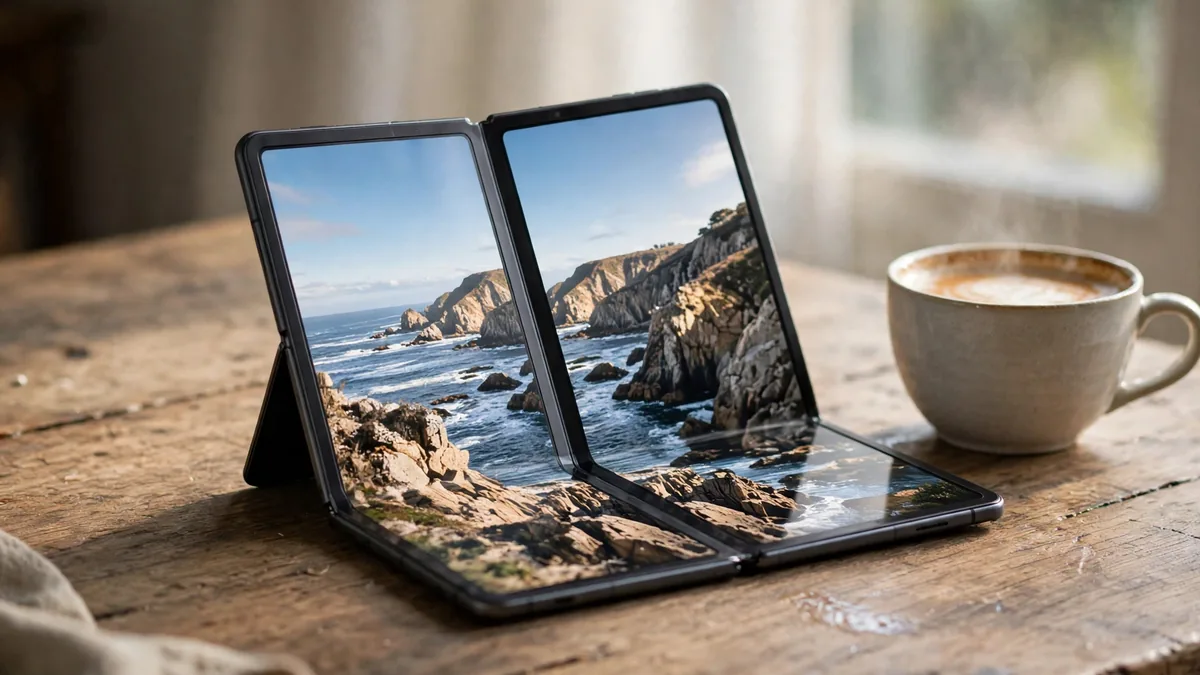
A foldable tablet really has two screen sizes, and both matter. Folded, the cover screen is usually about 6.2 to 6.5 inches across, which is the size of a large phone and the screen you will use for quick messages, calls and one-handed reading. Unfolded, the main display opens to about 7.6 to 8 inches, which is proper tablet territory for films, documents and drawing. The useful question is not how big the unfolded screen is, but how often you will actually unfold it, because a cover screen that feels cramped will keep you folding and unfolding all day, and that is where the hinge earns its keep.
The hinge: rated cycles and the crease
The hinge is the heart of the machine, and its headline number is the fold-cycle rating, usually quoted at 200,000 to 400,000 folds. At 100 folds a day, 200,000 cycles is roughly five and a half years of use, and 400,000 is roughly eleven, so both numbers sound generous until you remember that the rating is measured in a clean laboratory, not in a pocket full of dust. The crease is the other half of the story: every foldable screen has a faint line where it bends, and better models make it shallower and less visible in bright light.
Display: brightness, resolution and refresh rate
The main display is usually an OLED panel with a resolution around 2176 by 1812 pixels, which works out to roughly 360 to 400 pixels per inch, sharp enough that text looks printed rather than drawn. Peak brightness is the number that matters outdoors, and luxury models quote about 1,750 to 2,600 nits, which is bright enough to read in sunlight. The refresh rate is usually 120 hertz, which makes scrolling and stylus strokes feel immediate, and many panels drop to 1 hertz when the screen is still, saving battery without you noticing.
Weight and thickness: the folded penalty
Folded, a luxury foldable tablet is about 12 to 13 millimetres thick and weighs about 240 to 270 grams, which is noticeably thicker and heavier than a flat phone of the same screen size. Unfolded it is about 5 to 6 millimetres thick, which feels astonishingly thin, like holding a sheet of glass. That folded thickness is the price of the hinge and the two battery halves, and it is the reason the device never quite disappears into a pocket the way a normal phone does. If you carry it in a jacket pocket, the folded numbers matter most; if it lives in a bag, they matter much less.
Battery: two halves, one number
The battery is split into two cells, one in each half of the device, and the combined capacity is usually about 4,400 to 5,000 milliamp-hours, which is smaller than the battery in many ordinary tablets. That is not a mistake but a trade-off: the hinge and the fold take up space that a flat tablet gives to its battery. Real-world use is about a full day of mixed reading, video and browsing, or roughly 10 to 14 hours of video playback, and the cover screen sips power while the big unfolded display drinks it. As our guide to how a luxury foldable tablet works explains, the two battery halves must charge and drain in step, and the spec sheet only shows you their combined total.
Performance and cameras: flagship chips, modest lenses
Inside is usually a flagship mobile processor with 12 to 16 gigabytes of memory and 256 to 512 gigabytes of storage, which is enough to run several apps side by side on the big unfolded screen without stuttering. The cameras are the compromise: a main lens of about 50 megapixels, an ultrawide of about 12 megapixels and a telephoto of about 10 megapixels with three times optical zoom. They are good cameras, but they are not the best cameras the maker sells, because the folding body leaves no room for the large sensors and lenses of a flat flagship phone. If photography is your priority, the camera numbers matter; if the folding screen is the point, they are a footnote.
Luxury Foldable Tablet Specs
| Specification | Typical range |
|---|---|
| Unfolded display | About 7.6 to 8 inches, OLED, 120 hertz |
| Cover display | About 6.2 to 6.5 inches, OLED, 120 hertz |
| Resolution, main display | About 2176 by 1812 pixels, 360 to 400 pixels per inch |
| Peak brightness | About 1,750 to 2,600 nits |
| Hinge rating | About 200,000 to 400,000 folds |
| Folded thickness | About 12 to 13 millimetres |
| Unfolded thickness | About 5 to 6 millimetres |
| Weight | About 240 to 270 grams |
| Battery | About 4,400 to 5,000 milliamp-hours, two cells |
| Charging | About 25 to 45 watts wired, 15 watts wireless |
| Memory and storage | 12 to 16 gigabytes, 256 to 512 gigabytes |
| Main camera | About 50 megapixels, ultrawide 12, telephoto 10 |
| Water resistance | IPX8, protected against immersion |
What Does a Luxury Foldable Tablet Cost?
A luxury foldable tablet typically costs an estimated 1,700 to 2,200 dollars, compared with an estimated 800 to 1,200 dollars for a flagship flat tablet of similar power. The hinge assembly and the flexible display account for most of the gap, and the price climbs further with more storage or a bundled stylus. The way the device is built, with its two halves and its moving hinge, is the reason the repair bill is so high, as our guide to how a luxury foldable tablet is made shows. A plain luxury tablet is cheaper to buy and cheaper to fix, but it will never fold into your pocket, and that single trick is what the premium buys.

A Rare Fact
The first folding screens were tested by robots that opened and closed them hundreds of thousands of times, but the engineers discovered that the robots folded too perfectly. Real hands fold at an angle, press unevenly and sometimes stop halfway, so the test rigs had to be reprogrammed to fold badly on purpose, with dust, grit and off-centre pressure added to the routine.


