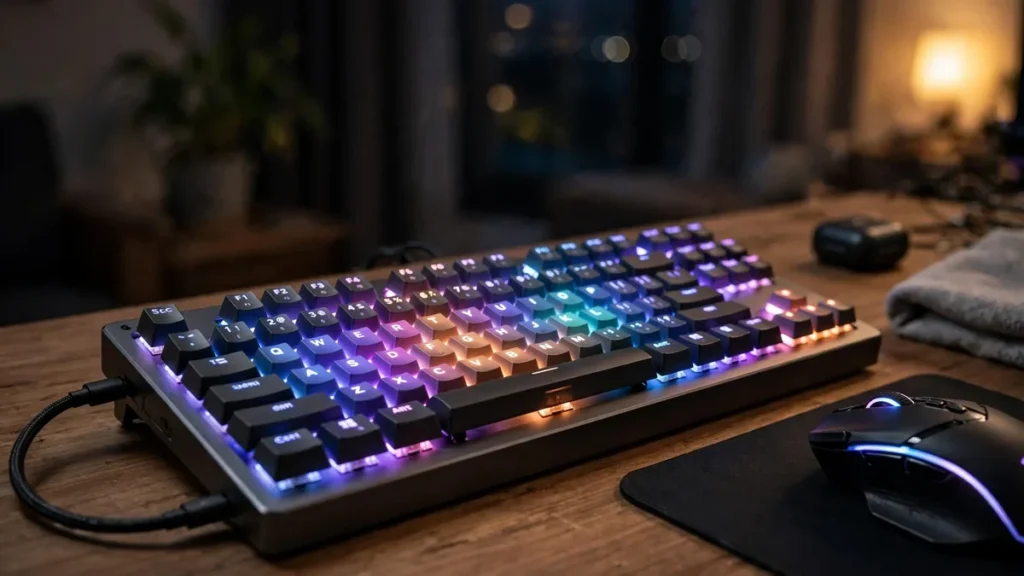
The duel is decided in a fraction of a second. Two players see the same enemy at the same moment, both press the same key, and one of them fires first. The difference is not reflexes. A luxury gaming keyboard is a race car disguised as office equipment, and every part of it is built to be faster than the player using it.
This is how a luxury gaming keyboard works, system by system: the switches that turn a press into a signal, the board that reads every key at once, the processor that sends the signal to the computer, the stabilisers that keep wide keys level, the lighting that guides the eye, and the case that keeps the whole board steady and quiet. It is a different machine from the computer it plugs into, and the guide to luxury gaming PC specs, explained sets out the numbers behind that computer, where the keyboard’s speed is only one part of a much larger race.

The switches: a press that becomes a signal
Under each keycap sits a switch, a small mechanical device that turns the movement of your finger into an electrical signal. Some switches click, some are silent, and some resist at first and then give way with a small bump, and players choose between them the way drivers choose tyres, because the feel of the switch is the feel of the game itself.
The board: reading every key at once
Under the switches sits a printed circuit board, a flat plate of fibreglass threaded with copper tracks that carry a signal from every switch to the keyboard’s brain. The board is often hot-swappable, which means a switch can be pulled out and a different one pushed in without a soldering iron, so a player can change the feel of a single key in under a minute.
The processor: faster than a blink
The signals from the board flow into a small processor, the keyboard’s brain, which decides what to send to the computer and how fast to send it. Most office keyboards report to the computer a thousand times a second, which sounds fast until you learn that a luxury gaming board reports eight thousand times a second, so the gap between pressing a key and the computer knowing about it shrinks to an eighth of a millisecond. The processor also handles macros, the little recorded sequences that turn one keypress into a whole string of actions, and it stores your settings on the board itself, so that the keyboard remembers your lighting and your key layout even when you plug it into a different computer. The guide to how a luxury gaming console works follows a gaming console through its own systems, where the same race against time is run by a machine that must answer a controller just as quickly.

The stabilisers: keeping wide keys level
The wide keys, the space bar, the enter key and the shift keys, are too long to sit on a single switch, so each one is held level by a stabiliser, a small wire bar that runs underneath the key and ties its two ends together. It is a small part that nobody sees, and players can hear the difference in a single keystroke.
The lighting: colour that helps you play
Under every keycap sits a tiny light, and together they turn the keyboard into a glowing map of the game. Each key can be lit in its own colour, so that the movement keys glow one colour, the weapon keys another, and the keys you never use stay dark, which means a player can find the right key in a dark room without looking down. The lights are not just decoration: they can pulse when a game event happens, flash red when health is low, or ripple across the board when the computer starts up, all controlled by software that talks to the game itself. The lights are set into the board so that they shine through the keycap legends, and the best boards use keycaps made from thick plastic that lets the light through the letters but nowhere else, so the glow stays sharp and clean. The guide to how a luxury gaming laptop works explains how a gaming laptop balances the same kind of speed and light in a machine that must also stay cool on your lap.
The case: weight that keeps the board still
The last system is the case, a slab of aluminium or heavy plastic that holds everything together and keeps the board from sliding across the desk in the middle of a match. The cable is detachable, so it can be replaced when it frays, and it connects through a port set into the case where it cannot be yanked loose by accident.
The gaming keyboard at a glance
| Part | Typical luxury figure | What it tells you |
|---|---|---|
| Switches | Mechanical or optical, triggering after 1 to 2 millimetres | How fast a keypress becomes a signal |
| Circuit board | Hot-swappable board, scanning keys thousands of times a second | How many keys can be pressed at once without loss |
| Processor | Reports to the computer up to 8,000 times a second | How small the delay is between press and action |
| Stabilisers | Lubricated wire bars under every wide key | How level the space bar and enter key stay |
| Lighting | One light per key, each colour set on its own | How the board guides your fingers in the dark |
| Case | Heavy aluminium case, foam layers, rubber feet | How steady and quiet the board stays in a match |
| Keycaps | Thick double-shot plastic, legends that never wear off | How long the letters stay readable |

What it costs
A luxury gaming keyboard typically costs an estimated $200 to $450, depending on its switches, its case and whether the switches can be swapped without soldering, and the estimate covers the board alone, not the keycaps, the wrist rest or the custom switches, which players often buy separately and which can cost as much as the board itself. The price is really the price of speed and feel: a board that answers in an eighth of a millisecond and still feels the same after a year of hard play is a precision instrument, and it is built like one.
A rare fact
One detail few players ever learn is that the fastest gaming keyboards do not actually wait for the key to be fully pressed, because they watch the switch with a beam of light and fire the moment the beam is broken, a fraction of a millimetre into the press. The technology is borrowed from the sensors in a computer mouse, and it means the key can fire before the player has felt it move at all, which is why some professional players say their fastest boards feel as if they are reading their minds.
Put the systems together, switches first, then board, processor, stabilisers, lighting and case, and a luxury gaming keyboard stops looking like a typing tool and starts looking like what it is: a precision instrument built for a race measured in milliseconds, where the winner is the player whose equipment answers first, and the board under their fingers is the quietest, fastest member of the team.