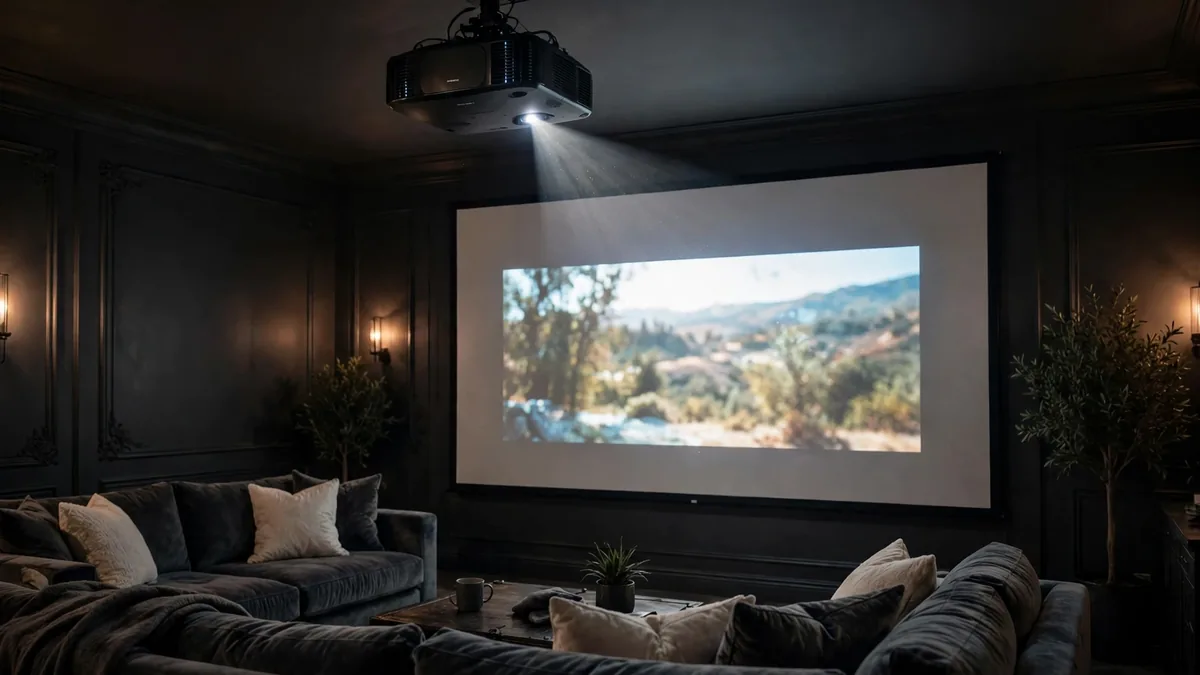
The room goes dark, the ceiling hums once, and a rectangle of light blooms on the far wall. A moment later the wall is gone. In its place is a mountain road at dusk, rain on the windscreen, headlights cutting through the dark. Nobody in the room is looking at a screen. They are looking at light itself, thrown across the room by a small black box that sits quietly on a shelf and pretends to be furniture.
A luxury projector is a light engine. It takes a digital picture, turns it into coloured light, and throws that light across a room with a lens the size of a camera’s. The trick is doing it brightly enough to survive a lit room, quietly enough to forget it is there, and sharply enough that a face on screen looks like a face, not a grid of dots.
This is what happens inside that box, from the moment the light is born to the moment it lands on the wall.
How It Works
Step 1: The light source
Every projector starts with light, and luxury models now use lasers instead of lamps. A bank of blue laser diodes fires into a phosphor wheel, a spinning disc coated in a material that glows yellow-white when the blue light hits it. The combination produces a bright, steady white light that can last twenty thousand hours or more, with no bulb to change and no slow dimming over time.
Step 2: Splitting the light into colour
White light is not useful until it is split into red, green and blue. Luxury projectors do this in one of two ways. Three-chip models pass the light through a prism that divides it into three beams, one for each colour, and send each beam to its own imaging chip. Single-chip models use a spinning colour wheel that flashes red, green and blue in rapid sequence, fast enough that the eye blends them into a full-colour image.
The three-chip design is the luxury choice. It delivers all three colours at once, so there is no flicker and no rainbow effect when the eye moves quickly across the screen. The prism and the chips are aligned to a fraction of a hair’s width, because a misalignment of even a few microns makes the colours separate into fringes on the screen.
Step 3: The imaging chips
The imaging chip is where the picture is made. In most luxury projectors it is a DLP chip covered in millions of microscopic mirrors, each one the size of a red blood cell, each able to tilt thousands of times a second. A mirror tilted one way reflects light toward the lens and makes a bright pixel; tilted the other way, it throws the light into a trap and makes a dark pixel.
Step 4: The lens
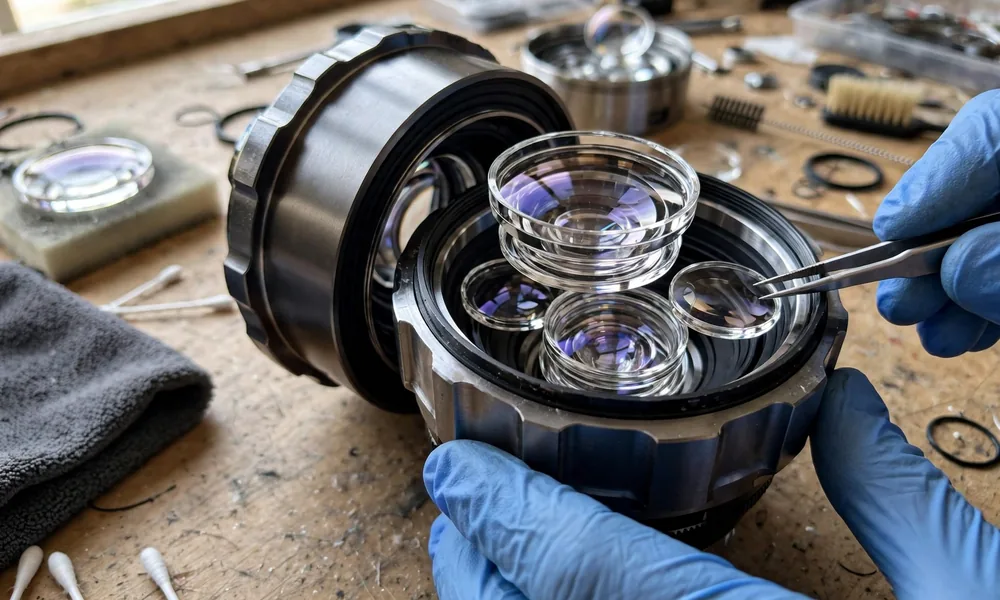
The lens is what turns a picture a few centimetres across into an image three metres wide. It is a stack of precision-ground glass elements in a metal barrel, and on a luxury projector it is motorised: it can zoom, focus and shift the image up, down and sideways without anyone touching the box. That shift matters, because it lets the projector sit on a shelf instead of dead centre in front of the screen.
Lens quality decides sharpness. Cheap lenses soften the corners of the image, while a good lens stays sharp from edge to edge and keeps straight lines straight. The glass is coated to cut reflections, and the barrel is sealed against dust. The luxury projector build explains how that lens assembly is put together in the factory.
Step 5: Processing the picture
Before the image reaches the chip, a processor works on it. It takes the signal from the streaming box or disc player, upscales it if needed, and adjusts the colour, contrast and motion. High dynamic range processing is the star here: the processor reads the brightness data in the signal and decides, scene by scene, how bright each part of the image should be.
Motion processing smooths camera pans, and noise reduction cleans up grainy dark scenes. The processor also handles the tone mapping that squeezes a cinema-bright signal into the range a projector can actually show, keeping the highlights bright without crushing the shadows. A smart TV does the same kind of processing, but the projector has a harder job because its image is so much larger.
Step 6: Cooling and silence
A projector that makes three thousand lumens of light also makes a great deal of heat, and heat has to go somewhere. Air is drawn in through a filter, blown across the laser module and the imaging chip, and vented out the back. The trick is doing all of that without noise, because a whirring fan ruins a quiet film scene.
Step 7: Throwing the image on the screen
The last step is the screen itself, and it matters more than most owners realise. A good screen is not just a white wall: it is a coated surface that reflects light evenly back to the seats, with a gain that controls how bright the image looks from different angles. Some screens reject light from the sides, which keeps the picture bright even when a lamp is on.
The projector and the screen are calibrated together. A sensor measures the light on the screen and the firmware adjusts the colour and brightness until the image matches the cinema standard. When it is done, the wall disappears and the film takes over. The smart TV in the next room cannot do this: it is a window, while the projector is a doorway.
| Specification | Typical figure |
|---|---|
| Light source | Laser phosphor, 20,000 hours |
| Brightness | 2,500 to 4,000 lumens |
| Resolution | 4K, 3840 x 2160 |
| Contrast ratio | Up to 1,000,000 to 1 dynamic |
| Throw ratio | 1.3 to 2.0 to 1 |
| Noise level | 22 to 28 decibels |
| Screen size | 100 to 150 inches diagonal |
How much does one cost?
A luxury projector costs far more than a television of the same size, and the screen is extra. As an estimate, a good laser 4K projector costs roughly 3,000 to 6,000 dollars, while a flagship three-chip model can be estimated at 10,000 to 25,000 dollars. A quality screen adds an estimated 1,000 to 3,000 dollars, and installation and calibration add more.
What the money buys is scale: a picture ten feet wide, with cinema colour and a darkness no television can match in a dark room. For a film lover, there is no substitute. The television is for the news. The projector is for the night the lights go down and the wall becomes somewhere else.
A rare fact
Here is something few people know: the mirrors on a DLP chip tilt more than a thousand times a second, and they do it for years without wearing out, because they never actually touch anything. Each mirror pivots on a tiny hinge in a vacuum, and it is flipped by an electric charge rather than by a motor. A single chip can contain more than eight million of these mirrors, and a speck of dust landing on one of them is big enough to jam it.
That is why the chip lives in a sealed chamber, and why projector factories are cleaner than most hospitals. The whole machine exists to protect those tiny mirrors, feed them light, and let them paint a picture on your wall sixty times a second.