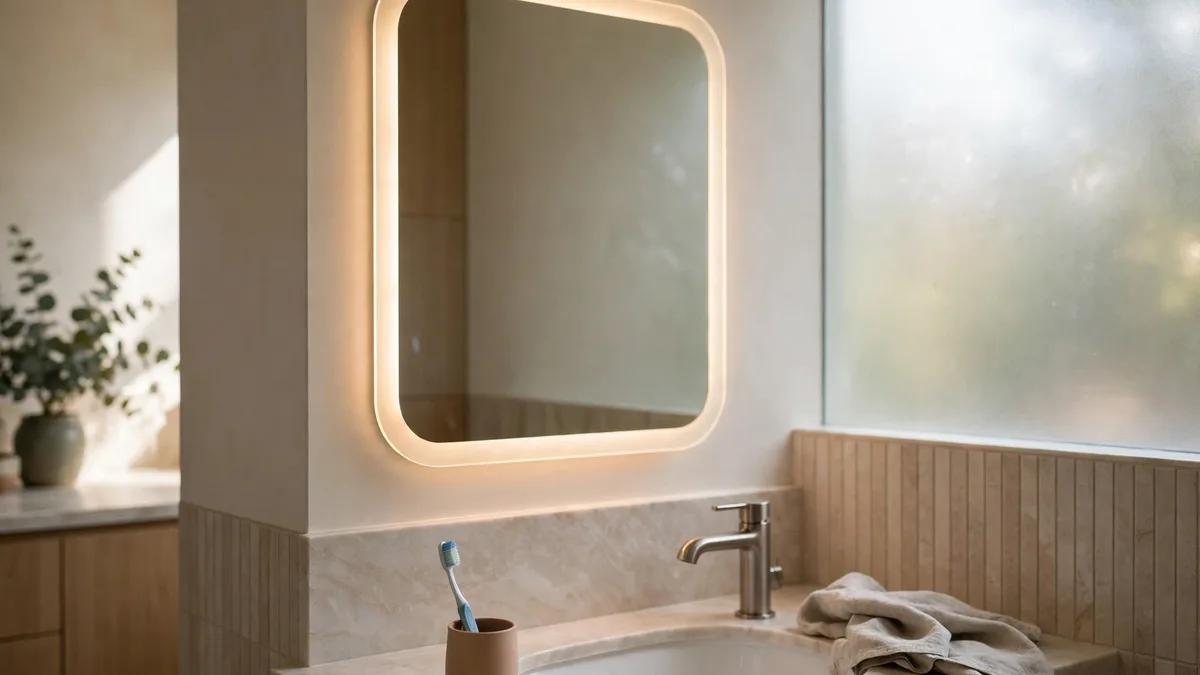
For most of history a mirror was the simplest thing in a house, a sheet of glass with silver on the back, and it asked nothing of anyone. The luxury smart mirror is the opposite. It still reflects a face, but behind the glass sits a display, a computer, a set of sensors and a speaker, and in the morning it shows the weather, the news, the calendar and the time, all floating beside the reflection of the person brushing their teeth. It looks like a mirror, and it behaves like a quiet assistant that never leaves the wall.
The trick is that none of the electronics can be seen. The screen must shine through the glass without washing out the reflection, the touch controls must work through a wet bathroom, and the whole thing must survive steam, splashes and years of daily use without ever fogging from the inside. This is how it works.
How It Works
Step 1: The mirror glass hides the display
Everything starts with the glass, because a smart mirror has to be a good mirror first. The front is a special two-way mirror, silvered just enough to reflect a face clearly in normal light, but thin enough in places to let a bright display shine through from behind. The display sits directly against the back of the glass, with no air gap to cause reflections or fog, and the brightness is tuned so the text is readable in a bright bathroom without turning the mirror into a television.
Step 2: The screen shows only what the morning needs
Behind the glass, a slim display and a small computer run the mirror’s daily show. The computer wakes on a schedule or when it senses a person standing in front of it, and it draws the weather, the time, the calendar and the news in simple, large text that can be read at arm’s length through steam and toothpaste. The layout is deliberately sparse, because a mirror covered in widgets would be useless as a mirror, and the owner can choose what appears, hiding the news on a quiet Sunday and showing the traffic on a workday morning.
Step 3: Sensors watch the room and the person
The mirror knows when someone is standing in front of it, and it knows what the bathroom is doing. A motion sensor wakes the display, a light sensor matches the screen brightness to the room, and temperature and humidity sensors watch the steam building up after a shower. Some mirrors add a camera, but the best luxury models avoid one entirely, using radar-like sensors instead, so the mirror can sense a person without ever recording an image of them.

Step 4: The glass stays clear with hidden heating
A bathroom mirror that fogs up is useless, and a smart mirror fogs up worse than an ordinary one, because the electronics behind the glass stay cool while the room fills with steam. The answer is a thin heating pad bonded to the back of the glass, which warms the mirror just a few degrees above the temperature of the room, enough to stop condensation forming but not enough to feel warm to the touch. The heater switches on when the humidity sensor detects a shower starting, and switches off again when the steam clears, so it uses almost no power.
Step 5: Touch and voice work through glass and steam
Controlling the mirror means reaching through its own surface. Touch zones are built into the glass itself, with capacitive sensors behind the mirror that can feel a fingertip through the silvering, even when the finger is wet, and a small microphone array listens for voice commands over the sound of running water. The mirror can change the light, play music, read out the day’s appointments, or switch the display to a simple clock, all without the owner touching a phone with wet hands.
Step 6: Light, sound and the home join in
The mirror is not a lonely device, because it talks to the rest of the house. Its lights can be dimmed or warmed to flatter a face in the morning and to relax it at night, its speaker can play music or a podcast from the home’s system, and it can pass messages to other devices, turning on the hallway light when the morning routine starts or telling the thermostat that someone is awake.
| Specification | Typical figure |
|---|---|
| Glass | Two-way mirror glass with a display bonded directly behind it |
| Display | Slim screen showing time, weather, calendar and news in large text |
| Anti-fog | Heating pad behind the glass, switched on by a humidity sensor |
| Controls | Touch zones through the glass and a voice microphone array |
| Sensors | Motion, light, temperature and humidity, often with no camera at all |
| Lighting | Adjustable warm-to-cool light around the frame, dimmable by touch or voice |
The cleverest part of a smart mirror is what it refuses to do. It does not cover itself in apps, it does not record its owner, and it does not stop being a mirror when the network fails, because the mirror was in the bathroom long before the computer arrived, and it will be there long after the computer is replaced. The best designs hide the technology so completely that a guest can use the mirror for a week without realising it is smart at all, and that invisibility is the luxury, a room that helps without ever announcing itself.
What One Costs
A luxury smart mirror typically costs an estimated $1,500 to $6,000 installed, and the price is set mostly by the size of the glass, the quality of the display and the lighting rather than the computer inside. A small mirror with a simple display sits at the low end, while a large, back-lit mirror with a full display, a heater and a sound system costs far more. The price is in the glasswork, not the gadgets, and how a luxury car display works shows the same screen-through-glass problem solved for a dashboard, while why luxury smart glasses cost so much explains what happens when a display has to sit even closer to the eye.
A Rare Fact
Some luxury smart mirrors can judge the light in a bathroom and change their own colour temperature to match it, so the face in the mirror looks the same in the morning as it will look outside in daylight. Make-up applied under warm bathroom light can look very different in the sun, and the mirror’s trick is to mix its own light until the reflection matches the daylight the owner is about to walk into. It is a small piece of physics, a few sensors and a ring of adjustable lights, but it is the feature owners mention most, because it is the one that changes how they look before they leave the house.

A luxury smart mirror is a two-way mirror, a hidden display, a heater, a set of sensors and a quiet computer, all working together so the morning runs a little smoother. It shows the weather, keeps itself clear of steam, listens over running water, and then disappears back into being a mirror. For the security side of the same smart home, how a luxury smart lock works explains the device that guards the front door while the mirror runs the bathroom.