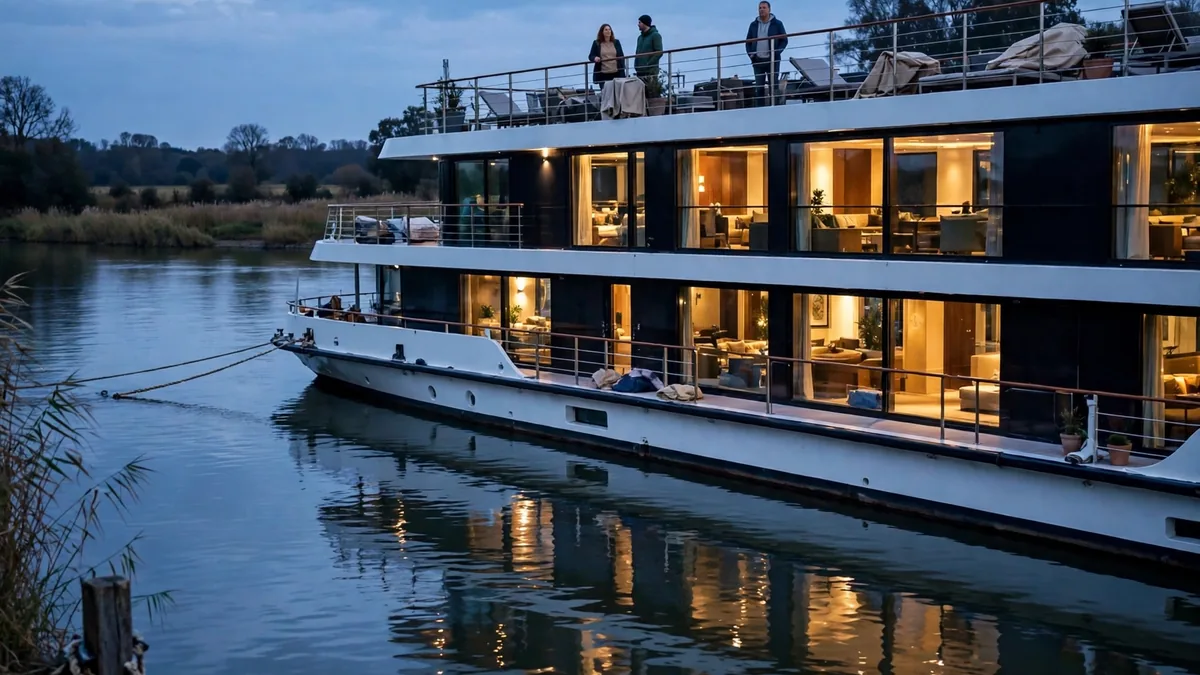
Stand on a riverbank at dusk and watch one glide past, and a luxury river cruise ship looks less like a machine than a small lit hotel that has learned to float. Warm light spills from a long row of windows, someone leans on the rail of the sun deck with a glass in hand, and the whole long hull moves without hurry or noise. It is easy to forget that the calm is engineered, and that every quiet evening on board rests on thousands of tonnes of steel, pipe and wiring.
A river cruise ship is a different problem from an ocean liner. It must be long and low, because rivers are shallow and bridges are lower than the open sea ever demands. It must turn in a channel barely wider than itself, moor against a town quay rather than a deep-water terminal, and carry its guests in comfort while drawing less water than a small fishing boat.
The yards that build them work in covered halls beside the river, cutting steel into a shape that will spend its life in fresh water, fitting it out like a hotel, and then sliding it into the same river it will cruise. This is how a luxury river cruise ship is made, from the first steel plate to the evening the first guests step aboard.
How a Luxury River Cruise Ship Is Made
Step 1: The hull is designed long, low and shallow
Everything starts on paper, or rather on a screen, where naval architects draw a hull that is often more than a hundred metres long but only a few metres deep. The beam is set by the locks and bridges of the rivers the ship will sail, and the draught is kept shallow so the ship can reach towns that a deeper vessel could never visit. The hull is divided into watertight compartments, the engine rooms are placed low and amidships for balance, and the passenger decks are stacked above in a long, flat superstructure. The shape that emerges is a compromise between a hotel and a boat, and every later step of the build has to respect it.
Step 2: Steel plates are cut, bent and welded in the dry dock
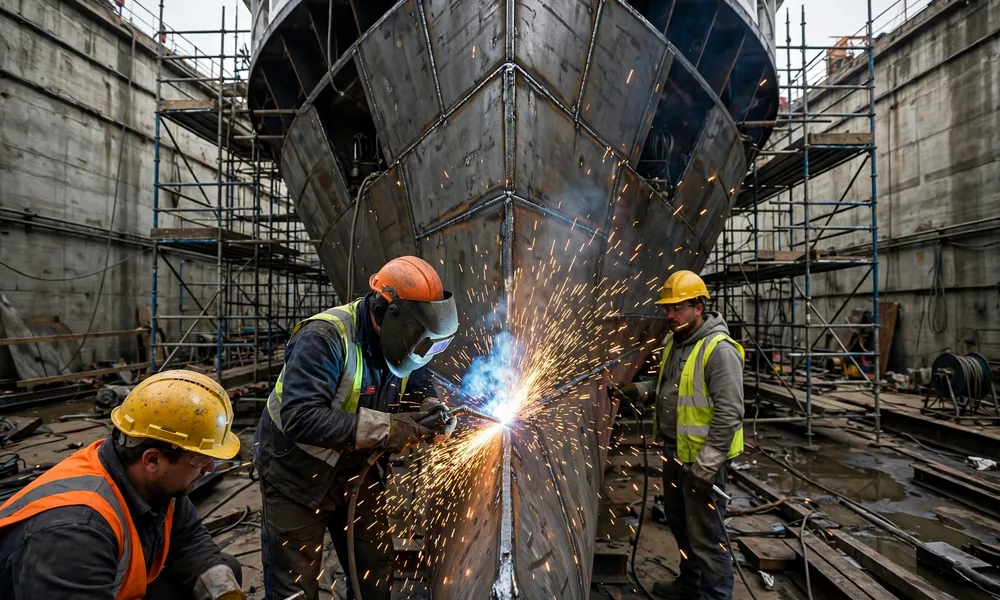
With the design fixed, steel plates arrive at the yard and are cut by plasma torches or lasers to the exact curves of the hull. The plates are bent on rollers, lifted into place in a dry dock or a covered building hall, and welded together section by section, starting with the flat bottom and rising up the sides. Bulkheads are welded in to divide the hull into compartments, decks are laid across them, and the whole steel shell is blasted and painted with coatings that resist fresh-water corrosion. Once the hull holds water, the ship already looks like a ship, even though it is still an empty steel box. The systems that will fill that box are a story of their own, as our guide to how a luxury river cruise ship works explains.
Step 3: Engines, propellers and thrusters are fitted
Before the decks are closed up, the machinery goes in. River cruise ships usually carry two or three diesel engines, sometimes with electric drive, mounted low in the hull on flexible beds that keep their vibration away from the cabins above. Shafts run aft to propellers that are smaller than an ocean ship would use, because the water is shallow, and bow thrusters are fitted at the front so the ship can slide sideways into a quay without a tug. The engines are started and run on test beds, the steering gear is checked, and the whole installation is surveyed before a single cabin wall goes up.
Step 4: The superstructure rises, cabin by cabin
Above the hull, the superstructure is built as a series of light steel or aluminium decks, and the cabins arrive as prefabricated modules, complete with beds, bathrooms, wiring and air conditioning, craned into place and bolted down in a row. This modular method is what lets a river ship feel like a hotel: each cabin is finished in a workshop, tested, and then slotted into the ship like a drawer. The scale of the fitting-out is closer to a big ocean liner than most people expect, as our guide to how a luxury cruise ship is made shows.
Step 5: Plumbing, wiring and the galley are installed
Behind the polished panels, the ship is a maze of services. Fresh water is stored, heated and pumped to more than a hundred cabins, waste water is collected and treated on board, and air conditioning must keep every cabin comfortable while the sun beats on the steel roof. The galley is fitted like a restaurant kitchen, with ovens, cold rooms and dishwashers sized for a full dining room, and the bridge is fitted with radar, river charts and radios for the narrow, busy waterways. The numbers behind all of this equipment are worth a look, as our guide to luxury river cruise ship specs, explained shows.
Step 6: Sea trials, snagging and the first sailing
When the paint is dry and the cabins are dressed, the ship is floated out and put through its trials on the river. The crew tests the engines at full power, turns the ship in a tight channel, checks the thrusters against a current, and runs the anchors, the lifeboats and the mooring winches. A long list of small faults, called snags, is written up and fixed, from a sticking door to a rattling vent, and only when the list is empty does the ship take its first paying guests. That first sailing is quiet by design: the ship slips from its berth, the river opens ahead, and months of steelwork and fitting-out disappear behind a calm evening on deck.
Luxury River Cruise Ship Specs
| Specification | Typical range |
|---|---|
| Length | About 110 to 135 metres |
| Beam | About 11 to 12 metres |
| Draught | About 1.5 to 2 metres |
| Guests | About 150 to 190 passengers |
| Cabins | About 75 to 95 cabins |
| Engines | Two or three diesels, about 1,500 to 2,500 kilowatts total |
| Speed | About 20 to 25 kilometres per hour |
| Build time | About 18 to 24 months |
What Does a Luxury River Cruise Ship Cost?
A luxury river cruise ship is estimated to cost roughly $30 million to $50 million to build, while a larger ship with more suites and a bigger sun deck is estimated at $50 million to $70 million or more. A single luxury cabin module is estimated at $80,000 to $150,000 fitted, and a full dry-dock refit is estimated at $5 million to $10 million. Prices are estimates only and vary by size, yard and level of finish.
A Rare Fact
Some luxury river cruise ships are built with a wheelhouse that lowers on hydraulic rams, sinking the whole bridge down into the ship so the vessel can slide under a low bridge. It is a piece of engineering most guests never notice, because it happens while they are having dinner.