A luxury robot arm moves like it is thinking. It swings across a workbench, pauses, and then lowers its gripper onto a part no bigger than a coin, holding it so gently that it does not leave a mark, and so firmly that it never slips.
That movement is the result of machined metal, small powerful motors and software that knows exactly where every joint is. This is how a luxury robot arm is made, from blocks of aluminium to the first part it picks up on its own.
How It’s Made
Step 1: The arm segments are machined from aluminium
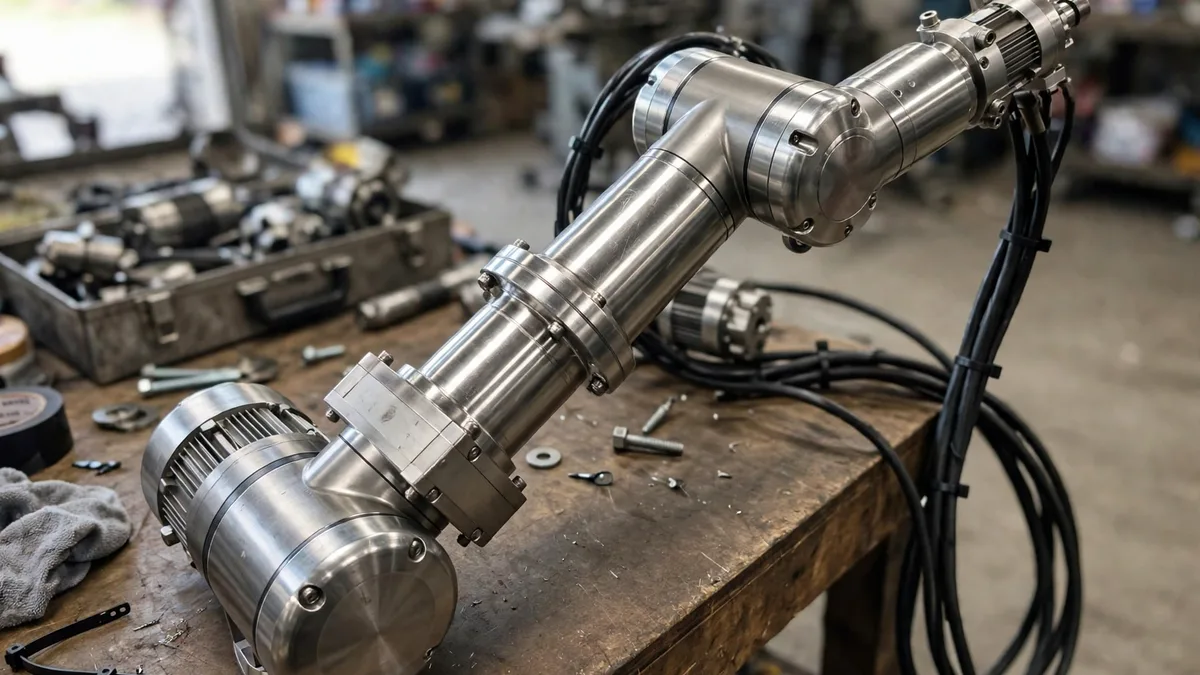
A robot arm starts as solid blocks of aluminium alloy. Computer-controlled mills carve them into the long, hollow segments of the arm, cutting away everything that is not needed until each piece is light, stiff and exactly the right shape. The inside of each segment is hollowed out so cables and wires can run through it, protected from dust and knocks.
Every segment is measured after machining, because a part that is a fraction of a millimetre too long will throw off the arm’s aim at full stretch. The pieces that pass are bead-blasted and anodised, giving them a smooth, hard skin that resists scratches and fingerprints.
Step 2: The joints and gearboxes are built
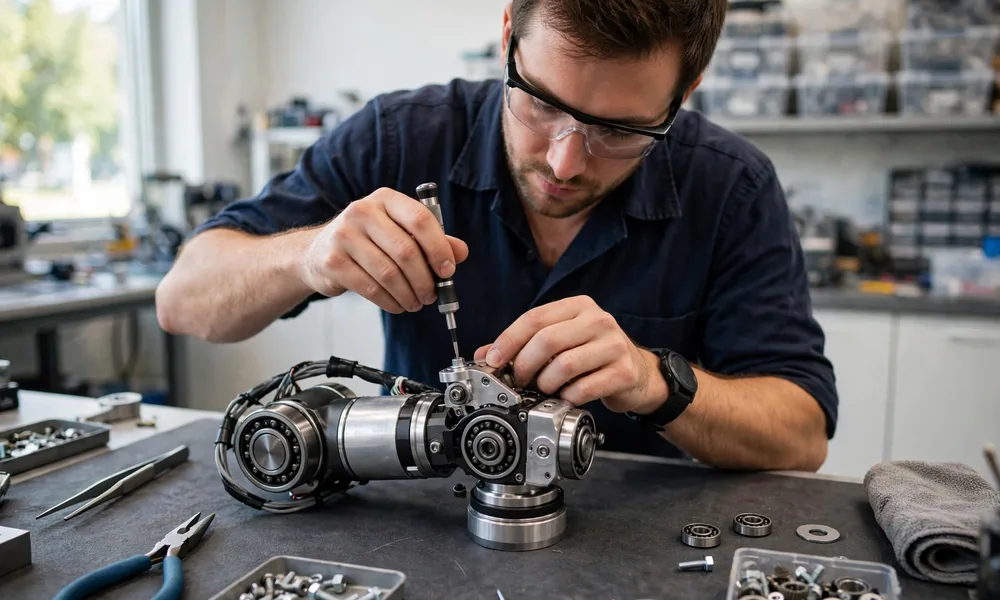
The joints are where the arm gets its strength. Each joint holds a compact gearbox, a set of steel gears cut so precisely that they turn with almost no play, and a motor that can hold its position against a heavy load. The gears are hardened, ground and oiled, then sealed inside the joint housing, because a single speck of grit in a gearbox would wear the teeth down within weeks.
Workers assemble each joint by hand, turning the gears slowly to feel for any roughness before the housing is closed. A joint that turns smoothly here will move smoothly for years; one that catches will only get worse, so it is rebuilt until it feels right.
Step 3: The motors and encoders are fitted
Inside every joint sits a servo motor, a small motor that can turn to an exact angle and hold it. Beside each motor sits an encoder, a disc that reads the motor’s position thousands of times a second and reports it back to the controller. Without encoders, the arm would be guessing where it was, and it would never place a part twice in the same spot.
The motors are wound with copper wire, fitted with magnets and tested on a bench before they go into the arm. Each one is run up to full speed and stopped dead, over and over, because the motor that cannot stop precisely is the motor that will drop things.
Step 4: The wiring and gripper are installed
Once the joints are built, the arm is wired. Thin cables run through the hollow segments, carrying power to the motors and signals back from the encoders, and they are routed with slack at every joint so they never stretch or snag as the arm bends. The cables are tied, clipped and labelled, because a technician who cannot trace a wire cannot fix the arm.
At the end of the arm sits the gripper, the hand that does the work. Some grippers close like fingers, some use suction, and some swap tools in seconds, picking up a screwdriver one moment and a camera the next. The gripper is fitted last, and its fingers are adjusted until they close evenly every time.
Step 5: The controller and software are loaded
The arm’s brain is a controller box, mounted in the base or nearby, carrying the processor that turns a task into movement. Engineers load it with software that knows the length of every segment, the weight of every joint, and the limits of every motor, so it can plan a smooth path from one point to another without jerking or overshooting.
The arm is then taught its first moves. A technician guides it through a simple pick-and-place task, and the software records the path, smoothing the corners and setting the speed. The arm repeats the task hundreds of times, and each run is logged, because a luxury arm is expected to repeat the same move to within a hair’s width, all day, every day.
Step 6: The arm is calibrated and tested
A finished robot arm is calibrated with a laser tracker, a device that measures the position of the gripper in space to a fraction of a millimetre. The arm is sent to dozens of points across its reach, and the controller learns exactly how the real arm differs from the perfect one on paper, correcting for tiny bends and twists in the metal.
Then the arm is run through a long endurance test, lifting and placing parts hour after hour while engineers watch for heat, drift or wear. The test also checks the arm at full reach, where the load on the joints is greatest and any weakness shows first. Only an arm that finishes the test as accurate as it started is cleaned, wrapped and shipped, ready to take up its place on a production line.
| Spec | Detail |
|---|---|
| Segments | Machined aluminium alloy, hollow for cables, anodised finish |
| Joints | Hardened steel gearboxes with servo motors, sealed against dust |
| Position sensing | Encoders reading each motor thousands of times per second |
| Gripper | Fingers, suction or quick-change tools, adjusted to close evenly |
| Repeatability | An estimated fraction of a millimetre, checked by laser tracker |
| Testing | Hundreds of repeat runs plus a long endurance test before shipping |
The hardest part of building a luxury robot arm is the contradiction between strength and delicacy. It must lift heavy parts without flexing, yet place tiny ones without crushing them, and it must do both thousands of times a day without drifting. The arm that manages it feels less like a machine and more like a steady hand.
What One Costs
A luxury robot arm typically costs an estimated $25,000 to $120,000, and the price is set mostly by its reach, its lifting strength and the precision of its joints. A small bench arm sits near the bottom of the range, while a large arm with tool-changing grippers and a full controller costs far more. For the numbers behind the machine, the luxury robot arm specifications break down reach, payload and accuracy, and how a luxury drone is made follows another flying machine built from the same careful mix of metal and software.
A Rare Fact
A luxury robot arm can be taught a new task simply by being moved through it by hand. The technician holds the arm, guides it through the motion once, and the controller remembers every joint angle along the way, so the arm can repeat the exact movement on its own, as if it had been programmed for weeks.

A luxury robot arm is machined aluminium, hardened gears and a controller that never loses count of where it is. It is built slowly, calibrated with lasers, and then it spends years repeating the same careful movement, never tiring and never slipping. For a smaller machine that works on its own around the home, how a luxury robot vacuum works shows a robot with a much humbler job and the same clever sense of direction.